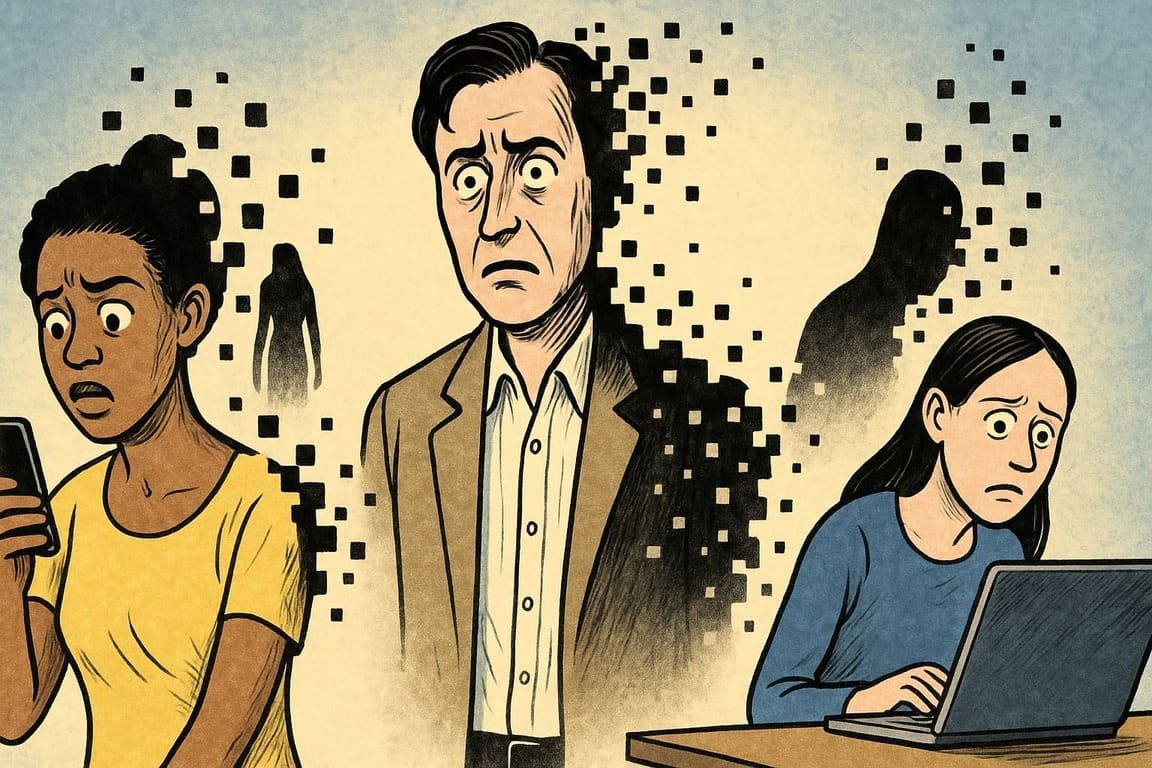
Night spills across a sprawling metropolis, glass towers catching the blue glow of silent notifications pulsing behind curtains. A solitary commuter stands inside a half-lit train, her face reflected in the polished window, flickering between past and present as the carriage glides through tunnels. The world seems alive with voices, yet her phone, buzzing in her pocket, reminds her that the most crucial conversations happen where no one can see. As screens awaken, shadows deepen around her, each ping another echo from a life only partly lived. Here, in the quiet churn of digital habits, souls slip away not with a bang, but in a seamless, endless scroll.
Every device is a portal, promising connection yet delivering only half-formed memories, leaving users haunted by what never was. In the city’s tech-driven labyrinth, invisible fingers erase more than they reveal, pruning timelines and profiles until identities become sketches, not stories. The hum of a smart fridge, the soft glow of an always-on camera, all testify to a new reality where being present means being parsed, indexed, archived. Friends toast over glowing tablets, laughter frozen mid-frame, their moments shared but never truly kept. With every filtered story and muted video call, more of the authentic self slips beyond reach.
A flicker of recognition crosses her face as she scrolls, pausing on a photograph posted years before—a version of herself that feels unfamiliar. The city moves on, alive with the illusion of intimacy, yet each citizen carries a silent absence, a private archive of deleted texts, unfinished chats, and profiles left to fade. Nobody talks about the discomfort of constant exposure, the feeling that every thought, captured and stored, starts to lose its substance. In a world where erasure is easy, true presence becomes radical.
At a late-night café, a barista wipes the counter while glancing at the security camera’s silent eye. Outside, an ad on a passing bus asks, “Are You Still There?” The question lingers long after the bus is gone. In a society obsessed with digital footprints, it is the vanishing act—the quiet slipping away of attention, emotion, and memory—that defines the new ghost story.
This article is about what’s left behind. It is about the haunting silence inside every connected device, the growing rift between our living selves and our digital doubles. If you think you are in control, you’re already halfway to becoming a digital ghost.
Quick Notes
- Self-Erasure Is the New Power Move: The more you share, the less you own. Each online post becomes a ghostly echo, impossible to reclaim and too easy to forget. Disappearing is not just accidental; it’s engineered.
- Tech Feeds the Hollowing Out: Social platforms are designed to archive your life, yet their relentless curation leaves you feeling like a highlight reel, not a person. Attention is currency, but memory is getting cheaper every day.
- FOMO Is a Phantom Pain: Chasing connection creates emptiness. You’re haunted by what you miss, but rarely remember what you actually experience. The line between participation and performance blurs until it vanishes.
- Companies Profit from Vanishing Acts: The more data you shed, the more valuable your absence becomes. Ghost accounts, deleted messages, and privacy settings all fuel a silent economy of surveillance.
- Humanity Needs a Recall: When your story is controlled by algorithms, true presence requires resistance. You must reclaim the lost art of being fully here, even as the world tempts you to disappear.
The Illusion of Presence
Modern life promises endless visibility, yet most people experience a growing sense of erasure. Every photo snapped, every status updated, becomes part of an invisible mosaic, more image than individual. You might believe that sharing proves your existence, but each update is only a placeholder, filling feeds while draining meaning. Take Mia, a marketing director who curated her entire career on LinkedIn, only to realize that colleagues remembered her posts, not her voice. Her profile remains immaculate, but her story feels hollow.
The sense of being watched is constant. Phones record heartbeats, watches monitor sleep, smart assistants listen for commands. With every convenience comes another record, another way to track existence. Yet, paradoxically, the more you’re recorded, the less you’re truly known. Tech companies celebrate engagement, but their metrics flatten out complexity. When you become a statistic, your uniqueness evaporates.
Social platforms thrive on engagement, yet true attention grows scarce. Feeds update relentlessly, feeding your brain dopamine, then demanding more. If you don’t post, you fade; if you do, you drown in noise. A viral tweet from entrepreneur Arjun Patel, “We’re living in public, but dying in private,” captured this paradox. His followers cheered, then moved on, each chasing their own moment of viral validation.
Missing from all this activity is the silent erosion of self. The person you were yesterday lingers in search caches and backup files, but rarely in memory. Relationships built on digital check-ins become fragile, easy to ignore when the app is closed. When a friend, Jamie, lost her account in a hacking scandal, she realized her digital life had been more substantial than she thought. Recovering photos and contacts wasn’t enough—something deeper was lost.
In the end, presence is less about being seen than being remembered. The tragedy of the digital age isn’t that people are invisible; it’s that they are endlessly visible, yet easy to forget. Your moments are archived, but your meaning fades. The more you document, the less you exist.
Algorithms and the Art of Erasure
Tech giants built empires by promising to capture your memories forever. In reality, their algorithms decide what survives and what slips away. Feed algorithms highlight moments that fit trends, burying anything nuanced or awkward. Over time, your digital self becomes a parody, a highlight reel edited by unseen hands. A London-based chef named Marcus found his food blog reduced to viral recipes, while stories of struggle and failure were quietly filtered out. The parts of his journey he valued most vanished into digital obscurity.
Deletion is now a luxury. Not long ago, erasing mistakes meant shredding a diary page or burning a photograph. Today, deleted texts live on in backups, and privacy settings offer only the illusion of control. Each attempt to vanish becomes a breadcrumb for data brokers, marketers, and would-be employers. The phrase “Nothing ever disappears online” is no longer a warning—it’s a business model.
The phenomenon of digital minimalism has sparked a backlash. Some users strip down their profiles, archive old posts, and leave only a few carefully chosen highlights. This act of curation feels empowering at first. Yet, as professor Rachel Lim at NYU notes, “The more you curate, the more you reduce yourself to a brand.” You’re not just deleting memories; you’re deleting meaning.
Meanwhile, the pace of innovation ensures that yesterday’s scandals are today’s forgotten memes. A viral video might shape the news cycle, but within days, new content drowns it out. Political figures like Senator Mason Briggs use this churn to their advantage, releasing statements designed to be forgotten. In the digital fog, accountability slips through the cracks.
Algorithmic erasure is not neutral. It shapes public memory, favors the loudest voices, and amplifies conformity. Every user becomes a ghost in someone else’s feed, glimpsed for a moment, then gone. As the noise intensifies, genuine connection becomes an act of rebellion. If you want to be remembered, you must resist the urge to vanish.
FOMO, Memory, and the New Loneliness
The fear of missing out drives endless scrolling. Yet, ironically, the more you chase updates, the less you recall. FOMO becomes a phantom pain—sharp, real, yet rooted in illusion. You spend hours keeping up with trends, only to forget the substance of each one. Research from psychologist Dr. Leah Wells shows that constant social media use increases anxiety but decreases real-world connection. People see more, feel less, and remember almost nothing.
A sales manager named Kevin once led a team of ambitious new hires, coaching them on deal-closing tactics over Slack. He prided himself on being available 24/7, responding to every ping. When burnout hit, he realized he couldn’t recall a single meaningful conversation from the last year. The metrics were impressive; the memories were missing.
Tech platforms capitalize on this hunger for engagement. Notifications promise belonging but deliver only distraction. The ritual of “checking in” creates routines without relationships. One anonymous TikTok influencer confessed, “My followers know my dog’s name, but nobody texts me when I’m offline.” The digital tribe is vast, but intimacy is rare.
The paradox of FOMO is that it creates a sense of community while deepening isolation. You know what your peers ate for breakfast but not what keeps them up at night. This superficial knowledge breeds anxiety, a sense that everyone else is living while you’re merely watching. Over time, this emptiness becomes its own kind of ghost—an absence at the heart of abundance.
As the world moves faster, true memory becomes a form of resistance. You must choose which moments to keep, which to forget, and which to truly live. The battle is not against forgetting, but against never having experienced anything deeply enough to remember.
Profiting from Absence
Behind every digital ghost story is a profit motive. Companies build fortunes on vanishing data, ghost accounts, and forgotten content. When you delete a message, set your profile to private, or walk away from an app, your data still generates value. Ghost users inflate audience numbers, boost engagement statistics, and provide a safety net for tech giants when real growth slows. An ex-employee from a major social network once said, “Deleted doesn’t mean gone. It means valuable in a new way.”
This economy of absence shapes the way platforms are designed. Features like “disappearing messages” or “private stories” feed the illusion of control, while backend servers quietly harvest metadata. The promise of privacy is always just out of reach, an incentive to stay logged in and keep sharing. Meanwhile, advertisers and political operatives target users not by what they say, but by what they erase.
Case studies from Silicon Valley reveal how companies court regulators by offering transparency, then bury inconvenient data in labyrinthine systems. The act of vanishing becomes a currency—a way to manage risk, avoid scrutiny, and control narratives. When a scandal erupts, it’s not the facts that matter, but how quickly they can be scrubbed from public view.
Ordinary users feel the effects in subtle ways. Job seekers worry about old posts resurfacing. Parents agonize over their children’s digital footprints. Activists delete conversations, hoping to evade surveillance. The result is a culture of caution, where everyone becomes a ghostwriter of their own life story.
Yet, as the stakes rise, so does resistance. Whistleblowers like Sofia Ramirez have exposed the mechanics of algorithmic erasure, calling for new forms of digital accountability. Her viral TED talk—“Owning Your Absence”—challenged users to demand not just data protection, but data dignity. The era of digital ghosts is not inevitable. It’s engineered.
Reclaiming Presence in a World of Absence
Fighting the digital ghost effect requires new habits and new philosophies. Presence is no longer about being online, but about being deliberate. You must choose to engage, not simply react. One approach is digital sabbath: a weekly unplugging to reclaim agency over memory, emotion, and time. Executives at companies like Basecamp have adopted this ritual, reporting better mental health and deeper focus.
A high school teacher, Mrs. Bennett, noticed her students drifting during Zoom classes, their eyes glazed by too many screens. She instituted “offline storytelling” days, encouraging students to share stories face-to-face. Attendance soared, and students reported feeling seen for the first time in months. The smallest act of presence can be revolutionary.
Tech can also be reclaimed as a tool for presence. Mindful platforms that prioritize quality over quantity are gaining traction. Startups like Daybook and DigitalDetox offer ways to organize memories and experiences, not just archive them. Their founders insist that “tech should help you remember, not erase.”
Yet, the real work begins with the individual. You must decide what to keep and what to let go. Curate your own history with intention, knowing that every deleted file is a decision about identity. Ask yourself: what would you miss if it disappeared? What moments truly define you?
In a world obsessed with visibility, being present is the greatest act of courage. When you choose to show up fully, you defy the algorithms that profit from your absence. To be seen, to remember, and to matter—that is how you haunt the digital world, instead of being haunted by it.
When the Lights Go Out: The Linger of the Digital Ghost
Across the city, lights flicker in living rooms where laughter once echoed without a witness. Forgotten playlists drift through smart speakers, recalling voices now lost to time. A commuter steps off the train, the blue glow of her screen fading behind her as she moves through a world both smaller and more infinite than before. Each step is a risk, each silence a possibility. Even as her data lingers on distant servers, the taste of fresh air reminds her that living is more than being logged in.
In the end, every ghost haunts someone. And every reader carries the power to choose whether they will vanish or remain unforgettable. So ask yourself: are you present, or just another shadow flickering across a screen?