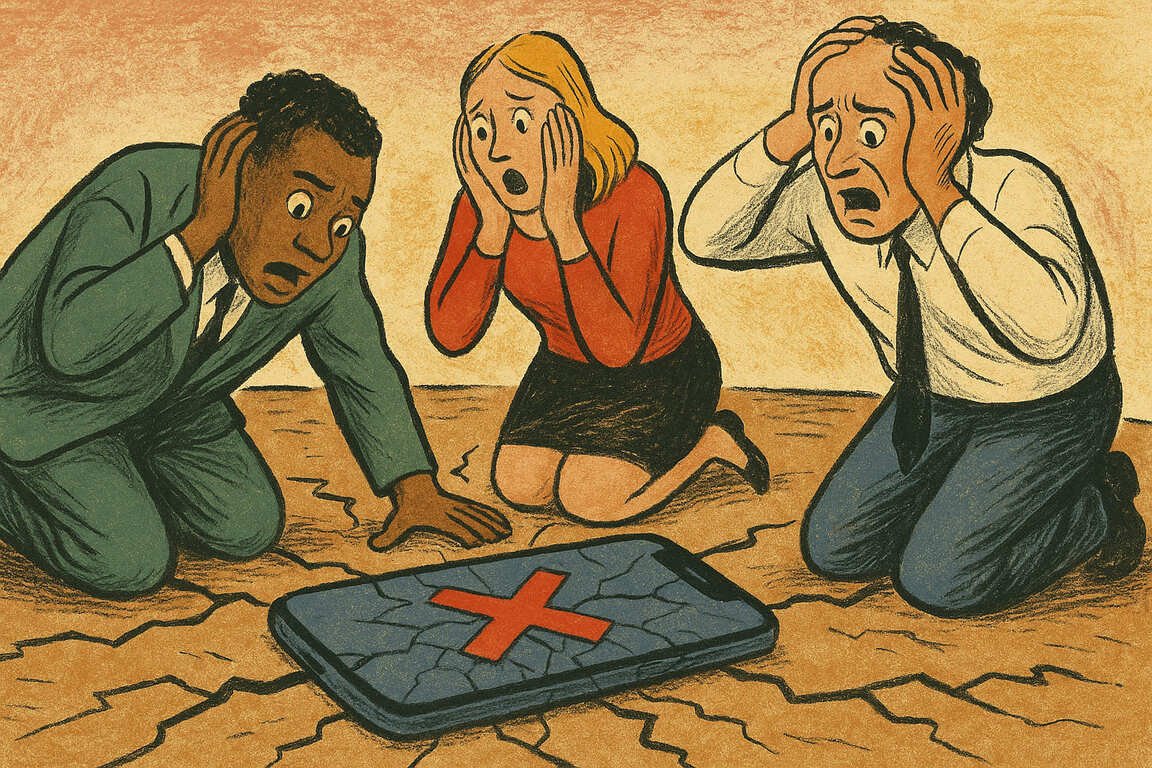
A Tuesday morning, sunshine poured through a busy coworking hub—laptops open, earbuds in, phone screens flickering with notifications. The rhythm broke in an instant: screens froze, calls dropped, digital clocks blinked 00:00, and the building’s hum fell quiet. People glanced up, confusion spreading like wildfire. The city outside, alive with the sounds of honking, chatter, and delivery bikes, slowly stalled. The internet had vanished, and so had the illusion of control.
In one corner, a designer stared at her frozen project, fingers hovering uselessly above a lifeless keyboard. A coffee spilled, ignored, as everyone reached for routers and phones. Someone whispered, “It’s just a glitch,” but the power didn’t return. Slack messages hung unsent, streaming music fell silent, a distant printer beeped, desperate for an answer.
As the hours stretched, the air thickened with tension. Anxiety crept in, sharp and electric, as news traveled by word of mouth instead of notifications. On the street, a bike messenger stood confused—directions trapped inside a dead phone. Shopkeepers wrote receipts by hand. Students squinted at paper books. Digital silence had seized the city, and the crowd’s confusion turned to something darker: fear.
Quick Notes
- Total Dependency Exposed: The sudden loss of digital access reveals just how vulnerable individuals and entire industries are to a single point of failure.
- Panic in the Void: When everything stops, routines, confidence, and even personal identity are shaken by the absence of connectivity.
- Desperate Workarounds: Stories of shops, teams, and families scrambling for analog solutions, only to find old skills faded and trust stretched thin.
- Offline Lessons: The collapse sparks unexpected moments of ingenuity, reconnection, and humility—forcing reflection on what truly matters.
- Never the Same Again: The aftershocks leave deep questions: Will society rebuild for resilience or rush even faster toward digital dependence?
When Everything Stops
The reality of digital silence hit hardest in places built on speed. At FastCart Grocers, the point-of-sale system crashed, leaving checkout lines snaking down aisles. Cashiers, most never trained on manual registers, huddled with managers, scribbling prices and tallying totals. A customer, anxious and late, begged for a paper receipt; nobody knew where the pads were stored. “I felt helpless,” admitted Malik, a store supervisor, “like I’d lost my memory along with the signal.”
For healthcare workers at CityMed Clinic, the outage turned life-or-death. Nurses who relied on e-records scrambled for dusty binders and scrawled new charts by hand. A doctor, Dr. Aisha, resorted to stethoscopes and intuition. She described the day as “equal parts chaos and courage.” In the waiting room, patients grew restless, some texting in vain, others whispering stories of the last blackout.
At a law office, junior associate Priya missed a critical filing deadline—no emails, no cloud, just silence. The partners gathered in the conference room, drafting handwritten notes and dispatching interns on foot to deliver documents. A lost deal, a missed signature, a lesson in humility. “We never realized how much we relied on being reachable,” Priya reflected.
The world spun on, stripped of its usual rhythm. Every second without a signal became a test of patience, memory, and grit.
Panic and Adaptation
As hours dragged into the afternoon, the city’s nervous energy turned frantic. Restaurants scribbled orders on napkins, runners shouted instructions between kitchens and tables. At Pearl Street Deli, owner Gina kept business afloat with a pocket calculator and her high school math. “We messed up a few orders, but customers helped out,” she says, offering a grateful smile.
Teenagers left their homes, searching for friends the old-fashioned way. Parks filled up with wandering crowds, laughter breaking the tension. Yet, for many, the loss of digital connection felt like losing a limb. Sasha, a freelance designer, stood frozen in a café, project files trapped on a cloud server she couldn’t reach. “I forgot how to plan without my apps,” she confessed.
Emergency services moved with a mix of urgency and caution. Firefighters knocked on doors, checking on elderly residents whose smart alarms went quiet. Radio chatter replaced group texts. A dispatcher, Miguel, used a decades-old rotary phone for the first time, marveling at how slowly information traveled.
Families dusted off board games, lighting candles as the sun set. Some found the pause welcome, others sat in silence, missing the soft buzz of their devices. “It was both scary and beautiful,” recalls Lena, who hadn’t seen her children’s faces glow in candlelight for years.
Adaptation came slowly, sometimes painfully. Each workaround revealed a skill forgotten, a trust rediscovered, or a fear newly named.
The Price of Reliance
Beneath the scramble, deeper truths surfaced. In a downtown bank, a security guard named Omondi realized his entire routine depended on digital locks and cameras. With systems down, he patrolled every floor, flashlight in hand, relying on instinct over algorithm. “It was the first time I felt alone in years,” he admits.
In the suburbs, a mother, Beatrice, tried soothing her anxious daughter, who couldn’t message friends or check assignments. Tears came not from boredom, but from the shock of disconnection. “It’s like my world disappeared,” the girl whispered. Beatrice comforted her, telling stories from her own unplugged childhood.
At a local news station, anchors scrambled for updates, forced to report from memory and paper notes. An old typewriter found new life in the corner, tapping out breaking news. The newsroom felt electric—raw, alive, and slightly terrified.
Offline, the city’s heartbeat slowed. Traffic jams stretched for miles as navigation apps failed. Small arguments broke out in shops and cafes, nerves frayed by uncertainty. Yet, kindness, too, found its moment: a stranger lending a phone, a shopkeeper waving off payment for water, neighbors checking on neighbors.
The price of reliance was counted in lost dollars, missed messages, and shaken confidence. But also in renewed gratitude for the smallest, most human forms of connection.
Rediscovering Old Strengths
By day’s end, some started to find their footing. Teachers at Ridgeway Primary used chalk and blackboard for the first time in years, students giggling as they practiced cursive. At an accounting firm, partners swapped stories of “fax machine heroics” and manual ledgers, rediscovering pride in skills the cloud had made obsolete.
At the city’s main square, a group of musicians, cut off from their streaming playlists, pulled out old instruments. Their impromptu concert drew a crowd—singing, clapping, swaying without the need for speakers or power. “I forgot music could sound this alive,” said Dan, a software engineer.
Families gathered on balconies, sharing food and stories under the stars. The silence, once frightening, began to feel gentle—a pause long overdue. Even the tech diehards found a strange peace in analog routines, savoring moments that screens usually hurry along.
Leaders across sectors took note. The city council vowed to invest in backup systems, train for analog emergencies, and teach digital literacy with a human twist. “We can’t let convenience make us weak,” the mayor declared at an emergency meeting, her words echoing through candlelit halls.
The digital silence, once a terror, became a strange teacher. Its lessons were hard-won, but unforgettable.
The New Rules of Connection
When the signal returned, it didn’t erase the memory of the day offline. Laughter rang out as devices buzzed back to life, but some faces betrayed a longing for the quiet. At Greenleaf Café, Gina kept a chalkboard menu beside the digital screen—a reminder not to forget.
Parents made new rules: one hour of screen-free time each evening, family walks instead of endless scrolling. Companies scheduled “offline drills” and stocked up on paper, pens, and patience. Priya’s law firm now celebrates “Analog Fridays,” reconnecting with clients by phone and letter.
A sense of vulnerability remained. People talked more about backups, about trust, about skills that can’t be digitized. Friends checked in on one another, asking not for updates but for stories.
For many, the collapse sparked a deeper question: Are we building a world that can survive without its own heartbeat? Or have we traded resilience for the illusion of ease?
Dawn in the Aftermath: A Fragile Return
Sunrise broke over the city, gentle and unhurried. The old routines returned—devices buzzing, emails pinging, subway doors sliding open. Yet, beneath the hum, something new lingered: an uneasy respect for silence, a memory of a day when every voice mattered, unfiltered and unconnected.
People moved through the streets, eyes lifted for once, searching for each other, not just a signal. Some found relief in the return of noise, others missed the clarity only silence brings. You will decide if the next collapse leaves you helpless—or if you’ll carry the strength of quiet into whatever comes next.