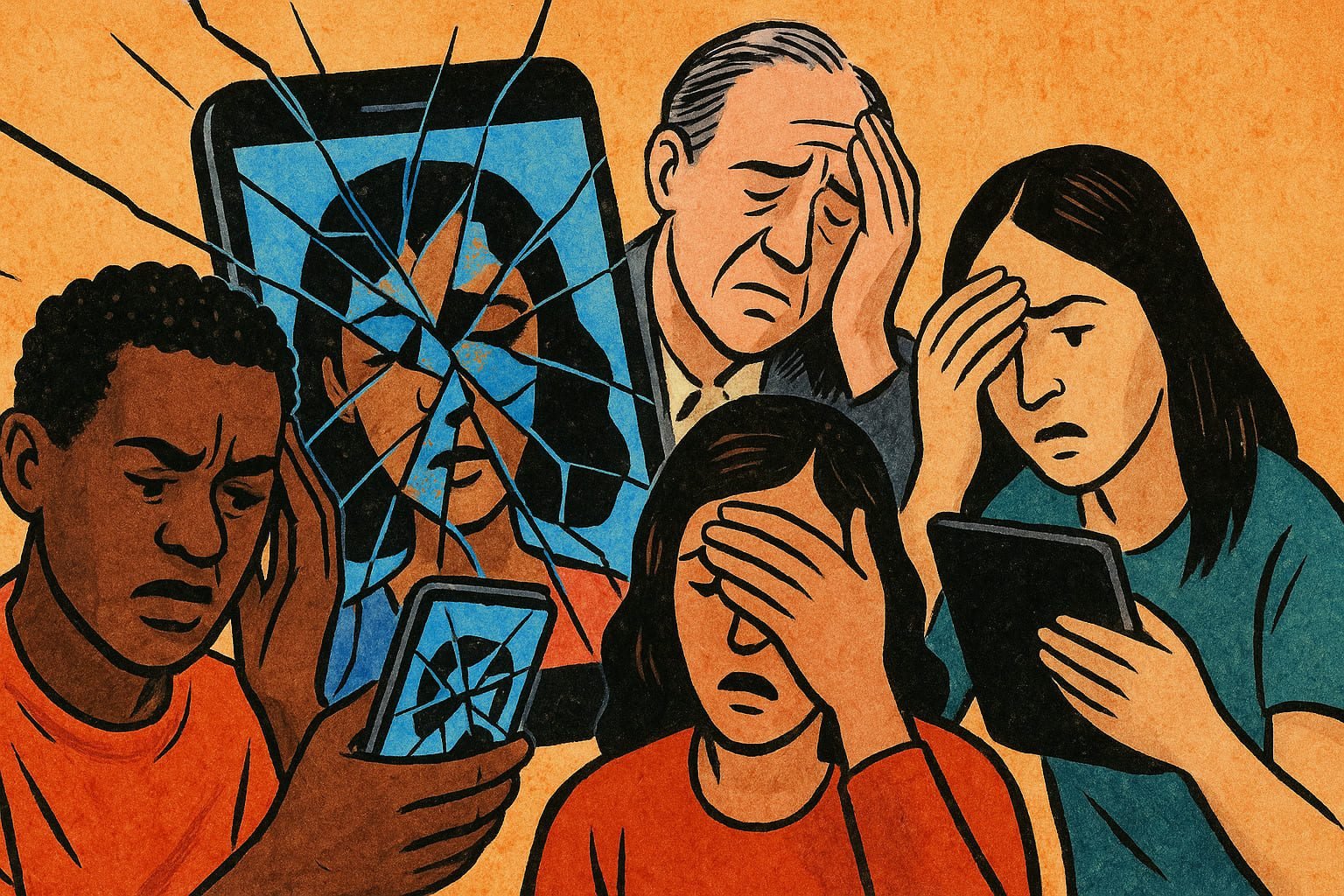
A river of faces flows across the world’s screens—some laughing, some crying, each shaped by a thousand filters. In a cluttered apartment, under the flicker of a phone’s blue light, a teenager scrolls endlessly, pausing only to edit a photo, trying to match a face that never really existed. Every window in the city glows with a different version of its owner, each profile picture a polished lie. Somewhere, a talent scout at an agency reviews influencer portfolios, their cursor hovering over portfolios that blur together—avatars, not humans.
Tonight, digital avatars negotiate for attention, outbidding each other in a bazaar that never closes. Passwords, birth dates, shopping histories: traded like baseball cards, stripped of their owners’ voices, made into a commodity. A privacy breach trends for an hour, then vanishes, replaced by another headline about stolen data. Far from the headlines, a retiree in a quiet town loses access to her account, her memories locked behind a failed verification question. She sits in silence, staring at a loading icon spinning where her wedding album should be.
In chat rooms, dating apps, and game lobbies, people mold themselves to fit the expectations of the room. Friends become followers, coworkers become connections, families are distilled into curated galleries. The gaps between these identities widen, and the pressure builds. Every digital interaction asks: Are you real? Do you belong? As the city’s lights flicker, so do the fragments of each soul, fighting to hold together under the weight of a hundred digital masks.
The modern soul is not shattered by disaster but by a thousand tiny edits, a slow erosion of self beneath the floodlights of the network. In this marketplace of identity, the cost is measured not in dollars, but in the slow, steady loss of what makes each person whole.
Quick Notes
- Online Lives Fractured: People split their identities across platforms, each version chasing validation, none feeling whole.
- Privacy Becomes Performance: Personal details are traded for convenience, yet trust evaporates, leaving people anxious and exposed.
- Case Studies in Disconnection: Real people vanish behind avatars, lost in verification loops, or manipulated by fake news, with human costs often ignored.
- The Battle for Authenticity: Genuine connection gets drowned out by noise; only those who risk showing their flaws break through.
- The Price of Belonging: As digital lives expand, the true self shrinks—leaving everyone to ask: what are you willing to give up for connection?
Digital Doppelgängers – Who Are You When Everyone Is Watching?
Scrolling through a feed is like walking a hall of mirrors, each reflecting a different face. In one, a new mother posts smiling photos, careful never to mention sleepless nights or anxiety. In another, a startup founder shares motivational quotes, omitting the fear that the next funding round won’t come. Behind every post lies a gap—a space where truth is edited out for applause. One marketing executive, Diego, admits he’s “never himself online,” always calibrating every update to impress clients or outshine peers. His followers know the brand, not the man.
Teenagers perfect this art from an early age. A high schooler named Hana runs three separate accounts—one for family, one for friends, one for strangers. Each account shows a different life, none fully honest. When a rumor spread in her class, it wasn’t about what she said, but about which version of herself said it. The confusion leaves her questioning which identity is real, and which is just a mask for survival.
On LinkedIn, job seekers shape themselves into ideal candidates, pruning anything messy or unconventional. Recruiters see hundreds of profiles, all blending into a single archetype. Real stories vanish—failures, doubts, sideways moves erased for a smooth upward climb. One recruiter, Priya, privately complains that the best candidates are often those with the roughest edges, yet the system rewards sameness over substance.
A CEO in San Francisco confessed at a retreat that he hadn’t posted anything real in years. “You show vulnerability and the trolls swarm, or your investors call to ask if you’re okay.” The price for honesty feels steep, so the mask stays on. The resulting loneliness, he says, is worse than any business setback. Colleagues nod in recognition, knowing they’re all trapped in the same unspoken agreement.
For everyday users, the tension is quieter but just as deep. A retiree in Iowa keeps her Facebook “likes” safe and generic, afraid of political arguments or scams. She shares baby photos, hides her grief, and deletes anything that might draw attention. Her online presence is neat, but her sense of belonging grows smaller with each year. The hall of mirrors multiplies, and she wonders if anyone will ever see her as she is, not just as she appears.
The Privacy Theatre – When Security Becomes a Spectacle
Privacy used to be a right; now it’s a negotiation. Every new app demands an email, a birth date, a fingerprint. People trade details for access, clicking “Accept” before reading what they’ve agreed to share. A young professional, Eric, once tried reading a privacy policy but gave up by the fourth paragraph. “It’s all a game,” he says. “You want the app, you give up the data.” The illusion of control comforts, but the real power belongs elsewhere.
Cyberattacks make headlines, but most privacy losses happen quietly. A university student in Lagos found her personal photos posted on a fake account, her protests ignored by the platform’s support team. She learned that recovering stolen identity is nearly impossible, and the shame lingers long after the account is gone. Her story circulates among friends as a warning, but few change their habits, convinced it could never happen to them.
Companies promise security, but the reality is often a patchwork of quick fixes. A bank in Singapore rolled out facial recognition, only to discover the system could be tricked by a high-resolution printout. Clients panicked, and trust evaporated overnight. “We wanted convenience, but got chaos,” the CTO admitted at a conference. The race to stay secure is never over, and the costs—financial and emotional—keep climbing.
Public figures face a different threat. Celebrities and politicians hire teams to scrub the web, but leaks still surface. A well-known athlete lost sponsorships when private messages were exposed, taken out of context and spread within hours. The incident left him paranoid, double-checking every device, second-guessing every word. “You have to assume everything is public,” his manager says. The performance never ends.
Ordinary people aren’t immune. A teacher in Boston received scam calls after her phone number leaked in a data breach. She changed her number but felt the violation linger. Trust became harder to rebuild, and her online life shrank. The performance of privacy becomes just that—a show, with the real costs hidden offstage.
Lost in the Loop – Case Studies of Disconnection and Damage
Behind every online profile is a story of loss. Not every disappearance is dramatic. Some are silent—accounts closed, friends unfollowed, memories deleted. A young man named Oscar fell into a phishing scam, losing not just his savings but years of digital memories. His friends rallied around him, but the sense of violation changed how he saw himself. “It’s like someone stole a part of me,” he said. The digital world moved on, but Oscar never fully recovered.
In some cases, the system itself becomes the villain. After an algorithm flagged her posts as “inauthentic,” a community organizer in São Paulo lost access to her account. She spent months fighting for restoration, missing work opportunities and personal connections. The stress took a toll on her health. In a world where your profile is your passport, losing it feels like being locked out of society.
Fake news and deepfakes add another layer of confusion. A viral video claimed a politician made offensive remarks, only for it to be debunked days later. The damage was done; trust never fully returned. Friends of the politician received threats, and the online mob moved on to the next target. The chaos leaves everyone wary, unsure what is real or who to believe.
Some try to disappear on purpose. A software engineer in Paris deleted all social accounts after a breakup, hoping for a fresh start. Yet, every job application, every new friendship, seemed to demand a digital footprint. “You’re suspicious if you don’t exist online,” he joked, half-serious. The effort to escape only deepened his sense of isolation, as if the world had shrunk to fit the screen.
Parents face their own dilemmas. A mother in Sydney discovered fake accounts using her daughter’s photos, spreading false stories. She fought for removal, but the process was slow and traumatizing. The ordeal left her questioning the value of connection when the price could be so high. Each attempt to reclaim control felt like fighting a tide that never truly stops.
The Hunt for Authenticity – Breaking Through the Noise
Genuine connection survives in pockets, but only when people risk being seen. A jazz musician in New Orleans shares raw, unedited performances, accepting mistakes and missed notes. His following is small but fiercely loyal. Fans say they trust him because he’s “real,” not because he’s perfect. His gigs sell out, not for viral moments, but for the promise of something honest in a world of scripted encounters.
A tech startup in Mumbai launched a “no filters” campaign, urging users to post one unedited photo per week. The results surprised everyone: engagement soared, and users reported feeling less anxious about their appearance. The founder, Aarav, received letters from teenagers grateful for the permission to just “be themselves.” One message read: “For once, I don’t feel like I have to hide.” The experiment challenged the assumption that only perfection wins online.
Small communities form around vulnerability. A support group for parents of children with disabilities shares stories of setbacks as well as victories. In a closed forum, the pressure to perform fades. Members say the group “feels like family,” a rare oasis where identity is accepted, not curated. The experience leaves many wishing the rest of the web could learn the same lesson.
Artists and writers pioneer new forms of connection, hosting virtual salons where anonymity is embraced. Participants share fears and failures without fear of exposure. One attendee called it “the only place I feel whole.” The room is digital, but the sense of belonging is deeply real.
Pop culture occasionally rewards authenticity. Films, books, and viral campaigns that reveal flaws and contradictions often become cult favorites. The lesson is clear: people crave honesty, even as algorithms push the opposite. The challenge is to keep showing up, flaws and all, and to find others willing to do the same.
What We Lose, What We Gain – The Unfinished Story of Digital Souls
Digital identity is a moving target, shaped by forces no one fully controls. As online lives grow, the gap between appearance and reality widens. Some learn to surf this divide, balancing the demands of the crowd with private truths. Others get lost, their sense of self fading with every update. The cost is not always visible, but it is always felt—a slow erosion of wholeness, traded for the promise of connection.
Change is possible, but it requires intention. Some schools now teach digital citizenship, helping students understand the risks of self-curation and the value of privacy. One principal in London says the biggest lesson is “you don’t have to share everything.” Parents, teachers, and friends model boundaries, showing that it’s possible to exist online without losing yourself. The goal is not to disappear, but to appear as you are, not as others demand.
Companies respond, slowly. New platforms experiment with stronger privacy tools, transparent algorithms, and real human support. A fintech startup in Nairobi built its brand on user trust, sharing stories of both success and mistakes. Customers report feeling “seen,” not just sold to. The effort pays off in loyalty, a rare commodity in a crowded market.
Philosophers return to old questions: What is identity if not the sum of our connections? The answer, as always, is complicated. Digital lives amplify the best and worst of humanity, leaving everyone to choose which parts to keep, which to let go. The challenge is to stay whole in a world built on fragments.
The story isn’t finished. Each day, millions make choices—what to share, what to hide, who to trust. The hope is that, somewhere in the noise, the true self survives, waiting for the moment when it can finally speak, and be heard.
Shards of Truth: The Final Reflection
In a quiet house, a single lamp glows beside a stack of forgotten letters. The screens are silent, notifications fading to nothing, every profile picture frozen in time. On the wall, old family photos cast shadows—faces unfiltered, moments unedited, each wrinkle and laugh line a badge of real life. Outside, the world moves on, but inside, a heart remembers the difference between being seen and being sold.
Somewhere, a child falls asleep clutching a worn-out teddy bear, unaware of the online storm swirling just beyond the door. The day’s digital drama has ended, but the need for connection remains, persistent and unyielding. Shadows stretch across the floor, each one shaped by a life lived in full, not just for the approval of invisible strangers. The silence is not empty, but full of hope—a promise that wholeness waits on the far side of the screen.
Nothing the network offers can replace the touch of a hand, the sound of a true friend’s voice, the comfort of being known beyond the profile. The soul, though battered by the endless scroll, endures—waiting for the day when truth needs no filter. Now, you must choose which pieces to keep, and which to let go.