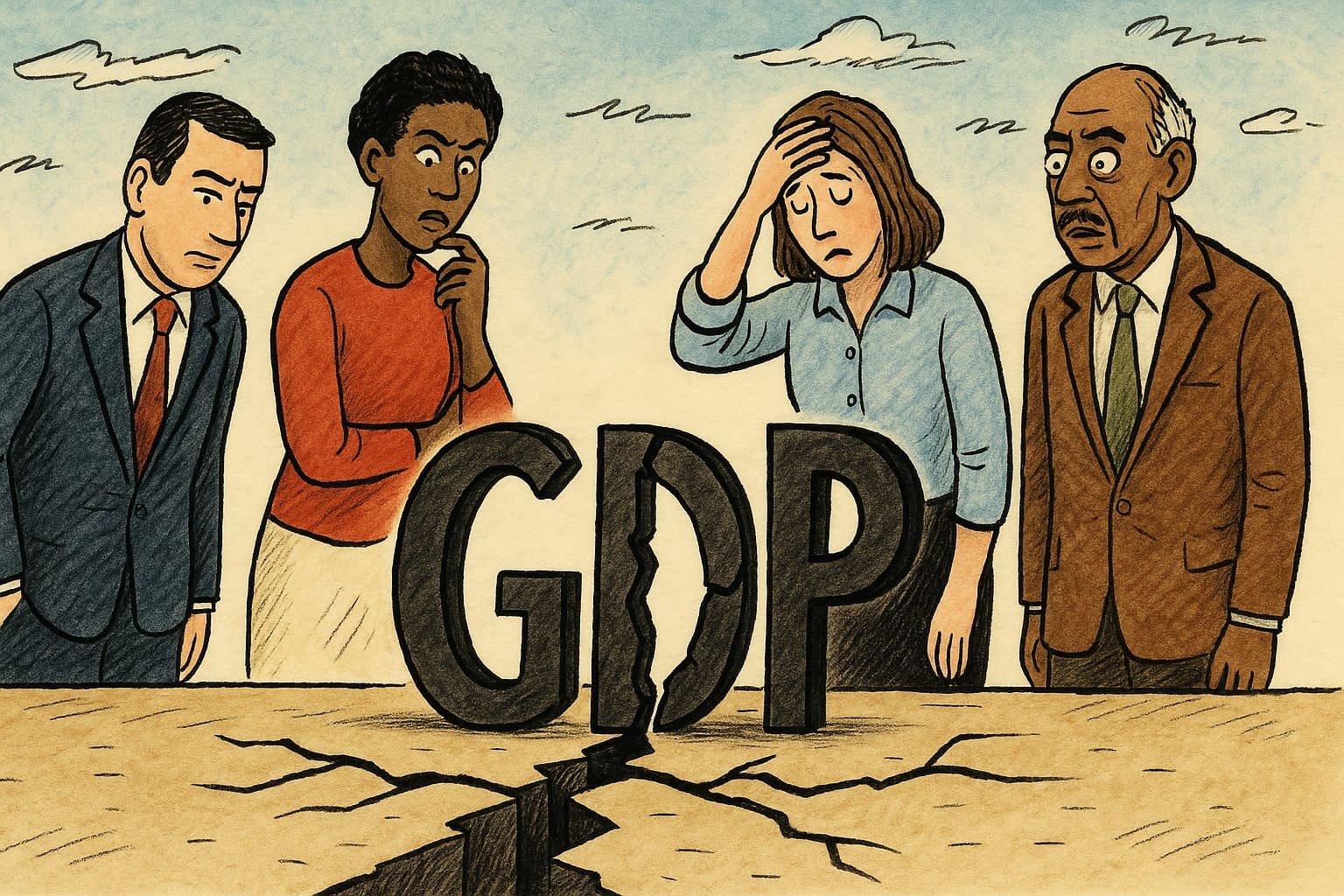
Imagine you’re watching your favorite sports team, the crowd roaring with excitement. Suddenly, the scoreboard only tracks one thing: calories burned by the players. No points, no goals, just a weird obsession with one metric. People cheer anyway, hypnotized by the glow of the numbers. Absurd, right? Yet every government, media outlet, and business leader keeps up a similar ritual, obsessing over Gross Domestic Product (GDP) as the one true score of national progress. Behind the headlines, GDP is a broken mirror; reflecting only fragments of our real lives and ignoring what truly matters: happiness, justice, health, meaning, even the planet’s survival.
GDP was born in a world shaped by war, depression, and industrial engines. It fit an era where “more stuff” meant “better life.” Now, the global script has changed, but the main character hasn’t. We have climate change, burnout, inequality, and yet we keep cheering for bigger numbers, thinking it means we’re winning. But is “growth” worth it if your city drowns, your kids get sick, or your friends can’t afford homes? What if the GDP obsession is quietly stealing the future from under our noses?
This is a story about seeing through the illusion; about exposing the fatal flaws in our favorite economic myth. It’s about how leaders, citizens, and even rebels with a cause are rewriting the rules, demanding a better way to measure progress, and finding purpose in the wreckage of old ideas. Are you ready to rethink what matters, or will you keep cheering for the scoreboard while the world burns?
Quick Notes
- The GDP Illusion: GDP was never meant to measure happiness, justice, or the health of a nation; just economic activity. Its obsession hides real progress and deepens inequality.
- Cracks In The Growth Machine: Economies chasing GDP often ignore critical costs: environmental destruction, burnout, rising inequality, and vanishing community bonds.
- Stories From The Edge: People on the ground; teachers, business owners, activists; see the disconnect between “growing” economies and shrinking well-being. Their stories reveal the system’s blind spots.
- Philosophy of Progress: Challenging GDP means questioning our deepest values. We must define success in ways that honor human dignity, not just output.
- Building The Next Scorecard: A new future demands new metrics. Nations, companies, and citizens are experimenting with better ways to measure prosperity, meaning, and happiness.
GDP: The Flawed King of Economic Storytelling
The world fell in love with GDP as the simplest plot twist ever: more is better, always. Politicians campaign on GDP growth, and news anchors treat the number like a weather report. Yet few people know what’s actually counted in that all-important figure. Broken windows, oil spills, hospital bills, and weapons manufacturing; GDP gobbles it all up with no regard for whether the activity makes life better or worse.
Real lives get lost in the spreadsheet. Lucy, a school principal in Manchester, watched her school’s funding shrink even as the economy “boomed.” She saw stressed-out kids, burned-out teachers, and wondered why national growth never showed up in the classroom. GDP celebrated the city’s skyscraper boom, but ignored the rise in childhood anxiety and the loss of green spaces. For Lucy, the disconnect was personal and painful.
This blind spot isn’t just an accident. GDP was invented in a world obsessed with winning wars and rebuilding factories. The goal was to mobilize resources, not measure meaning. The father of GDP, Simon Kuznets, even warned against using it as a measure of welfare but his caution got lost in the roar of industry. Over time, GDP became not just a statistic, but a moral compass for national ambition.
GDP loves disaster. Hurricanes, epidemics, and wildfires all “grow” the number because they force new spending. That means a country can be wracked by tragedy and still post “record growth.” It’s a carnival mirror, reflecting a funhouse version of reality where suffering can look like progress. No wonder the average person feels whiplash when their lived experience doesn’t match the headlines.
Philosophers call this a “category error”; confusing means with ends. We chase growth as an end in itself, forgetting that numbers are just a tool. When the tool becomes the master, entire societies risk losing the plot.
The True Cost of Chasing Growth: Stories Hidden Between The Lines
The quest for ever-higher GDP has a dark underbelly. Forests vanish, rivers choke, cities overheat all for the sake of “production.” The system rewards pollution, overwork, and resource extraction while pretending those costs don’t exist. GDP can’t see the child who can’t breathe, the worker with no time for family, or the coral reef turning white beneath the waves.
A small business owner named Marco ran a bakery in Milan for twenty years. Each year, his city’s GDP ticked upward, but his quality of life slipped. Higher rent, longer hours, and shrinking margins left him wondering who really benefits from growth. Marco’s bakery closed last winter, replaced by a chain store that employs fewer people at lower wages. The statistics say the city is thriving, but Marco feels like he was written out of the story.
Communities pay a steep price for this relentless march. Parks become parking lots, public services shrink, and people feel more isolated despite “progress.” GDP never notices when a community loses its sense of belonging or when local traditions vanish in the rush for scale. The soul of a place can disappear while the data says it’s never been stronger.
Pop culture often mocks this obsession. Films and novels satirize the idea that more consumption equals more happiness, but the joke is getting old. Even business leaders once the high priests of growth are starting to question whether the old model is fit for the world we face.
Linking back to Daniel Pink’s ideas, work that lacks meaning breeds disengagement. A society that values output above all else risks losing its spirit. The true cost of GDP-mania is paid in human and environmental capital, not just currency.
Life at the Margins: Case Studies From Those GDP Ignores
National averages mask local realities. In Flint, Michigan, the GDP rose while water poisoned children. In Dhaka, garment workers made billions for the nation but struggled to feed their families. The headlines never matched the lived reality of people at the margins.
Meet Akiko, a software engineer in Tokyo who left her high-powered job for a simpler life in the countryside. Akiko’s decision “reduced” Japan’s GDP, but increased her own happiness and the wellbeing of her village. She now runs a co-op that keeps local traditions alive, offers meaningful work, and builds community resilience. To her, the old growth model felt empty; the new life feels real.
Non-profits and social enterprises are rewriting the script. In Kenya, a women-led collective revitalized a dying neighborhood, creating jobs and improving health without adding much to GDP. Their story shows that real progress can be invisible to economists but life-changing for communities.
In Silicon Valley, a group of entrepreneurs formed a startup that prioritized mental health, flexible hours, and parental leave. Their revenue is modest, but employee satisfaction is sky-high. Investors initially balked at the “low growth,” but customers remained fiercely loyal. For these founders, meaning mattered more than market share.
Philosophically, this is Maslow’s pyramid inverted. Societies are “rich” on paper but fail at providing safety, belonging, and self-actualization. A better measure would capture the complexity of human experience, not just transactions.
Why We Keep Worshipping GDP: And What It Says About Us
The hold of GDP is psychological, not logical. It’s an easy story: bigger numbers mean a better life. Politicians love it because it’s simple to explain. Voters feel reassured by “growth,” even when their own lives stagnate. It’s the illusion of progress, dressed up as science.
Governments are trapped by their own scorecards. If GDP falls, headlines scream “recession.” If it rises, they claim victory, even if the gains are uneven or toxic. The political cycle runs on this hamster wheel, chasing short-term boosts at the expense of long-term health.
Ikigai; Japan’s philosophy of purpose offers a clue. Societies thrive when people find meaning in their work and community, not just in their paychecks. The GDP cult flattens these subtleties, pretending all jobs and all growth are equal. It ignores what gives life value: time, connection, beauty, purpose.
Real people sense the emptiness. Social media is full of memes mocking the “GDP is up” narrative as housing gets more unaffordable and public services shrink. The gulf between statistical “success” and lived experience has never been wider.
Challenging GDP isn’t about rejecting progress. It’s about demanding progress that counts for something. If we’re going to keep score, let’s do it in a way that honors our best hopes, not just our busiest factories.
The Next Scorecard: Rebuilding How We Measure Success
The movement for better metrics is already underway. Countries like New Zealand, Bhutan, and the United Arab Emirates are experimenting with happiness indexes, sustainability goals, and social progress frameworks. These new scorecards try to capture what GDP misses: health, education, equity, environment, and joy.
A real-world example: Finland has consistently ranked high on well-being indexes, not because it grows the fastest, but because it values balance, trust, and shared prosperity. Citizens there see government as a partner, not just an enforcer. The system isn’t perfect, but it’s closer to measuring what matters.
Companies are joining the revolution. Global brands like Patagonia and Unilever now track social and environmental impact as closely as revenue. Leaders argue that true value comes from creating long-term resilience, not just quarterly profits. Their shareholders haven’t abandoned them instead, they’ve attracted a loyal, purpose-driven customer base.
Communities, too, are building alternative economies. From urban gardens in Detroit to eco-villages in Spain, grassroots efforts are showing that well-being can be grown, not just bought. These stories rarely make front-page news, but they light the path for those seeking more than the GDP can offer.
The philosophical leap is enormous but overdue. Daniel Pink’s research shows that autonomy, mastery, and purpose drive real motivation. Societies that align their measures with these deeper needs will outlast those clinging to broken myths. The future belongs to those brave enough to ask, “What kind of world are we really building?”
Stop Cheering for the Wrong Scoreboard: It’s Time to Change the Game
The world is at a crossroads. GDP, the king of economic metrics, has ruled for too long. Its failures are obvious to anyone willing to look beyond the headlines. We live in an age where bigger numbers no longer guarantee a better life sometimes, they hide the very crises that threaten our future.
Real progress means seeing through the illusion, challenging the scoreboard, and building new ways to count what counts. Our generation has the power to flip the script, demand better answers, and measure success by the lives we touch, the communities we nurture, and the planet we protect.
So here’s the challenge: Will you keep cheering for calories burned, or will you demand a new scoreboard; one worthy of your hopes, your dreams, and your truth? The future will be written by those who dare to measure it differently.
What’s your metric for a life well-lived? Maybe it’s time to start keeping score on your own terms.
Partnered. Provocative. Worth Your Scroll.
This is a Promoted Post by ESYRITE—yes, it’s paid, but never filtered. Our voice stays raw, real, and razor-sharp. We team up with bold ideas, game-changers, and stories that spark something real. If it’s here, it earned its place—no fluff, just impact. We don’t just promote—we provoke. Stay sharp. Dive deeper.
