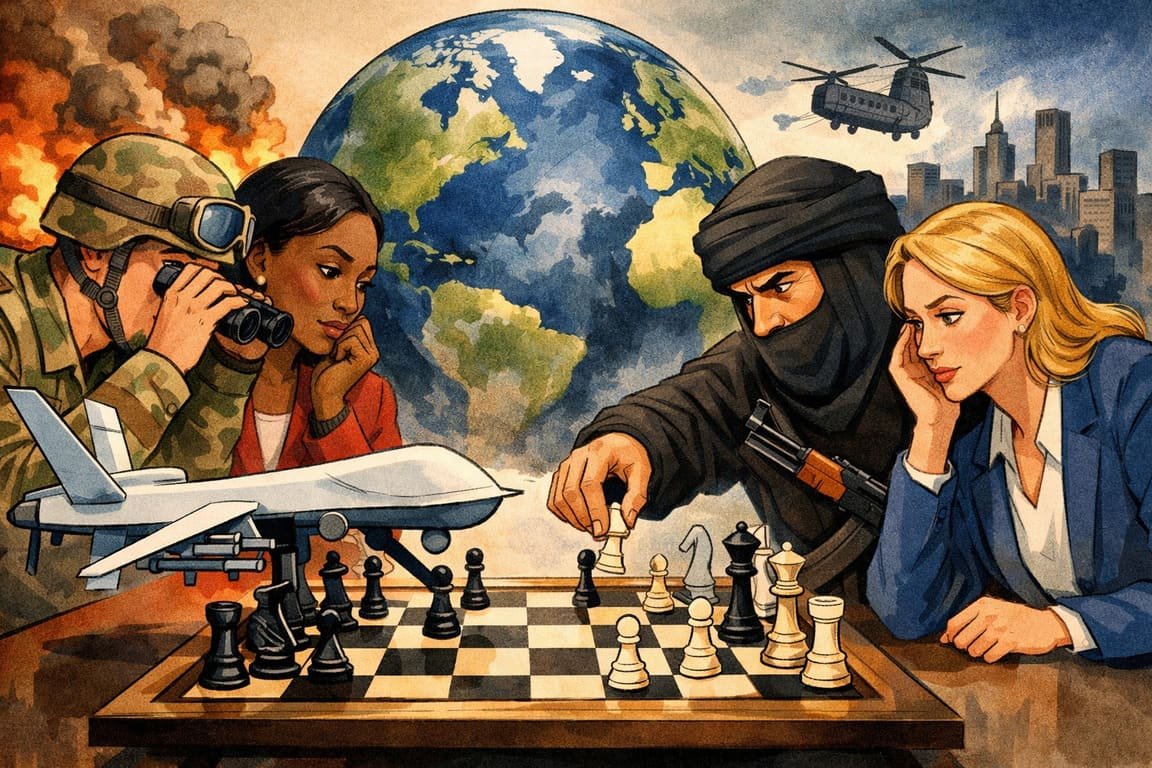
The room no longer feels like a command center. There are no countdown clocks, no urgent voices slicing through the air. Screens glow with data that looks precise yet strangely incomplete. The war on terror did not end here. It faded into something quieter, more complicated, and far harder to measure. Victory once sounded like a destination. Now it feels like a question nobody knows how to phrase without revealing discomfort.
At the beginning, the story was simple enough to sell. Identify the enemy. Destroy its leadership. Restore order. The clarity was comforting, especially in moments of fear. Governments spoke with certainty, and citizens accepted it because uncertainty felt dangerous. Over time, that certainty cracked. Networks fractured instead of disappearing. New actors emerged faster than old ones collapsed. The conflict stopped behaving like a war and started acting like a condition.
Early military campaigns dismantled centralized groups such as Al-Qaeda, yet ideology proved more mobile than infrastructure. Remove a command structure and the belief system adapted. Cells localized. Recruitment decentralized. The enemy stopped needing territory to survive. Power shifted from hierarchy to narrative, from camps to conversations, from borders to belief.
As attention drifted, the conflict migrated. It embedded itself into domestic policy, airport rituals, digital surveillance, and public anxiety. Security became ambient. Always present. Rarely questioned. Citizens adjusted without formal consent, trading convenience and privacy for the promise of safety. The war no longer needed daily headlines to shape behavior. It lived quietly inside systems.
The rise and fall of groups like Islamic State illustrated this evolution vividly. Battlefield defeats did not erase the conditions that fueled recruitment. Political vacuum, economic despair, and social alienation continued to regenerate extremism under new banners. Military success struggled to translate into durable peace. Winning one chapter failed to close the book.
Policy adapted in response. Large scale invasions gave way to precision strikes, intelligence sharing, and algorithm driven targeting. Drones replaced divisions. Data replaced declarations. This shift reduced visible casualties for intervening powers, but it also distanced societies from consequences. War became cleaner on paper and harder to feel. Distance dulled scrutiny.
Ethical boundaries blurred quietly. Remote operations reduced risk for those authorizing force while concentrating risk elsewhere. Civilian harm became easier to deny and harder to verify. Accountability scattered across chains of command and classified protocols. Responsibility thinned as efficiency thickened.
A fictional intelligence officer once described the change with blunt fatigue. Success no longer meant closure. It meant containment. Prevent attacks. Disrupt plots. Keep the noise low. The mission became maintenance rather than resolution. That shift altered morale. Endless vigilance replaced the idea of an end point.
Philosophically, the war on terror exposed a flaw in modern power thinking. Violence was treated as a problem solvable through superior force. Terrorism feeds on meaning, grievance, and identity. Force can disrupt symptoms, but it rarely cures causes. Remove one actor and another steps forward shaped by the same pressures. The conflict revealed the limits of kinetic solutions to psychological wars.
Some nations quietly experimented with alternatives. Community based prevention programs. Rehabilitation pathways for former extremists. Local leaders replacing raids with dialogue. These efforts lacked spectacle and rarely dominated news cycles, yet they produced fragile progress. A mayor in a divided city once observed that safety returned not when soldiers arrived, but when young men found reasons to stay home.
Political rhetoric struggled to keep pace with this reality. Leaders continued speaking in absolutes long after ambiguity became the defining feature. Elections rewarded certainty over honesty. The war persisted as a symbol more than a strategy, invoked when fear proved useful. Winning became a talking point rather than a measurable outcome.
Media fatigue compounded the problem. Conflicts without clear endings lose attention. As coverage thinned, scrutiny followed. Policies continued largely unchallenged, shielded by complexity and distance. The absence of outrage was mistaken for success. It was closer to exhaustion.
Globally, the burden distributed unevenly. Regions closest to violence absorbed daily risk while distant powers debated frameworks. Refugee flows, economic disruption, and generational trauma accumulated quietly. The war on terror reshaped borders, laws, and psychology without formal declaration.
Late at night, between briefing notes and unfinished reports, the truth presses gently. Winning was never about erasing an enemy. It was about building systems resilient enough to deny terror its oxygen. That work remains unfinished, unglamorous, and deeply human. And as the conflict settles into this quieter phase, one unsettling question remains unresolved: if victory cannot be declared, will the courage to rethink the fight finally arrive, or will the war simply learn to survive in silence?
