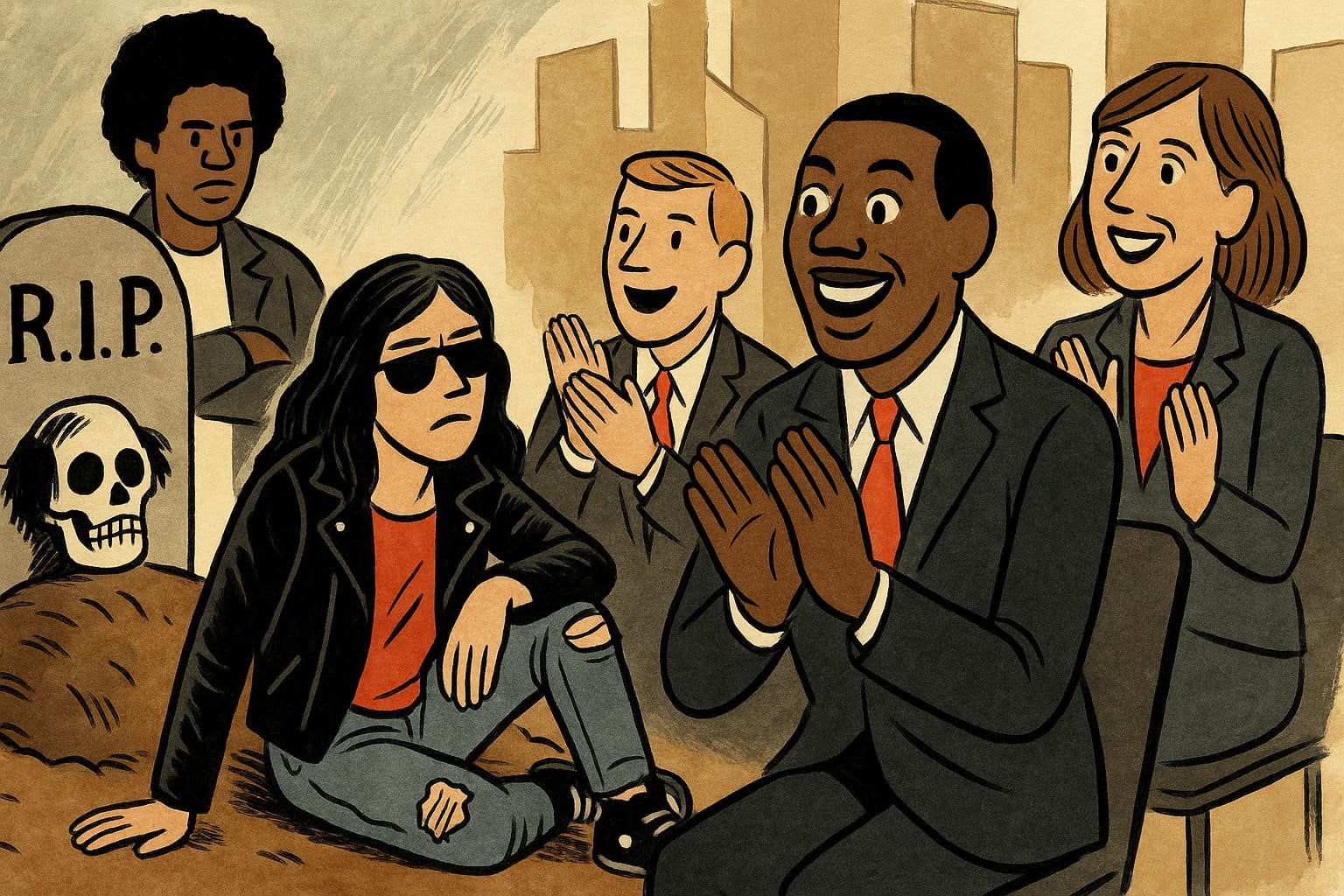
The city pulses with a fluorescent ache, as rain smears neon logos down glass facades. Shadows dart across open-plan offices, each workstation aglow with the blue light of another late-night hustle. In one corner, an old vinyl poster of the Sex Pistols is pinned above a snack bar stocked with gluten-free granola. Somewhere below, a cluster of young rebels; once icons of style and defiance now blend into the khaki sea of casual Fridays and company laptops. Their tattoos peek beneath rolled-up sleeves, but their eyes stare at Slack, not at the moon. The revolution is scheduled, sanitized, and tracked by productivity software.
There is a silent irony here. The very rooms where culture was supposed to break the rules have become glass cages. The startup with exposed brick and ping-pong tables now runs quarterly reviews that would make any bank manager weep with pride. What was once a promise of edge has faded into PowerPoint slides and HR training modules. The rebel yell was filtered through noise-cancelling headphones, then buried beneath corporate mission statements.
At the annual company “innovation jam,” a hired DJ spins vintage Beastie Boys while managers mingle, clutching compostable cups. The crowd laughs at inside jokes about disruption, never realizing they’ve become a parody of the outsiders they used to worship. One brand director, formerly the leader of a skate punk band, pitches a new campaign built on “radical authenticity” a phrase approved by the compliance team, sanitized for brand safety, and delivered by a CEO in a Patagonia vest.
There is a scent of something missing: a whiff of lost rebellion, a hunger for risk that can’t be found on an expense report. The cold-brew flows, but so does the conformity. Rebellion is now just another brand pillar, dusted off for marketing sprints and dropped when investors need stability. The legends of cool, who once swaggered down back alleys, are now featured in LinkedIn posts celebrating “resilience” and “agility.”
Somewhere, a lone janitor mops the floors after the “hackathon.” She hums an old tune by The Clash. The lyrics echo softly through the open office: “Should I stay or should I go?” In this sterile kingdom, the answer was given long ago. The rebels stayed, but their cool was signed over in exchange for shares and stock options.
Quick Notes
- Cool Wasn’t Killed—It Was Monetized: The energy that once fueled cultural revolutions got packaged, priced, and sold back to you. If rebellion used to be an act of defiance, today it’s the theme of a marketing deck. “Authenticity” became a buzzword, not a battle cry.
- Corporate Knows How to Steal the Show: The power suit got traded for hoodies, but the mindset stayed. Every anti-system gesture became a case study in brand strategy. Corporate giants didn’t defeat rebellion; they absorbed it and made it their own.
- The Stoic Myth of Individualism Fell Apart: Philosophers promised meaning in standing alone. The open office, though, rewards team players and consensus builders. You’re told to “speak your truth,” but only within the safety of company guidelines.
- Rebellion Became the Product, Not the Threat: Music, art, even protest; each was chopped up for content and sold as an experience. The audience became the customer, the outsider became the influencer. Every “movement” was market-tested and crowd-sourced.
- The Trap Is You Didn’t Notice It Happening: Cool died not with a scream, but a standing ovation. If you want to escape, first you must see the cage. And maybe, just maybe, imagine a rebellion that can’t be bought.
From Punk to Pitch Deck—The Great Cool Sellout
The path from rebellion to routine is paved with good intentions and better margins. A designer who once painted protest murals is now lead creative at a social media agency, blending street art with ad copy for tech giants. Her friends cheer her “making it,” but she wonders if she traded her spark for a seat at the table. The transformation isn’t dramatic; it’s subtle, creeping in with each new benefit and branded lanyard.
In the early 2000s, a startup named SonicSoup made headlines for its edgy office, wild ideas, and tattooed founders. They called themselves “pirates” in press interviews and rejected everything about “old school” business. A decade later, SonicSoup was acquired by a Fortune 500 firm, their innovation packaged as a service. The once-infamous “pirate code” now sits framed in the HR corridor, cited as an example of “corporate values.”
Every era gets the rebellion it deserves, but the internet made cool a commodity. Virality became more valuable than voice. A sneaker drop can crash servers, but not change lives. A meme can topple reputations, but rarely builds new ones. The badge of “anti-establishment” became the establishment. In 2024, the co-founder of SonicSoup, Owen Tan, summed up his journey in a podcast: “You start out wanting to break the rules, but after a while, you realize the rules are just another puzzle to solve. And solving puzzles pays better than breaking windows.”
The story is repeated in every industry. Tech once mocked the suits, now they are the suits; just with brighter socks. What was once a secret language; graffiti, punk, indie zines is now Google’s homepage doodle. Corporate creativity replaced chaos with culture decks and replaced wildness with wellness apps. Today’s rebels file their taxes quarterly and their tweets twice daily.
A brand can’t make you cool, but it can sell you the feeling. Companies know how to borrow edge, bottle it, and resell it as “lifestyle.” The artist’s voice gets layered beneath product launches and viral campaigns, all packaged in a way that keeps shareholders smiling. A famous chef, once blacklisted for refusing a TV deal, now hosts a branded cooking show; his tattoos hidden beneath a crisp white apron, his edge exchanged for a sponsorship deal.
The biggest lie sold to the rebels was that the system could be hacked from within. Yet the house always wins, and cool is now a collectible, not a cause. If you’re not careful, your defiance will be monetized, stylized, and forgotten before the next quarterly report. The system doesn’t care how you look; only how you sell.
Corporate Cannibals—How Giants Devour Edge
Every time you try to outsmart the system, the system finds a way to turn your trick into its trophy. Corporations have mastered the art of mimicry. When streetwear exploded from the back alleys, luxury labels didn’t sneer; they copied. What used to be a sign of defiance now sits behind velvet ropes at runway shows. The underground wasn’t defeated, it was invited in and handed a business card.
Remember the rise of artisanal coffee? Small, rebellious, independent shops popped up everywhere, promising an experience against “Big Coffee.” Today, most of those founders have sold their brands to the very companies they once critiqued. A fictional founder, Tara Nguyen, once told The Roast Report, “It was never about selling out, just selling enough to survive.” Now, her tiny café’s signature blend is mass-produced, the taste as flat as the mood in her old shop.
Music festivals once had a whiff of anarchy, where boundaries blurred and anything felt possible. Today, major beverage sponsors control the playlists and the seating chart. Attendees are less likely to lose themselves in the moment than to search for the perfect Instagram shot. The same security guards who used to chase kids off fences now help them find the nearest selfie station.
Even protest, the last stand of “real rebellion,” has been tidied up for TV. Marches are managed by marketing consultants. Hashtags are approved by legal teams. Signs are distributed with QR codes for donations. Genuine rage is easy to dismiss; managed anger is easy to monetize.
The result is a world where nothing feels risky anymore. Edginess is as harmless as a branded pop-up event. Every former outsider is courted, copied, and catalogued. The status quo doesn’t fear rebels; it recruits them. After all, nothing kills cool faster than consensus.
In the shadow of these corporate cannibals, you’re left to wonder if there’s any edge left to claim. The risk now is not in being caught, but in being ignored. Real rebellion resists packaging, but most just settle for a paycheck. As long as cool can be bought, it will never threaten the machine.
Stoic Illusions—Why Individualism Became a Corporate Myth
Philosophy promised freedom in the face of conformity. Stoics told stories of standing tall while crowds bowed, of keeping a straight back and an open mind. Yet the modern world rewards those who blend, not those who stand apart. “Be yourself,” the onboarding video insists, “but make sure it fits with the team.” The paradox is brutal: individuality is celebrated in principle, punished in practice.
Companies now offer “bring your whole self to work” seminars. But beneath the slogans, difference is only tolerated when it’s convenient. Try offering a contrarian view at your next staff meeting, and watch as the temperature in the room drops. Compliance isn’t demanded; it’s disguised as collaboration. A marketing director named Felix, who once wrote essays on stoic courage, now spends his days approving branding guidelines and rewriting his LinkedIn bio to fit each new role.
Personal branding replaced personal truth. The marketplace rewards curated identities over messy, real selves. Social platforms encourage users to share “authentic moments,” as long as they fit the prevailing mood. The stoic philosopher Epictetus said, “No man is free who is not master of himself.” In today’s world, self-mastery often means self-censorship.
A fictional startup, TrueFace, tried to build a company culture on radical honesty. Employees were encouraged to voice dissent, challenge the founders, and question everything. Within a year, half the staff left, citing burnout and anxiety. The survivors learned to keep their real opinions private, speaking only in safe, pre-approved language.
Even outside the office, you’re sold stories of “breaking the mold.” Every brand tells you to “think different,” but only within the lines they’ve drawn. The myth of individualism is useful for selling products, not for changing systems. The Stoics faced lions; modern rebels face Slack threads and performance reviews.
Freedom isn’t dead. It’s just that most people would rather not pay the price. You can keep your tattoos, your playlist, and your “personal brand” as long as you play by the rules. The rebel inside you may never die, but don’t be surprised if it wakes up one morning and finds itself working in HR.
The Rebellion Industry—How Movements Became Merchandise
Not so long ago, movements were messy, unpredictable, and uncomfortable. Today, even outrage is available in three convenient sizes. Brands love to tell you that they “stand for something.” They hire diversity officers, launch sustainability campaigns, and change their logo for Pride Month. Every movement is another chance to sell a t-shirt.
Look at the rise of eco-friendly products. What started as a grassroots plea for less waste has become a marketing goldmine. A fictional activist, Jayla Ruiz, spent years building a local campaign against plastic pollution. Now, her slogans are printed on reusable bags sold in mega-marts. When she tried to challenge a major brand for using her words without permission, she received a check and a “thank you for your advocacy” tweet.
The entertainment world, too, has turned causes into content. Movies dramatize rebellions, then sell action figures to kids. Streaming platforms release documentaries about protest, while their parent companies lobby against change. The audience is moved, but only as long as the credits roll. The real work is rarely as photogenic as the merch table outside.
In the tech world, the “hacker ethic” became another value proposition. Companies encourage employees to “break things and move fast,” but only within the sandbox of quarterly KPIs. The true spirit of hacking; solving problems no one else can see has been boxed up and branded as a service.
The greatest irony is that rebellion now feels safe. You can protest, post, and purchase without risking anything real. Movements are monetized before they can even make a difference. If every cause is a campaign, then nothing is sacred. What used to be a call for change is now a limited-edition collaboration.
If you ever find yourself doubting the depth of your beliefs, look for the logo. When the revolution is sponsored, the message gets lost. The world doesn’t need more rebels for hire. It needs people who remember what it’s like to stand alone, without a brand’s blessing or a company’s applause.
The Unseen Cage—Why Escape Is the New Cool
You wake up each day surrounded by reminders of the rebellion that never was. Your phone chirps with news of the latest “disruptor,” but the ad beside it sells you the same old story. The walls may be painted in neon, but they’re walls all the same. Freedom, once found in the margins, is now just another click away or so they want you to believe.
The world is filled with people who tried to escape. One fictional manager, Brent Yu, left a high-flying job at a digital agency to open a surf school. He traded boardrooms for boardshorts, only to find that even surfing had its own corporate conferences and influencer deals. “I thought I’d left the system,” he told the fictional podcast Off Grid, “but the system found me on the beach.” His story isn’t unique. The machine always adapts.
Every attempt to carve out a space for difference is met with offers to partner, collaborate, or “scale.” You start out wanting to shake up the world. Sooner or later, the world shakes you down for your mailing list and your mailing address. You can run from the boardroom, but you can’t hide from the spreadsheet.
The new rebellion isn’t louder. It’s quieter, stranger, harder to monetize. It’s the artist who deletes their social accounts to work in silence. The chef who opens a restaurant in a small town and refuses delivery apps. The coder who walks away from the big stock grant and builds something for joy, not growth. These acts don’t make headlines, but they keep the spirit of cool alive.
If you’re searching for freedom, look for what can’t be scaled, measured, or sponsored. Cool isn’t a style or a brand. It’s a refusal, a whisper, a secret code between those who know. The real revolution won’t be televised. It might not even be seen. But it will always be felt by those who dare to be uncool, unseen, and unbought.
Where the Masks Fall and the Echoes Begin
The rain has stopped. Moonlight spills across an empty rooftop, washing over faded graffiti and cracked concrete. A solitary figure lingers at the edge, shoes dangling over the city’s silent grid. Below, glass towers hum with all-night ambition. The cool air tastes sharp, electric with possibility and loss.
Far from the glow of brand campaigns and investor pitches, a quiet truth surfaces. The mask slides off, revealing a face marked by compromise and the longing for something that can’t be named. It’s not regret that weighs most, but the sense of stories left untold; chances never taken because the cost seemed too high, or too low.
Somewhere in the dark, another rebel hesitates at the threshold of becoming just another LinkedIn story. The wind carries laughter from a distant alley, a reminder that cool can still flicker where no one is watching. In that moment, the city is both a cage and a stage. Shadows stretch toward the horizon, reaching for something free.
No boardroom, brand, or system can steal the echo of a heart that chooses risk over comfort. The real victory isn’t in the applause, but in the silence after, when you realize the stage was always yours to claim.
Ask yourself: will you live as a product, or as a paradox that no system can ever sell?
Partnered. Provocative. Worth Your Scroll.
This is a Promoted Post by ESYRITE—yes, it’s paid, but never filtered. Our voice stays raw, real, and razor-sharp. We team up with bold ideas, game-changers, and stories that spark something real. If it’s here, it earned its place—no fluff, just impact. We don’t just promote—we provoke. Stay sharp. Dive deeper.
