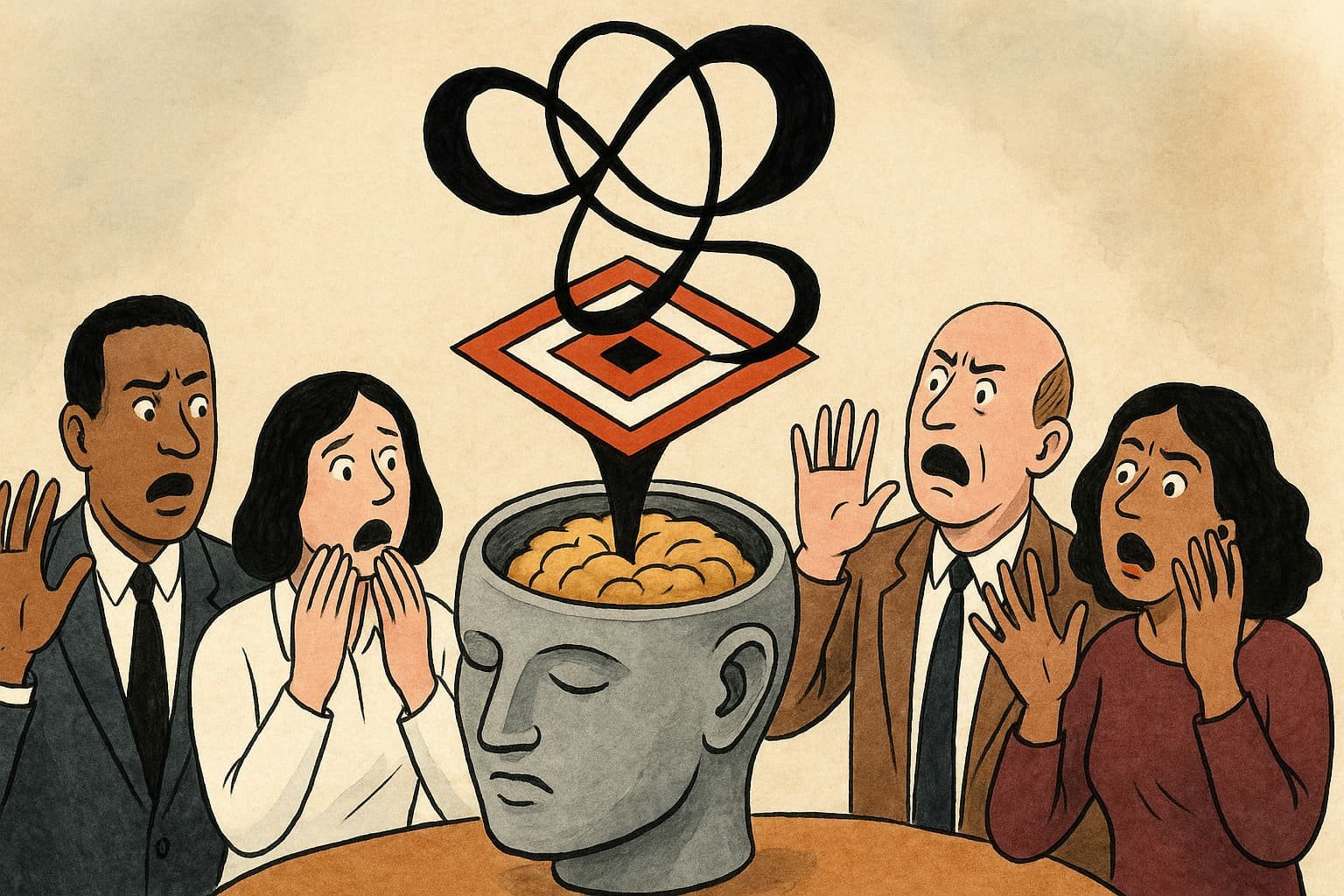
Under the harsh blue flicker of a digital billboard, a crowd moves as one. Faces glow with the cool light of a brand campaign none remember choosing. A latte sits untouched on a metal table while its owner scrolls, eyes glazed, hypnotized by the curves of an app icon. Somewhere, a creative director leans back, satisfied, watching as thousands unknowingly surrender their focus to a palette he selected over lunch. This is the real mind game: not a hackathon in Silicon Valley, but the daily battlefield of perception, desire, and attention. Everyone is a contestant, even when they think they’re just scrolling. The battlefield is silent but absolute. The prize is the control of thought.
In this world, design isn’t a paint job. It is power; subtle, surgical, and silent. The secret handshake isn’t taught in design school; it’s passed in boardrooms, whispered by UX architects, etched in the muscle memory of everyday rituals. A color becomes a craving. A typeface directs a generation. A micro-interaction turns hesitation into a sale. There’s no magic here, only psychology honed into weaponry. True designers are puppeteers and escape artists at once, blending philosophy and neuromarketing with the audacity of a stage magician.
To understand how design molds minds is to see beneath the surface of modern life, where pixels become levers and choices get rewritten by the quiet stroke of a brush. The secrets are everywhere: in the swerve of a street sign, the invitation of a rounded button, the story behind a sneaker drop. Each one engineered to reach under your armor, to slip past suspicion. The brilliance lies in what goes unseen. That is why, when product launches spark riots or a logo change triggers outrage, the true designers smile; they already rewrote the ending.
Most people believe taste is personal. The reality is closer to a trick of the light. Walk through any shopping mall, subway, or online feed and the evidence shouts from every direction. Who shapes these tastes? Why do minimalist hotel lobbies suddenly pop up everywhere, echoing the same Scandinavian silence? Why does every phone glow with a hue called “Calm Blue,” now that you crave “Calm Blue”? These are not accidents. This is the mind mold, the industrial alchemy that turns aesthetics into authority.
The rabbit hole doesn’t end there. Below every viral campaign sits a war room of behavioral scientists, brand strategists, and creatives plotting not just what you’ll buy but who you’ll become. TikTok knows what makes you stay. Netflix knows what makes you binge. Nike knows what makes you move. Each company is a silent partner in your evolution. The scariest part? You might love every minute of it. Now, let’s shatter the myth and dive deep; these are the secrets that shape the shape-makers, the hidden hands behind your most “personal” choices.
Quick Notes
- Design Is Psychological Warfare: Every detail; from app icons to airport signage; is engineered to hack your brain, steering choices you didn’t know you made. Designers wield neuroscience and emotional cues, not just pretty colors, to create addiction and loyalty.
- Minimalism Is Not a Style, It’s Social Engineering: Those clean lines and empty spaces are calculated, not accidental. The trend towards “less” is big business, subtly telling you what’s tasteful while making you crave the next upgrade.
- You Are the Product, Not the Customer: The real currency is your attention, memory, and behavior. Companies design for stickiness and FOMO, creating digital “skins” you want to wear; think Apple’s AirPods or Instagram’s endless scroll.
- Micro-Interactions Mold Your Mood: That satisfying click, that smooth animation, the subtle buzz, they’re all designed to spike dopamine, making you return for more. What feels intuitive is really predictive manipulation at work.
- Designers Are the Secret Puppeteers: The most powerful architects of modern culture aren’t politicians or celebrities but anonymous designers in offices from Helsinki to Shenzhen. Their decisions ripple across fashion, tech, and even how cities breathe.
The Invisible Code: Why Every Choice Feels Like Yours
Step into a high-rise office in Tokyo and you’ll see architects arguing over door handles as if negotiating world peace. They know a door handle is not just metal but an invitation or a warning. Walk through an Apple Store and you’re moving through a gallery of calculated restraint, where every table and curve whispers, “You’re special.” The secret? Making the audience feel sovereign, while all the while the script is pre-written.
You recognize the sensation when entering a room where the air feels expensive. That’s not coincidence. That’s brand strategy, down to the scent piped through the air vents. The famed hotelier Ian Schrager once confessed that he spends more time obsessing over lightbulb warmth than wallpaper. For him, the glow around a chair could mean another five-star review or a silent exit. Design is a language you speak without knowing its grammar.
A former product manager at Google, Maya Tran, tells the story of how a single shade of green tested on users doubled engagement overnight. No one remembered seeing the color; everyone changed their behavior. Maya’s team celebrated by switching all company chat windows to that same green. They weren’t just making products. They were rewriting rituals.
Digital experiences amplify this. Instagram’s heart icon is not just a button, it’s a modern oracle, flashing red at just the right moment to make you check again. A junior designer at Meta once revealed that every animation is timed to the heartbeat, engineered to match the tempo of desire. What feels organic is, in fact, algorithmic choreography.
In fast fashion, Zara’s rapid design cycles mean trends can be manufactured, tested, and abandoned in weeks. The shelf becomes a stage, the audience a data point. A Parisian stylist once quipped, “Fashion isn’t what’s worn. It’s what’s pushed.” Behind every “personal” style choice is a spreadsheet, an algorithm, and an army of taste-makers you’ve never met.
Real choice is precious. But when you find yourself craving the same mid-century couch as everyone on TikTok, ask: who’s really in control? The answer is never in the mirror. It’s always in the mold.
Minimalism: The New Maximum Control
Every era produces its own illusion of freedom. Today, minimalism is sold as a path to clarity. White walls, single-word brands, and monochrome palettes parade as purity. Yet the philosophy of less is, at its core, a tool of control. Minimalism whispers, “Let go,” while its true message is, “Let me decide what matters.”
Steve Jobs’ turtleneck simplicity masked a relentless perfectionism that bordered on tyranny. The original iPhone was stripped of buttons, not for aesthetics alone, but to dictate how users interacted with their world. A former Apple designer once laughed, “It’s not that people don’t like buttons. It’s that we don’t trust them with choices.”
Architecture, too, plays this game. The glass-walled offices of Silicon Valley were not designed to democratize space, but to expose everyone to the eye of the company. Openness becomes surveillance. Clean lines demand clean behavior. At a famous design firm in Copenhagen, an employee confessed that she wore muted clothing so as not to disrupt the “flow” of the office’s minimalist palette.
A Paris startup famously launched an app that did one thing: delete itself after 24 hours. It became a cult hit among designers. The founder, Luc Moreau, explained in a podcast that minimalism is an act of creative violence, erasing options to force intensity of focus. Minimalism is not emptiness; it’s strategic subtraction, sculpting what you’re allowed to desire.
In fashion, minimalism moves in waves. The bare sneaker trend began with a designer’s fatigue over logo wars and grew into a global quiet. What started as rebellion became the uniform. A London stylist remarked that minimalism is a luxury for those who can afford to throw away history. For everyone else, it is a silent test of conformity.
Real minimalism asks you to question: Who benefits when your life is “decluttered”? If the answer is always the same brands, the freedom is an illusion.
The Dopamine Game: When Design Becomes Addiction
You feel it in the swipe of a dating app, the buzz of a push notification, the slide of a zipper on new sneakers. Each moment is engineered for a hit of pleasure. Designers have learned that micro-interactions, tiny moments of delight trigger the brain to release dopamine. Addiction is not a flaw of the user. It is the holy grail of the design team.
A young app developer, Alex Kim, recalls the first time he made a button “bounce” when tapped. The result? Usage rates soared. He joked in a talk, “We aren’t designers. We’re digital drug dealers.” The room laughed, but the truth hung in the air. Digital products are built for anticipation, not satisfaction.
In retail, IKEA’s maze-like layout is legendary. A customer walks in to buy a lamp and leaves with a cartful of “accidental” purchases. Every twist and turn is a lesson in behavioral economics. The store is a funnel, and you are the liquid gold.
Netflix’s “autoplay” is a subtle, seductive trap. You intend to watch one episode. The interface quietly removes friction, fading credits as the next story loads. You don’t choose to stay. You forget to leave. Former Netflix product lead Linda Poon revealed that every time the “Are you still watching?” prompt appeared, it triggered shame in users, proof the design worked too well.
The dopamine loop is everywhere. Social apps ping you with likes, rewards, badges. A game developer at Supercell confessed, “Every sound, every flash, is a negotiation for your attention.” The goal is to keep you in the system, hoping for the next high.
Choice feels like freedom. Addiction feels like loyalty. But when the same hands write the script, the outcome is always the same. The house wins.
Cultural Architects: The Puppet Masters Behind the Curtain
Designers operate as secret architects of behavior. They don’t just shape objects, but the rituals and beliefs attached to them. Behind every viral product launch is a web of strategy, psychology, and cultural engineering. No move is random. No trend is born alone.
One legendary story is that of Dieter Rams at Braun. His principle, “Good design is as little design as possible,” became a global gospel. Yet Rams admitted, years later, that minimalism was less about beauty and more about control. By reducing choices, he controlled outcomes.
In South Korea, the success of the KakaoTalk app rewrote social rituals. Suddenly, every meeting, date, and job offer was confirmed with a cartoon sticker. The app’s designers shaped not just conversation, but emotion, changing how a generation expressed affection and rejection.
In advertising, the Old Spice rebrand stands as a case study. Wieden+Kennedy’s creative team didn’t just sell aftershave. They invented a myth—“The Man Your Man Could Smell Like.” This wasn’t just a campaign. It was a psychological judo move, flipping embarrassment into aspiration.
Designers also wield the dark art of “planned obsolescence.” Apple, Nike, and Tesla all drip-feed innovation, making yesterday’s marvel tomorrow’s trash. A car designer in Detroit whispered at a conference, “Our job isn’t to make the perfect car. It’s to make last year’s model look obsolete.” Perfection is a moving target, engineered for regret.
True design mastery lies in hiding the mold. The greatest designers leave no fingerprints, only habits, desires, and new standards. You’ll never see the puppet strings. That’s the final trick.
The Secret Society: Power, Ethics, and the Future of Mind Mold
To see design as innocent is to miss the plot. The new secret societies do not wear cloaks or gather by candlelight. They sit in open offices, analyze heatmaps, and run A/B tests on billions of lives. Their power is real, invisible, and growing. The challenge is not to resist design, but to demand responsibility from those who wield it.
The dark side of design is well documented. Social media platforms are accused of amplifying anxiety, polarizing politics, and commodifying attention. Yet, when called to account, executives shift blame to “user preference” or “the algorithm.” The truth is more uncomfortable. Design is always a choice. The design of systems can heal or harm.
A group of ex-Silicon Valley insiders formed the Center for Humane Technology, confessing their roles in creating addictive digital experiences. Their founder, Tristan Harris, declared, “We need a design renaissance; one that values human well-being over engagement metrics.” The irony: many of these same designers now consult for the world’s top brands.
Even fashion is not immune. The sustainability movement exposed how trends engineered for speed and novelty led to mountains of waste. Stella McCartney built a luxury brand on the promise of ethical design, proving that responsibility can sell as well as seduction.
The real secret is this: The power to mold minds can also liberate them. Designers can shape dignity as easily as desire, connection as easily as consumption. When design becomes self-aware, it becomes civilization’s conscience.
Revelation: The Unfinished Blueprint
On a rain-soaked rooftop above the city’s glow, a young designer stands alone, watching neon reflections dance in puddles. Down below, thousands move as one, guided by signals only the few can decode. Patterns swirl through the skyline: every lit window a pixel in an invisible mural, every passerby a brushstroke in a design no one sees but everyone feels. The designer’s hands tremble, not with power, but with the weight of possibility. The world is clay and she is both sculptor and sculpture, always shaping and being shaped.
A product launch can spark a riot. An interface tweak can steal hours from a generation. What endures is not the logo or the color scheme, but the invisible grip of belief; yours, mine, and ours. When designers dream, society follows. When they awaken, entire worlds shift.
So, ask yourself: Are you just scrolling, or are you letting someone else mold your mind? The secret is out. The blueprint is unfinished. You hold the pen.
