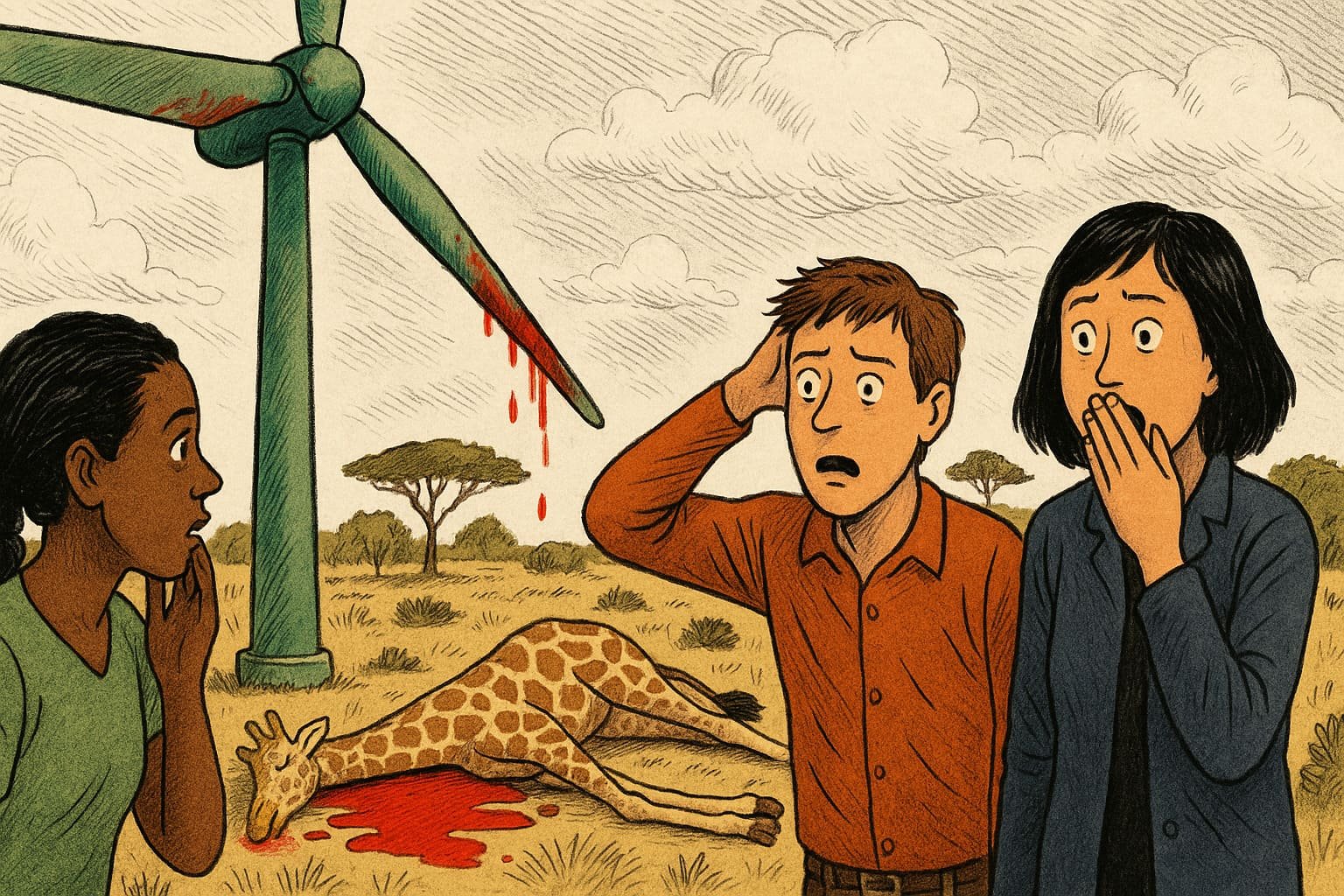
Picture this. You’re standing in a field where the sun rises over hundreds of solar panels. The wind hums softly as turbines spin in the distance. It looks like utopia the future we’ve been promised, where humanity and nature live in harmony, powered by green energy. But now imagine something unsettling just beyond that horizon: silent forests stripped of birds, rivers running dry, and grasslands bulldozed into oblivion. Suddenly, the very technologies hailed as our salvation begin to look more like villains in disguise. Is the clean energy revolution actually destroying the very habitats it claims to protect?
We’re obsessed with solar, wind, and hydropower; fixated on CO₂ reductions, renewable portfolios, and “net zero” promises. What we don’t talk about is the silent cost: entire ecosystems bulldozed for progress, fragile species on the brink, and rural communities wrestling with a paradox. This isn’t just another “both sides” debate. It’s a wake-up call to look beneath the eco-friendly surface and ask: Are we saving the planet by killing its wild heart?
Today’s environmental heroes; the wind farms, the solar megaprojects, the hydro dams hide a dark side. It’s the kind of twist that belongs in a movie script, not an ESG report. Yet, across the globe, real places and real people are grappling with this reality. From eagles falling to spinning blades to rivers silenced by concrete, we need to look the truth in the eye: green energy, unchecked, can be a silent killer. The time has come to stop pretending otherwise.
This isn’t a hit piece on renewables. It’s a plea for nuance. We must interrogate every solution, demand real sustainability, and never settle for easy wins that come with hidden casualties. By the end of this article, you’ll question what you thought you knew about clean energy, challenge the status quo, and walk away with a sharper vision for the future. If you think you know the story, get ready to be surprised.
Quick Notes
- Green Isn’t Always Clean: Even renewable energy can devastate habitats and wipe out biodiversity if not managed carefully, forcing us to reconsider what “clean” truly means.
- Wind and Wildlife Collide: Wind turbines, while eco-friendly, have caused major harm to birds and bats, raising ethical dilemmas about how we prioritize climate over species survival.
- Solar Sacrifice: The world’s solar farms are often built on valuable habitats, turning deserts and grasslands into barren industrial sites, leaving local communities and species scrambling for survival.
- Hydropower’s Hidden Flood: Dams promise low-carbon energy, but often come at the cost of submerged forests, ruined fisheries, and displaced indigenous cultures, leaving scars that last for generations.
- Rethink, Redesign, Respect: True sustainability means putting ecosystems at the heart of our transition, not on the chopping block. Only then can green energy live up to its promise without blood on its hands.
The Mirage of Clean: When Good Intentions Wreck Wild Places
Imagine a field biologist’s horror as her study site once teeming with rare wildflowers and nesting owls becomes a fenced-off solar megaproject. Her research grant turns into a witness statement. This isn’t an isolated tragedy. It’s an emerging pattern as green energy ambitions expand faster than environmental safeguards can keep up.
Decades ago, environmentalists fought against coal and oil because they choked skies, poisoned rivers, and destroyed homes. Now, we’re forced to grapple with a cruel irony: the tools we championed to save the Earth are destroying its last untouched corners. A wind farm might spare the atmosphere but rob a community of the landscapes they call sacred. A solar array can slash emissions while slicing through animal corridors that have existed for millennia.
Take California’s Mojave Desert. What began as an untouched ecosystem home to tortoises, foxes, and migratory birds became an expanse of mirrored panels. Local conservationists warned of catastrophic losses, but policymakers prioritized speed over stewardship. The result? Species driven into fragmented pockets, with some populations declining before anyone could even count the cost.
The “green rush” comes with a cost, but it’s rarely tallied on project spreadsheets. Planners tout kilowatt hours and carbon credits. They rarely mention what’s buried beneath: the ancient grasslands, the fragile wetlands, the life that quietly disappears. That’s the dirty little secret beneath the green veneer.
Some call this progress. But history will remember it as a missed opportunity; a moment when humanity, desperate to save itself, trampled over the wild world that gave it life. We’re not asking the right question. Instead of “how fast can we build?” it should be “what are we willing to lose?” Every decision draws a line between survival and sacrifice.
Flip the script. What if the greatest environmental threat isn’t oil or coal but our blind faith that anything branded “green” is harmless? That myth, left unchallenged, could be our generation’s biggest ecological blunder.
Biologist Laura Cunningham spent years tracking the desert tortoise in California’s Ivanpah Valley. When a solar giant broke ground, she watched her research sites bulldozed. Relocation efforts failed. Local tortoise populations crashed. It’s a cautionary tale: clean energy without ecological wisdom can turn the cure into a new kind of disease.
Wind Power’s Secret Casualties: When the Sky Isn’t Safe
Look up at a spinning turbine; graceful, silent, modern. Now imagine it as a trap for anything that flies. This isn’t a hypothetical risk; it’s a reality that haunts birders, wildlife biologists, and local residents across the globe. Wind power, the darling of climate policy, is claiming thousands of avian casualties in its relentless march for megawatts.
Birds of prey, like eagles and hawks, ride wind currents for survival. Place a turbine in their flight path, and every revolution is a potential death sentence. The Altamont Pass in California became infamous for its raptor kills, turning golden eagles into unintended martyrs for a low-carbon future. Bats, essential pollinators and pest controllers, fare no better; drawn to turbine blades by air pressure changes that literally explode their lungs.
Communities that once welcomed wind projects now face impossible choices. On the Isle of Lewis in Scotland, plans for a massive wind farm collided with concerns for rare peatland birds. The local debate became a global symbol: how do you weigh a carbon-free grid against the extinction of a species found nowhere else? There’s no easy answer just the gnawing realization that every green decision is a balancing act.
Developers point to mitigation: smart siting, radar systems, and turbine shutdowns during peak migration. It’s a start, but not a cure-all. The problem runs deeper into how we value life, who gets to make decisions, and what sacrifices are deemed acceptable. Sometimes, the losers don’t get a voice at the negotiating table.
Here’s the uncomfortable truth. The climate crisis is urgent. But a “win” for the climate that turns skies into graveyards isn’t a victory at all. We need new ways to measure success, not just by emissions but by the lives spared; feathered, furry, or otherwise.
For years, ornithologist Doug Bell watched golden eagles spiral above the California hills until turbines rose like a forest of spinning knives. Eagle carcasses mounted. The community pushed for better siting and safer designs, but the damage was done. The story became a rallying cry: clean energy at the expense of iconic species is a price too high.
Solar Farms or Ecological Deserts? The Price of “Infinite” Sun
The sun is an endless source of energy. But the land beneath those gleaming panels is anything but infinite. As the global race to build solar capacity accelerates, we’re learning that cheap energy sometimes means priceless habitats sacrificed in the name of progress.
Picture the ancient grasslands of Spain, home to rare orchids and the Iberian lynx. One day, they’re rolling fields buzzing with insects. The next, they’re flattened into sterile plots, fenced off to keep wildlife out and maintain efficiency. Ecologists call these “ecological deserts” places where life once thrived, now rendered biologically empty in pursuit of clean power.
Local communities aren’t always winners, either. In India’s Gujarat, a mega solar park meant electricity and jobs for some, but displacement and disrupted grazing lands for pastoralists. Generational ties to the land were severed. The supposed “green gold rush” brought money for some but cultural erasure for others. The transition left scars that won’t heal with time or profit.
Solar farms can also trigger unexpected ripple effects. Water needs for cleaning panels in arid regions compete with dwindling supplies for people and wildlife. Glare from giant installations can disrupt nearby wetlands and migratory routes. Once-rare plants and animals become memories, replaced by security cameras and maintenance crews.
Companies tout “biodiversity-friendly” solar designs, elevated panels for sheep, wildflower corridors for pollinators. These are promising, but too often they remain footnotes in glossy brochures, not standard practice on the ground. When profit and urgency drive decisions, nature usually loses the race.
The path forward? Solar can be a force for good but only if we stop pretending there’s no downside. We must demand smarter siting, community consent, and an honest reckoning with the real cost of “free” energy.
In Gujarat, the world’s largest solar park displaced entire villages of nomadic herders. Their ancestral grazing grounds vanished beneath glass panels. Promised jobs rarely materialized, and traditional livelihoods crumbled. The lesson is clear: green energy, without social justice, can be just as disruptive as fossil fuels.
Hydropower’s Hidden Flood: Dams, Displacement, and the Vanishing River
Hydropower projects have long been the poster children of clean energy: grand, majestic, and seemingly benign. The reality, though, is as turbulent as the rivers they dam. Behind every megawatt of “renewable” hydro lies a trail of destruction, loss, and heartbreak that rarely makes the headlines.
Picture the mighty Mekong in Southeast Asia a river that has fed civilizations for centuries. The construction of dams promised energy security and economic growth. Instead, entire fishing communities lost their homes as floodwaters swallowed villages, forests, and sacred sites. The once-abundant fisheries collapsed. The heartbeat of the region was silenced.
Hydropower isn’t just about water and concrete. It’s about people the indigenous tribes whose lands are submerged, the farmers who watch fertile valleys become barren reservoirs, and the children whose memories are drowned along with their family homes. These stories are everywhere, from the Amazon to the Congo, hidden beneath the language of “development.”
Wildlife suffers too. River dolphins, migratory fish, and hundreds of amphibian species disappear as their lifelines are severed. Scientists scramble to document what’s lost before the floodgates open. Sometimes they succeed. More often, their field notes become obituaries for vanished ecosystems.
Efforts to mitigate the damage; fish ladders, habitat offsets, community compensation rarely restore what’s been lost. The cycle repeats, dam after dam, as politicians chase power and profits, and NGOs protest in vain. The “clean” energy comes at a cost that lasts for generations.
If we’re serious about sustainability, we need to start listening. Listen to the river communities, the indigenous elders, and the scientists whose warnings echo in the empty valleys. Hydropower, done right, can help. Done wrong, it can erase entire worlds.
In Brazil, the Belo Monte Dam flooded vast stretches of rainforest and displaced thousands of indigenous people. The river’s flow changed forever. Sacred sites disappeared. The project became a flashpoint for environmental and social justice proof that “renewable” doesn’t always mean responsible.
Building a True Green Future: Lessons, Rethinks, and Bold Moves
We’re at a crossroads. The world demands a clean energy transition, but not one paved with extinction and uprooted lives. True sustainability isn’t just about carbon; it’s about community, culture, and the wild tapestry of life that makes our planet extraordinary.
First, we need to challenge the illusion that speed and scale justify all costs. Rapid expansion of renewables without ecological wisdom will only trade one crisis for another. Planning must go beyond spreadsheets and subsidies; it must start with the question: Who and what are we willing to sacrifice? If the answer is “nothing,” we have work to do.
Second, innovation must become a tool for harmony, not just efficiency. Imagine solar farms that coexist with wildflower meadows, wind turbines designed with input from bird experts, and hydro projects planned around the rhythms of rivers and people. These aren’t pipe dreams they’re already happening in places where stakeholders work together, not in silos.
Third, we must empower local voices. From indigenous leaders to rural farmers, those most affected by green projects must have a seat at the table. Consent, not just consultation, must be the new standard. Only then can energy transitions become opportunities for restoration, not just extraction.
Fourth, demand transparency. Every kilowatt of “clean” power should come with a full accounting of its ecological and social costs. Only with honest data can we make wise decisions and hold industry and policymakers to the highest standards.
Finally, remember that nature is not a luxury; it’s the foundation of our future. Protecting habitats is not a “nice to have” it’s the only way to avoid repeating the mistakes of the fossil fuel era. This generation has a chance to rewrite the story of progress. Let’s not waste it.
Danish communities pioneered wind cooperatives; projects designed, owned, and managed by locals. Wildlife experts, farmers, and citizens collaborated to choose sites, adapt turbine design, and reinvest profits into conservation. The result? Clean energy, thriving nature, and stronger communities. The model proves it’s possible to build a future that doesn’t demand sacrifice.
The Green Energy Paradox: And the Real Heroes of Tomorrow
It’s easy to believe the stories we want to hear: that green energy is always good, that technology saves without sacrifice, that we can build a cleaner world without a second thought. But reality, like any great story, is messier. Progress, if pursued blindly, can turn heroes into villains and promises into pyrrhic victories.
Here’s the real shocker: the future belongs to those willing to challenge easy narratives. To question, to adapt, to listen; especially to the voices and lives usually drowned out by the noise of “innovation.” Real environmental heroes are the ones who insist on asking: what’s the cost, who pays it, and how do we make it right?
If you take one thing away, let it be this: green energy doesn’t have to kill habitats, but it will unless we demand better. It’s time to build a future that honors every life, every landscape, every lesson nature has to teach. Only then will the “green dream” become reality not just for us, but for every wild thing that calls this planet home.
So the next time you flip a switch or cheer a solar panel, ask yourself: Is your clean energy as innocent as you believe? Or are you, too, living in the shadow of a new kind of ecological paradox? The choice, and the change, start with you.
Ready to be a true green hero? Start by demanding more from your leaders, your industry, and yourself. Because the planet’s story isn’t over yet and you have the power to help write its next chapter.
Partnered. Provocative. Worth Your Scroll.
This is a Promoted Post by ESYRITE—yes, it’s paid, but never filtered. Our voice stays raw, real, and razor-sharp. We team up with bold ideas, game-changers, and stories that spark something real. If it’s here, it earned its place—no fluff, just impact. We don’t just promote—we provoke. Stay sharp. Dive deeper.
