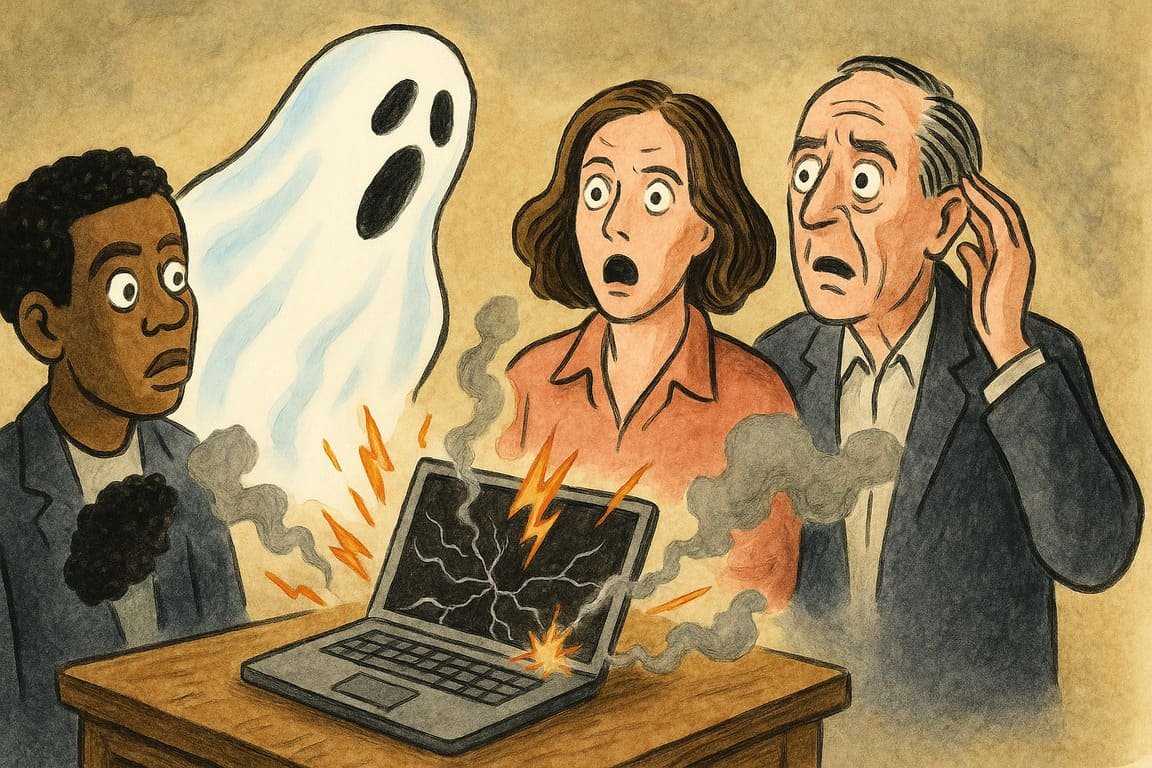
At midnight, inside a data center that hums like a restless hive, the lights blink in unnatural rhythms. Monitors show everything normal, but something unseen is at work: servers freeze, files vanish, screens flicker, and nobody can explain why. Tech support huddles in corners, whispering about “the ghost in the machine.” Outside, a city relies on this invisible network to keep trains running and bills paid, never suspecting how fragile the web really is.
Once, a global investment firm watched millions evaporate as its trading platform spiraled into chaos for three silent hours. No breach. No warning. Engineers traced every line of code, scanned for sabotage, replaced cables, but the problem dissolved on its own, leaving only shaken nerves and unanswered questions. The boardroom felt haunted, as if logic had been replaced by some ancient, mischievous force.
Across the world, IT teams swap stories of rogue updates, disappearing drives, and “ghost” processes nobody ever wrote. If you ask, most admit they believe in the digital supernatural, if only because reality keeps breaking in ways the manual never mentions. Some laugh it off, calling it “Friday the 13th Syndrome.” Others glance at the network closet with genuine dread.
This is the age of the Ghost Network—a reality where our systems run on hope and habit, not certainty. When everything is connected, nothing is truly safe from mystery.
Quick Notes
- The Untraceable Crash: Systems fail for reasons no expert can explain, sowing anxiety and eroding trust in digital infrastructure.
- Panic in the Shadows: Teams scramble, blame spreads, and leaders demand answers that technology refuses to give.
- Haunted by Updates: Automated patches and invisible changes introduce new chaos, making stability feel impossible.
- Invisible Sabotage: Even top engineers confess to seeing patterns—phantom bugs, vanishing data—that defy logic or explanation.
- Lessons from the Ghost: Organizations that embrace humility, redundancy, and transparency transform fear into resilience, turning the ghost into a teacher.
The Untraceable Crash: When Logic Collapses
Every major tech firm has a story: a flawless system that collapses with no obvious cause. At a Tokyo banking conglomerate, an ordinary Monday turned catastrophic as payment systems went dark. Engineers cycled through their troubleshooting scripts, but every fix failed. The crisis lasted hours, costing millions and scarring reputations. No root cause was ever found.
Tech giants like Google and Microsoft keep incident war rooms ready at all times, expecting the inexplicable. “Some bugs vanish when you look for them,” admits a senior SRE at Google, “like ghosts afraid of the light.” The feeling of powerlessness is universal.
During a hospital’s system outage in Chicago, doctors resorted to pen and paper, while IT combed through server logs that showed nothing but static. The patients survived. The certainty of digital systems did not. A nurse, shaking her head, joked, “Maybe the building itself is haunted.”
Pop culture nods to these mysteries. Films like “Mr. Robot” and “Blackhat” dramatize outages that cascade from the mundane to the surreal. Behind the fiction lies a simple truth: even the best technology can slip its leash.
In a hyperconnected world, every unexplained failure becomes a test of faith. When logic collapses, confidence goes with it.
Panic in the Shadows: The Human Fallout
The moment systems fail, fear spreads faster than any virus. At a logistics firm in Rotterdam, the entire operations floor froze as shipments vanished from their tracking grid. Managers barked orders. Technicians pounded keyboards. The only thing moving was anxiety.
During outages, blame is quick and sharp. Vendors, updates, “the cloud”—each gets its share. Executives want explanations, but the answer is often a shrug. “It just stopped working,” says Youssef, a sysadmin in Dubai, “and nobody knows why. You learn to accept it, or you burn out.”
Fictionalized panic is everywhere. In “Silicon Valley,” a critical data loss drives the characters to madness, while real-world stories echo that absurdity. An airline’s reservation system collapsed during a routine migration. The press demanded villains, but the villain was a bug that appeared and vanished, leaving reputations in tatters.
Teams invent rituals: reboot everything, check the cables, pray to the gods of uptime. These moments reveal a brutal lesson: technology can never be fully tamed. Behind the dashboards, people are scared, exposed, and searching for a scapegoat.
Once the lights return, the aftermath lingers. Trust is slow to rebuild when answers never arrive.
Haunted by Updates: Chaos from Progress
In the relentless march for innovation, companies push automated updates to every device, every server, every node. Each new patch brings the promise of security and speed, but also the risk of unleashing chaos.
Last spring, an insurance company’s call center crashed for a full day after a midnight Windows update rewired critical settings. The vendor denied responsibility, but the evidence disappeared with the log files. No apology could bring back the lost business.
The pace of change has outstripped understanding. Tech teams now joke that “no change is too small to ruin everything.” A SaaS startup in New York lost half its data during a “routine” update. Engineers restored the backup, but nobody ever figured out what triggered the loss.
Pop culture’s obsession with “the latest and greatest” feeds the problem. In “Upgrade,” a sci-fi thriller, a simple firmware patch leads to deadly consequences. The lesson: what’s new isn’t always what’s needed.
Even ordinary users know the dread of waking up to new icons, settings, or broken shortcuts. Change breeds anxiety. When updates become ghosts in the machine, trust unravels.
Invisible Sabotage: When Even Experts Are Baffled
Some failures come from within, but others feel like sabotage by unseen hands. Legendary hacker Kevin Mitnick once described how the most dangerous attacks left “no fingerprints.” Yet, not every phantom bug is the work of a saboteur.
Veteran engineers at IBM recall a “poltergeist” bug that rebooted servers across continents, only to vanish after three weeks. They never found the culprit. “Sometimes,” said the lead architect, “you just accept that the network has its own will.”
Stories circulate in tech forums about data that erases itself, settings that revert overnight, or hardware that simply dies on cue. It’s not paranoia. It’s pattern recognition in a world that makes no sense.
A British healthcare trust found sensitive records disappearing and reappearing over weeks. The audit trail said nothing. The press speculated about inside jobs, but the truth stayed hidden, wrapped in digital fog.
The fear is real. When even the experts are baffled, ordinary users feel powerless. The digital age promises control, but the ghosts remind us how little we truly possess.
Lessons from the Ghost: Building Resilience from Uncertainty
The companies that survive the ghost network era are the ones that learn humility. After a catastrophic outage, one bank rewrote its crisis protocol: not just fixing, but communicating, learning, and preparing for the next mystery.
Amazon famously runs “GameDay” events—simulating chaos to build resilience. Teams rehearse what to do when everything fails, fostering agility and calm in the face of the unknown.
A Nairobi fintech, after losing a full week’s transactions to a ghost glitch, rebuilt with redundancy: backup servers, multi-channel notifications, and transparency with customers. The pain became a lesson in strength.
Some of the best advice comes from old-school engineers: “Assume every system will fail eventually. Design with grace, not pride.” That humility allows organizations to bounce back faster, turning panic into process.
The ghost in the network will always be there. The wise learn to work with mystery, not against it. The bravest transform the unknown into an ally.
The Invisible Hand Still Pulls the Wires
Long after the crisis passes, the data center stands silent. Somewhere in the circuitry, a ghost lingers—felt, never seen. Leaders walk the aisles, remembering the panic, the powerlessness, the moment they realized control is always an illusion. Yet, out of fear grows wisdom, and out of mystery, the courage to build again.
Systems will break. Logic will falter. Every organization must learn to face the phantom, accept the unknown, and move forward anyway. You alone can choose: fear the ghost, or let it teach you to be braver than before.
