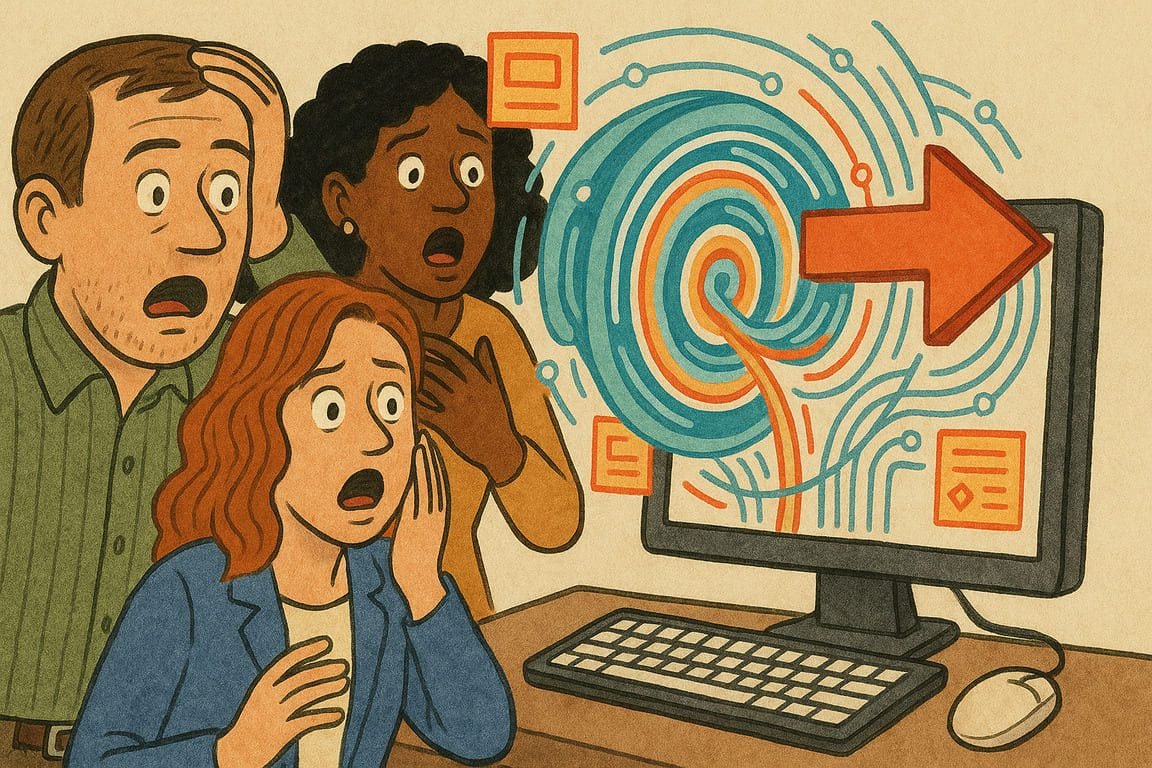
Neon light slices through city fog, spilling across the glass of a midnight co-working space. The hum of laptops blends with the rhythm of caffeinated hearts, as digital creators wage silent wars for attention, loyalty, and meaning. Their screens pulse with ideas—once-bold patterns now relics, yesterday’s innovations obsolete by breakfast. While the world slept, design itself shifted. Now, revolutions happen quietly, not with a bang but with a gentle, relentless creep, turning the familiar into fossils almost overnight. Blink and you’ve missed a tectonic shift.
Trends that once defined a generation, like glossy buttons and skeuomorphic icons, have vanished in the rearview. You might remember when every app begged to look like a physical object, desperate to feel “real.” Now, realism seems naive. The revolution slipped in silently, swapping shadows for starkness, detail for daring minimalism. The ones who adapted survived. The rest faded, pixel by pixel, into digital oblivion.
You wake up to discover your favorite music app has transformed, all sharp corners and ruthless simplicity. The familiar warmth is gone, replaced by something cooler, calculated to optimize every tap. You wonder: who made these rules, and when did you agree to them? Design’s new gatekeepers aren’t the old giants—they’re young, restless, and hungry for frictionless control.
Hidden behind every interface, a new philosophy takes root. The best design is invisible, bending itself around your wants before you know them. Spotify’s recommendations morph in real time, Netflix’s previews autoplay before you choose, Instagram stories nudge you with dopamine hits disguised as social connection. You’re not a user. You’re an audience for design’s psychological stagecraft.
Fierce debates play out backstage. Some call it progress: stripping away distraction to reveal a core experience, direct and addictive. Others mourn the death of character, nostalgia for the era when design had a signature, a voice, even a soul. Emily Vargas, creative director at a disruptive fashion brand, describes the dilemma: “We want design that disappears, but we crave moments that stop us in our tracks.” That contradiction is the spark behind today’s most viral products.
Every so often, a rule-breaker emerges. Take the rise of “brutalist” websites: bold, jarring, aggressively ugly on purpose. They shatter expectations, swapping polish for punch. Users love them, or loathe them—there’s no in between. These rebel designers know attention is the last scarce resource, and being memorable matters more than being likable. The revolution rewards those who risk everything for a reaction.
Real-life stories underscore the shift. Consider the fintech startup whose garish green palette drew scorn at launch, only to become a cult icon within months. Their lead designer, Rohan Majumdar, later explained, “We didn’t want to be ‘nice.’ We wanted to be unforgettable.” That’s the new law: play it safe and vanish, polarize and thrive.
You’re caught in the churn. Apps you rely on change without warning, forcing you to relearn habits overnight. Each update claims to “improve usability,” but often feels like a moving target, a test of adaptability. The frustration is real, but so is the thrill. There’s a dopamine rush to mastering something new, to being among the first to decode an unfamiliar language of icons and swipes.
Behind the scenes, technology accelerates change. AI suggests layouts, A/B tests colors in real time, and personalizes interfaces for every user. Designers train algorithms to optimize what you see, yet they also fight to preserve the spark of human imperfection. Every great product hides a debate: what should the machine decide, and what must remain human?
This revolution is global. Design cultures blend—Tokyo minimalism, Scandinavian clarity, Lagos maximalism—remixing old hierarchies. The most viral ideas leap borders without a passport. Last year’s meme becomes this year’s navigation pattern. You’re living in a global design city, where nothing stays local and every taste is up for grabs.
Yet even as the world speeds up, some things remain stubbornly true. The best design still starts with empathy. It’s not about showing off, but about solving problems you haven’t named. Every viral moment, every addictive interface, is just the latest costume for the oldest trick: making you feel understood, even cherished.
Change isn’t slowing down. If you build, you must unlearn as much as you master. Every project is a fresh risk, every launch a gamble with culture. The revolution has no endpoint—only new rules to break, new stories to tell. Your challenge is to keep up, but your reward is to matter.
A silent subway car races beneath the city, every commuter bathed in the glow of custom-tailored apps. Designers ride among them, invisible architects of the world’s new habits, watching for a smile, a wince, a flash of delight. The city pulses to a rhythm only they can hear—the heartbeat of a revolution unfolding in pocket-sized moments. Long after the lights flicker out, the question remains: are you a bystander, or will you shape what happens next?
