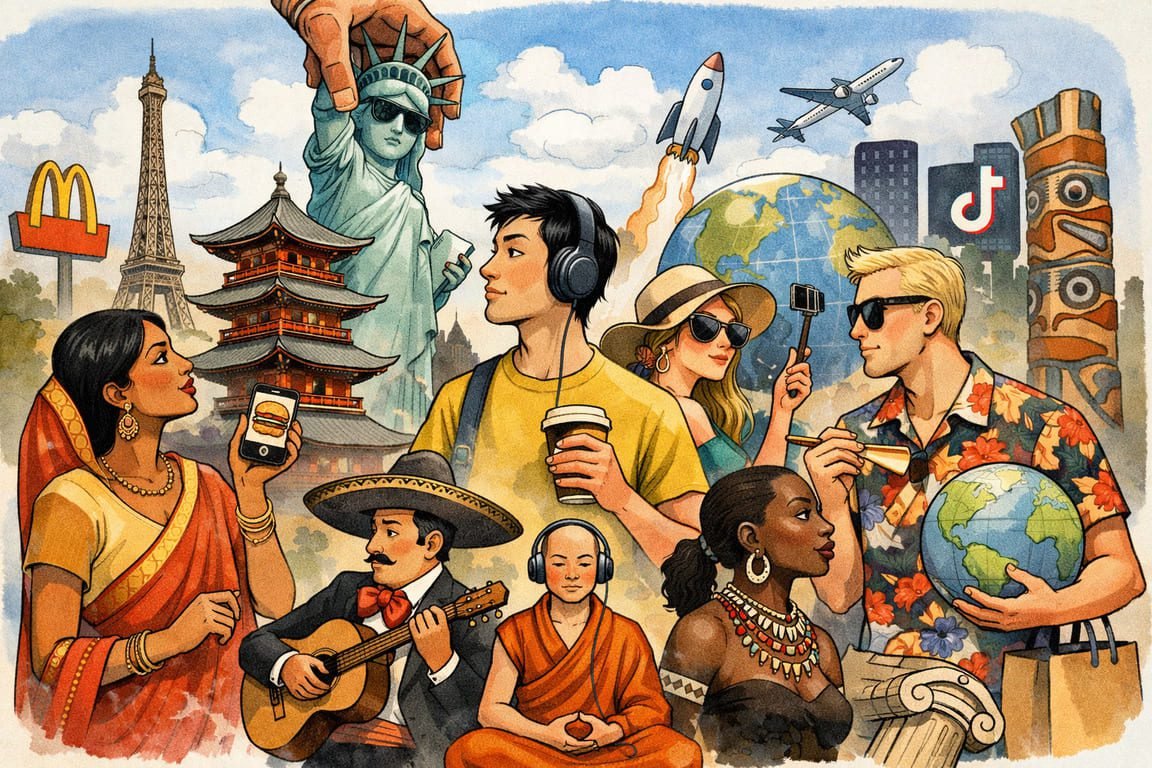
In a town square dressed for celebration, everything looks familiar at first glance. Costumes echo history. Music carries the right rhythm. Food tastes close enough to memory. Yet something feels managed. Movements are timed. Meanings are shortened. Rituals end early. What once grew from belief now performs for approval. No force arrived. No order was given. Culture changed because it learned what the outside world would reward.
Tradition used to move slowly. Stories passed through families. Customs evolved through need, faith, and repetition. Globalization collapsed that timeline. Suddenly, the local became visible everywhere. That visibility brought opportunity and pressure in equal measure. Communities discovered that their heritage had market value. Songs became content. Ceremonies became attractions. Survival began negotiating with spectacle.
Global power understands this leverage intuitively. Influence does not always arrive through armies or sanctions. It travels through screens, brands, language, and taste. When dominant cultures spread, they set defaults. What feels modern, acceptable, or aspirational begins to converge. Local expression adapts or risks being ignored. Often, adaptation is framed as choice rather than loss, especially among younger generations eager to belong to a wider world.
Tourism accelerates the transformation. Visitors search for authenticity but reward familiarity. Traditions compress to fit itineraries. Sacred practices become photo moments. Communities comply because livelihoods depend on it. Over time, performance replaces practice. Elders notice the difference. Outsiders rarely do. Culture survives visually while thinning internally.
Digital platforms sharpen the effect. Algorithms favor what travels well. Complexity slows momentum. Subtlety struggles. Cultural expressions that align with global aesthetics rise. Others sink quietly. A dance modified for viral appeal circles the world. The original version fades at home. Incentives shape creativity. Visibility becomes validation.
Language reveals the cost clearly. Dominant languages open doors to education, work, and influence. Local tongues retreat to private spaces. When a language shrinks, so does the worldview it carries. Humor loses texture. Memory loses nuance. Parents encourage what helps children succeed. Rational decisions accumulate into irreversible change.
Governments respond unevenly. Some protect culture through policy and funding. Others rebrand it as national capital. Museums modernize. Festivals globalize. Heritage becomes strategy. Organizations like UNESCO attempt preservation, yet recognition can freeze living traditions into curated displays. Safeguarding risks turning culture into artifact rather than practice.
Resistance emerges from within. Artists, writers, and musicians reclaim narratives on their own terms. They blend tradition with modern form without seeking permission. Their work feels alive rather than preserved. These efforts rarely scale smoothly. They matter precisely because of that. Culture survives through internal reinvention, not external management.
Power complicates the exchange. Dominant nations celebrate diversity selectively. Certain versions of culture are welcomed. Others are labeled inconvenient or outdated. Difference becomes decorative. Meaning gets filtered. Identity turns aesthetic. The uncomfortable parts disappear. What remains travels well.
Self perception shifts quietly. Communities begin seeing themselves through external eyes. Pride mixes with anxiety. Authenticity becomes something to perform rather than inhabit. Younger generations navigate contradiction daily, honoring heritage while adapting to global norms. Creativity flourishes alongside confusion.
Technology promises preservation through archives and digital memory. Songs are recorded. Rituals documented. Yet memory without practice is fragile. Culture lives through repetition and participation. What is remembered but no longer lived becomes history, not life. Screens cannot substitute for shared meaning.
None of this argues for isolation. Cultures have always borrowed and blended. The danger lies in imbalance. When exchange becomes extraction, diversity flattens. The world grows connected yet strangely uniform. Logos replace symbols. Variation survives mostly as branding.
In a quiet room away from festival lights, an elder folds unused garments, fabric heavy with stories no one asked about. Outside, the performance continues, applauded and shared widely. Inside, memory waits. And as culture becomes something optimized for the world’s gaze, one question lingers with uncomfortable force: when everything is visible and nothing is sacred, who decides which traditions live fully, and which are allowed to survive only as spectacle?
