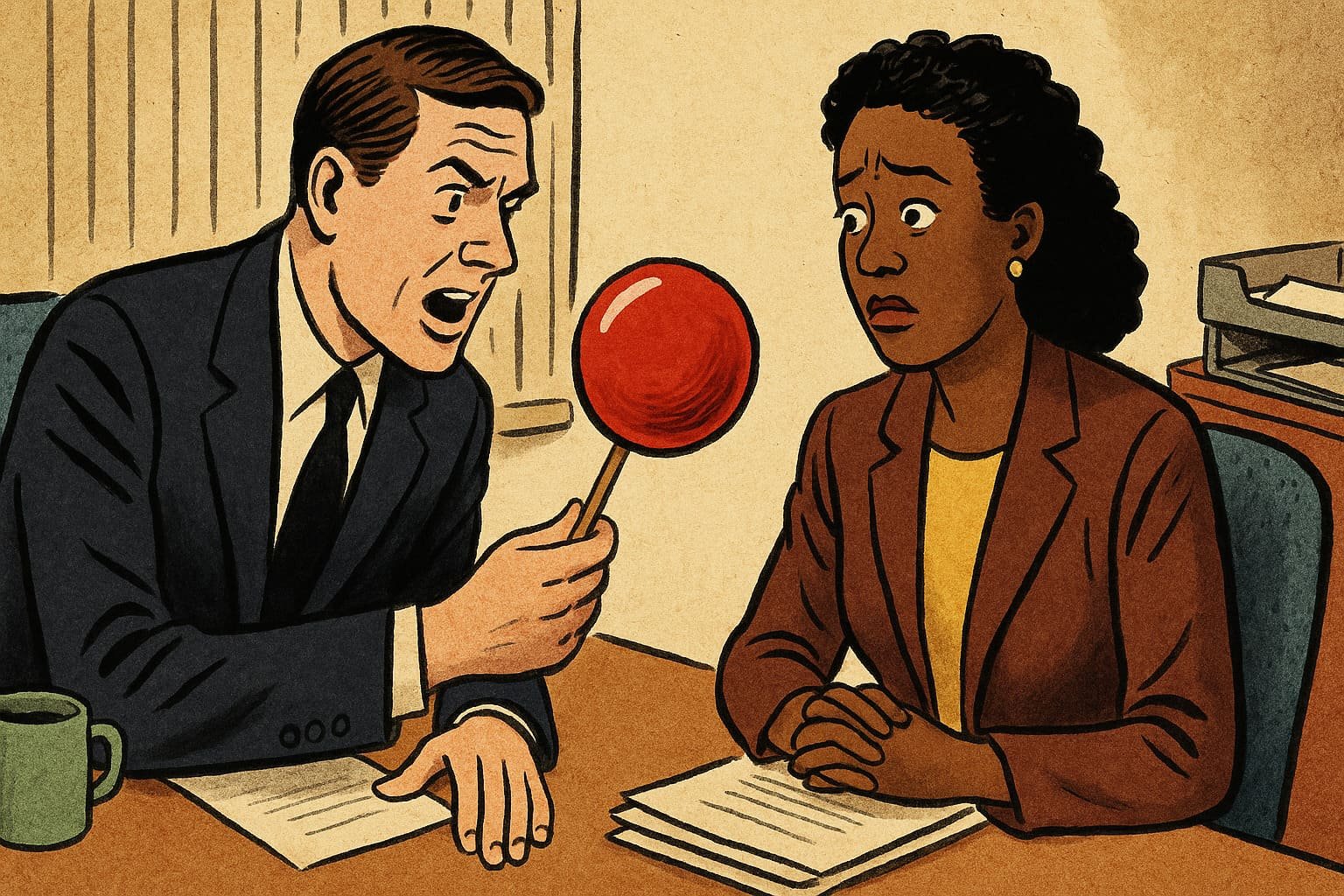
Outside, rain spatters against neon-lit glass, its rhythm lost in the sterile silence of the conference suite. Inside, sharp suits gather around a table polished so fiercely it warps every reflection. Words bounce between the walls like polished marbles; gleaming, smooth, and oddly slippery. Each sentence slides across the surface, dipped in syrupy optimism, concealing an aftertaste of discomfort that nobody dares swallow. At the head of the table, a CEO smiles with the quiet confidence of someone used to applause, reciting “transparency” and “authenticity” until the room almost forgets what raw truth feels like. Everyone senses the danger hiding beneath these sweet words: a subtle lie dressed in polite applause, the ghost of failure lurking beneath shiny slides, the risk of being the one who finally blurts out, “This isn’t working.”
In the age of radical transparency, honesty has become its own performance. The modern workplace offers candor with a filter; real feelings softened, failures repackaged as “learning moments,” and hard news wrapped in the velvet language of “feedback.” The result is a corporate culture where uncomfortable truths are polished until their edges vanish, leaving employees dizzy from sugar highs and starved for substance. Here, the truth exists but only in costume, parading as “constructive criticism” or “room for growth,” always staying just out of reach. Companies preach openness while teaching people to mask their real opinions with gentle euphemisms, so that every meeting sounds like a gentle rain when sometimes a thunderstorm is what’s needed.
At a global brand’s town hall, a junior analyst named Lina sits gripping her coffee cup, bracing for the quarterly update. She knows what’s coming: numbers dressed as success, setbacks painted as “strategic pivots,” and applause coaxed for minor victories. The executive at the podium thanks the team for “weathering the storm,” yet her words taste faintly artificial. Lina glances at her colleague; one eyebrow raised, half a smile curving in silent agreement. Everyone in the room knows what’s happening. Nobody says a word.
This is not just a corporate theater, but a social experiment in self-preservation. The sugarcoating of honesty isn’t accidental: it’s a learned survival skill. You can hear it in pop-culture too: think of Michael Scott’s infamous “feedback sandwich” in The Office, or the endless parade of “synergy” and “alignment” in Silicon Valley sitcoms. The public face of work has been replaced by a curated feed, where even failure is spun as “valuable experience,” and criticism gets lacquered with a dozen coats of positivity. The more honest the intent, the sweeter the delivery until the meaning melts away.
This article peels back the layers of corporate communication, exposing the truth hiding behind the sugar. It traces how businesses polish their honesty to avoid confrontation, why employees swallow the bitter pills in syrup, and what happens when leaders finally dare to serve the truth undiluted. These are not abstract musings, but lived realities from boardrooms, breakrooms, and coffee shop corners where real conversations happen behind closed doors. Are you ready to taste what’s beneath the frosting?
Quick Notes
- Sweet Lies, Bitter Outcomes: Companies spin setbacks as “strategic pivots” to avoid tough conversations, but this erodes trust over time. The more you sugarcoat, the more you invite confusion, gossip, and hidden resentment. If honesty were coffee, corporate America serves it with so much creamer you forget there’s caffeine at all.
- Feedback Theater: Polite feedback often hides what people really feel. A manager tells you “it’s a great start,” but means “this missed the mark.” Sugarcoated reviews make it harder for teams to grow. The “feedback sandwich” may sound friendly, but nobody digests the middle.
- Transparency’s Thin Veil: Even “radical transparency” cultures fall into the trap. Companies flaunt open-door policies while quietly managing information behind the scenes. When truth arrives filtered, trust evaporates. People crave clarity, not confusion by committee.
- Stories from the Frontline: Lina, the analyst, lives the reality; quarterly updates smooth over losses, leaders praise grit, and whispered hallway truths carry more weight than a dozen official memos. The most important lessons travel in unguarded moments, not branded emails.
- When Sugar Shatters: Real change begins when someone finally says what everyone’s thinking. The most transformative leaders stop glossing over problems and instead light a match under the illusions. Sugarcoating honesty may taste sweet for a moment, but it poisons ambition and unity in the long run.
Sweet Lies, Silent Wounds – How Polite Honesty Kills Real Trust
Every workplace has its secret language, a set of coded phrases that mean something entirely different when spoken aloud. “We’re evaluating all options” signals looming layoffs. “This isn’t a no, it’s a not yet” is often a gentle way to sideline bold ideas. These linguistic softeners evolved to avoid confrontation, but they also sow confusion, leaving employees unsure of what’s real. Over time, these little white lies become standard operating procedure, nudging people to second-guess every compliment or critique.
A global survey by Deloitte once revealed that employees rarely trust official company statements, preferring the grapevine instead. People look for truth in tone, in facial expressions, in who hesitates before answering a tough question. A middle manager at a fashion retailer once told her team that “we’re just repositioning the brand,” but everyone could see the urgency in her eyes; stores were closing, and no amount of branding magic could change that. Eventually, her attempts to soothe only bred suspicion, not reassurance.
The cost of sugarcoated honesty is subtle but immense. Teams waste energy deciphering subtext rather than solving problems. Creative ideas get buried under politeness, as nobody wants to risk breaking the surface calm. Even constructive criticism loses its punch when wrapped in too much positivity. A product designer at a tech startup confessed that “feedback always felt like a compliment sandwich, and I never knew if I was actually doing well or just being spared the truth.”
Pop culture skewers this habit ruthlessly. On Succession, executives deploy euphemisms as armor, calling disaster “a learning opportunity” while plotting behind the scenes. These stories resonate because they echo what happens in conference rooms everywhere. Everyone is speaking, but nobody is truly heard.
The wounds left by sugarcoating aren’t visible at first, but they fester. Trust withers as people learn that official language rarely matches reality. In time, employees disengage, leaders grow isolated, and organizations lose their agility. When the moment for decisive action finally comes, nobody knows how to be honest anymore.
The Feedback Sandwich – When Kindness Clouds Growth
Modern managers are trained to deliver bad news like gourmet chefs, layering truth between thick slices of praise. The feedback sandwich is everywhere: “You did great on the presentation, but maybe tighten the slides, though I loved your energy.” It sounds nurturing, but it often leaves people confused about what really matters. The urge to be kind creates a fog, and genuine improvement becomes nearly impossible.
Ask anyone who has survived a performance review, and you’ll hear stories. Ava, a copywriter at a creative agency, recalls her first major project. Her supervisor started with a big smile and said, “There’s a lot to like here!” After five minutes of soft-edged critique, Ava left unsure if her work was bold or bland. She spent weeks guessing, afraid to ask for clearer direction. Growth, it turns out, requires friction, not flattery.
Psychological safety matters, but overprotecting people from discomfort is not the same as support. Real learning happens when feedback stings; when it’s clear, specific, and delivered with care but not coddling. A marketing director at a fintech startup once replaced the feedback sandwich with a “radical candor” workshop. The results? Some tears, many breakthroughs, and an unfiltered dialogue that became the company’s engine for innovation.
Tech culture offers its own twist. At Netflix, employees are encouraged to “say what you really think, with respect.” This approach works for some, terrifying others. Not every workplace can handle this heat, but the lesson remains: diluted feedback helps no one. A supportive environment demands honesty, not just good intentions.
Pop culture mocks this dynamic with characters who specialize in double-speak. On Parks and Recreation, Ron Swanson’s brutal honesty becomes comic relief, but it’s also a reminder that sometimes, bluntness is the only way to break the cycle of confusion. For teams hungry to learn, sugarcoated feedback is a meal with no nutrition.
Radical Transparency – The Mask of Openness
Some organizations wear honesty like a badge, trumpeting “radical transparency” as their secret weapon. Open salaries, public performance metrics, even live-streamed town halls. It sounds revolutionary, but the reality often falls short. Transparency can become a performance, a spectacle that distracts from the messier truths lurking beneath the surface.
Consider Buffer, a startup famous for making every salary public. Employees praised the boldness at first, but soon whispered anxieties bubbled up. Junior staff compared paychecks, speculating about fairness, and managers struggled to explain every decision. The intent was trust, but the outcome was fresh insecurities layered with the same old awkwardness. Radical transparency is only as good as the trust and context supporting it.
Sometimes, leaders reveal “everything” except the most important details. At a global tech giant, employees cheered the new open-door policy. Yet, key decisions continued to happen offstage, behind closed doors, and often after hours. The real information flowed through backchannels, not in official updates. Transparency felt more like a stage play than a movement.
Public vulnerability has its limits. A famous case saw an executive cry on stage, confessing burnout and struggle. The audience applauded the authenticity, but weeks later, he was quietly replaced. The moment inspired, but it didn’t change the system. Openness can inspire connection, but if not followed by structural honesty, it dissolves into cynicism.
Pop culture, as always, has a lens. In The Devil Wears Prada, Miranda Priestly’s icy commands cloak the chaos of the fashion world, proving that surface transparency often hides more than it reveals. Authenticity without depth is just another mask.
Radical transparency, when wielded well, creates belonging. But when it’s all performance, it sharpens the ache for something real. If people sense the honesty is staged, they turn away, hungrier than ever for an undiluted truth.
Whisper Networks and Unfiltered Truth – The Real Conversation Underground
Every company has its shadow circuit; a web of whispered warnings, unofficial memos, and after-hours confessions. These are the places where truth survives, battered but intact. If you want to know what’s really happening in an organization, ask the assistant, the janitor, or the person who’s been around for a decade. Here, people speak plainly, unafraid of official spin.
When Google reorganized a major product division, public statements lauded “bold vision and unified direction.” Yet in quiet Slack channels, team members traded direct messages: “Prepare for layoffs.” Employees created spreadsheets to track real-time rumors, finding comfort in honesty shared behind closed doors. The leadership message soothed, but the network of truth-tellers protected.
The underground thrives because official channels rarely deliver the goods. In a London fintech company, staff relied on coded emojis to signal which projects were actually in trouble. The red pepper meant, “This is burning down.” The eggplant? “Someone’s in deep water.” These improvised symbols gave people a language for reality, bypassing polished PR.
A senior manager named Raj confessed over coffee, “I learned more from watercooler chatter than any executive briefing.” His team survived a painful restructure by trusting their own network, not the official narrative. The best ideas and warnings travel outside the spotlight, unburdened by politeness.
Fictional workplaces get this right. The newsroom in The Morning Show teems with coded glances and offhand remarks, conveying more in five seconds than any all-hands meeting ever could. Whisper networks are the company’s true nervous system, keeping the organism alive even as the brain recites polite scripts.
Truth’s hiding place is always somewhere unguarded. If you want honesty, follow the sound of laughter in the break room or the group chat that never sleeps. There, sugar dissolves and people speak the words that matter.
Shattering the Candy Shell – The Risk and Reward of Raw Honesty
At some point, someone dares to smash the candy coating. The room falls silent, breaths caught in collective suspense. A project manager stands up during a team call and says, “We’re failing. Here’s why.” The first seconds hang heavy with shock, then the atmosphere changes. Relief flickers in nervous smiles. The forbidden words set everyone free, even if just for a moment.
The courage to speak unfiltered truth is rare but contagious. At a mid-size marketing firm, an employee named Steph stopped the cycle of sugarcoating after a disastrous campaign. She called a meeting, skipped the usual niceties, and asked the team, “What did we really get wrong?” The conversation was messy, raw, and deeply uncomfortable. By the end, the team rebuilt not just the project, but their trust in each other.
This kind of honesty has risks. People may bristle, egos get bruised, tempers flare. But the upside is enormous. Teams who learn to argue, admit mistakes, and own uncomfortable realities become more resilient. Leaders who reward candor set a tone that ripples through every department. When the sugar shell cracks, creativity and innovation rush in to fill the space.
Satirical shows like Silicon Valley thrive on the chaos that comes from telling the truth in a world addicted to spin. Their characters stumble, fall, and occasionally soar because they say what everyone’s thinking, no matter the cost. The resulting energy, awkwardness, and sometimes even breakthroughs mirror what happens when real companies stop pretending.
The best organizations build rituals for truth-telling: post-mortems where failure is dissected, anonymous suggestion boxes that actually get read, or open forums where junior staff can challenge senior leaders. When raw honesty becomes a habit, performance soars and loyalty deepens. People crave a workplace where words mean what they say.
The transformation isn’t instant. The first honest conversation stings. The second is easier. By the third, the habit forms and the culture starts to heal. The risk is real, but the reward; a team that trusts itself enough to improve is worth every uncomfortable moment.
The Bitter Candy Hour
Somewhere, long after the lights fade in the meeting room, a lone figure lingers by the window, eyes tracing streaks of rain over shimmering city glass. Silence settles heavy, cut only by the soft hum of a cleaning cart and the pulse of distant streetlights. She remembers every word from that day; the compliments, the gentle rebukes, the laughter polished by restraint. It tastes oddly sweet, but now she sees the emptiness beneath the glaze.
A half-empty coffee cup sits abandoned on the windowsill, ringed with cold, syrupy residue. The promises made, the goals set, the lessons spun as triumphs; they echo hollow in the still air. She runs a finger along the glass, wiping away a line of condensation, revealing the city alive below, raw and unscripted. In that moment, she hungers for something real: not the comfort of soft words, but the clarity of what hurts, the power of what’s true, the freedom to admit the mess. Somewhere behind her, a janitor hums an old song about honesty, barely audible but strangely moving, as if the building itself is ready to confess.
The habit of sugarcoating truth dies hard. It clings to the tongue, making every new conversation feel both safer and lonelier. Yet, in the fragile silence of this late hour, something shifts. The room no longer feels like a prison made of polite applause, but a place waiting to be filled with honest voices. Outside, the city lights flicker with promise. Inside, she chooses not to rehearse the lines she’s been given, but to find her own. The taste of honesty, when it finally arrives, is bracing; sharp, unyielding, and strangely delicious.
Now, imagine tomorrow’s meeting. Will you keep sweetening the truth until nobody remembers what it is, or will you risk everything and say what you actually mean? The next moment is yours to shape: will it be candy or clarity?
Will you keep sipping from the cup of comfort, or dare to taste the truth; unfiltered, unapologetic, and finally your own?
Partnered. Provocative. Worth Your Scroll.
This is a Promoted Post by ESYRITE—yes, it’s paid, but never filtered. Our voice stays raw, real, and razor-sharp. We team up with bold ideas, game-changers, and stories that spark something real. If it’s here, it earned its place—no fluff, just impact. We don’t just promote—we provoke. Stay sharp. Dive deeper.
