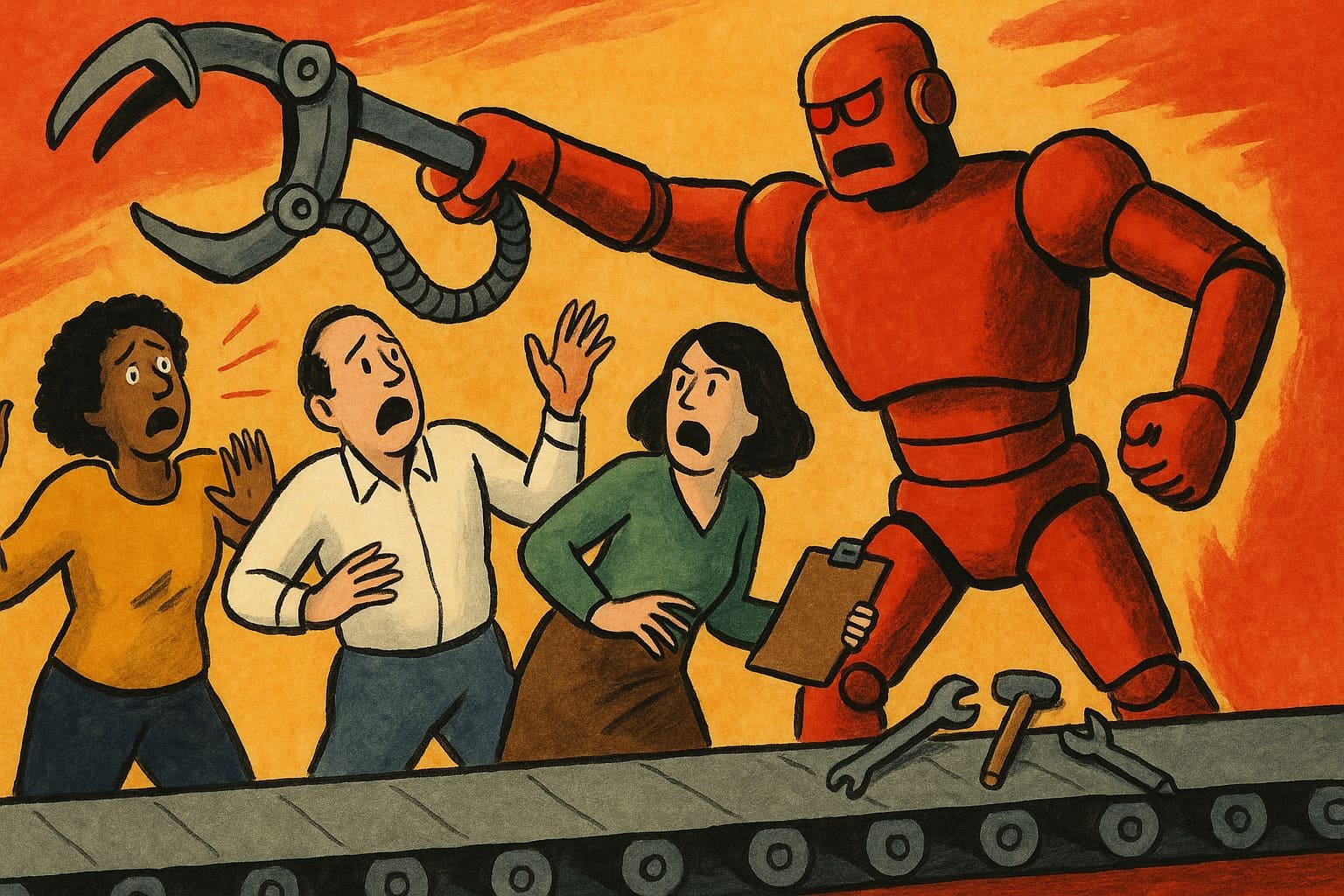
At three in the morning, a city’s heart beats beneath a web of humming wires, the glow of servers pulsing behind smoked glass. Down below, the last janitor wheels a cart through silent corridors, his mop squeaking in rhythm with distant whirrs as somewhere a robotic arm tightens a bolt on a luxury car door. Not a soul breathes, yet thousands of machines labor tirelessly, their clockwork hands never trembling with fatigue or fear. Above them, in skyscraper offices, half-lit screens flash relentless news of automation: pink slips flutter across inboxes, engineers pace, union reps sip cold coffee with jaws set for a fight. It’s not just a shift in industry; it’s the birth of an invisible war—one where software scripts replace sweat and every algorithm writes its own agenda, indifferent to the tired eyes staring back from empty cubicles.
A young coder, headphones over shaggy hair, fires off another update to a predictive scheduling bot. His inbox is an endless scroll of questions from warehouse managers, truck drivers, even a worried bakery owner whose father’s hands once kneaded dough. “Will the machine get it right?” “Who decides if I matter?” The questions spiral, sharp and urgent. Beneath the fluorescent hum, he wonders if he’s building progress or laying the groundwork for a silent coup. It feels like a gamble played in slow motion, with real lives riding on every commit.
By sunrise, newsfeeds light up with both panic and awe. Robot delivery fleets glide across city streets, dodging potholes and protests alike. Viral clips show drones out-maneuvering dogs, AI tools generating pitches in seconds, cashiers watching as their touchscreens replace cheerful greetings with cold, metallic beeps. The audience is everyone—executives savoring efficiency, workers clutching identity, families bargaining with a future that sounds both rich and ruthless. If the camera pulls back, you see the city pulse as one tangled organism, equal parts thrill ride and horror show.
The pop icons of yesterday—rock stars, actors, even rogue hackers—suddenly seem quaint against a new breed of digital gladiators. Their faces flash across TED Talks and YouTube rants: technologists, ethicists, self-styled prophets, each selling hope, fear, or snake oil. “Automation will set you free,” shouts one. “It’ll rob you blind,” retorts another. Everyone’s selling certainty, yet the feeling that no one really knows what happens next is as sharp as the cold steel on a robotic assembly line.
The real story isn’t about machines replacing people. It’s about the humans who must now wrestle with a problem bigger than lost jobs: a sense that meaning, power, and self-worth can be programmed, optimized, or deleted at will. It’s a crisis not of employment, but of existence itself. Every shift in the gears, every new update, is a test. Not of what robots can do, but of what people will decide to become.
Quick Notes
- Work’s New Enemy Is Invisible: It’s not the robot in the warehouse, but the algorithm in your inbox that’s changing the game. If you don’t see it coming, you’re already behind.
- Your Boss Isn’t Human Anymore: Welcome to management by math. The real boss doesn’t take bathroom breaks, never asks about your kids, and only cares about key metrics.
- Skills Are Now Expiring Like Milk: What kept you safe yesterday is useless tomorrow. The new premium is adaptability—can you rewire your own brain on demand?
- Survival Is a Group Sport: Lone wolves get automated first. Teams that learn fast, fail fast, and rebuild together become the last humans standing.
- Hope Is Not a Strategy: Betting your future on nostalgia is a losing game. It’s time to make your own playbook—one the machines can’t steal.
The Unseen Puppet Masters: When Algorithms Rule the Day
Every morning, millions check their phones before their feet hit the floor, scrolling past apps that quietly decide what matters. Behind each swipe and notification sits an unseen council: predictive analytics, optimization models, and AI frameworks. These digital rulers determine your news, your work schedule, even what you buy for dinner, all without ever asking permission. The power shift is subtle, like a stagehand pulling strings behind velvet curtains, and most never notice until they’re left out of the spotlight.
The real gut punch arrives when you see how companies wield these algorithms not just to automate tasks, but to reshape entire industries. Take the tale of Everline Logistics, a mid-sized delivery firm in Nairobi that traded human dispatchers for a smart-routing system. The AI didn’t just shave costs; it redefined who got the good shifts and who got sent home. One veteran driver, Musa, found himself replaced on prime routes by younger colleagues—chosen by a bot’s impersonal logic, not by seniority or skill. Overnight, decades of loyalty counted for less than a tweak to a scoring formula.
Worse, the transparency promised by digital management is often a mirage. Employees at digital-first restaurants, for instance, learned that being “optimized” meant racing against clocks, not serving customers with a smile. Workers at a popular pizza chain in London reported that after automation, their breaks became shorter and their targets higher, all justified by “efficiency data” no one could quite explain. It’s not just blue-collar roles feeling the squeeze: lawyers, doctors, even teachers now confront platforms that rank, monitor, and sometimes outshine them.
At a tech summit in Berlin, a consultant named Anya stood on stage and warned, “If you can’t measure it, you can’t manage it. But if you measure only what you see, you’ll soon have nothing left worth measuring.” The applause was nervous, and the after-party was filled with whispers. Can managers still lead if the real decisions are handed down by software? Can workers fight for dignity if their worth is calculated in code?
It’s a world where the biggest threat isn’t an army of steel robots, but an invisible empire of algorithms dictating who thrives, who struggles, and who disappears without a trace. The result is a kind of existential vertigo—knowing you’re not just working harder, but playing a rigged game where the rules keep changing. If you don’t learn to see the strings, you’ll wake up a puppet with nowhere left to dance.
The Myth of “More Time”: Automation’s Empty Promise
Every pitch for automation begins with the same tantalizing idea: the machines will set people free. The PowerPoint slides show smiling workers enjoying “creative time,” freed from drudgery by tireless robotic helpers. Reality, though, bites differently. Most people find that the time saved by automation rarely belongs to them—it’s snapped up by new metrics, new tasks, and new expectations that never seem to shrink.
Consider the classic case of Clarissa, a bank clerk in a bustling Mumbai branch. Her team rolled out a new software suite meant to “eliminate routine paperwork,” promising hours back every week. Instead, managers repurposed her spare minutes for sales calls and cross-selling. The old grind didn’t vanish; it morphed, always one step ahead. Clarissa’s colleagues traded paperwork for screen fatigue, with every microbreak monitored by tracking tools. Their new normal was an endless loop: do more, do it faster, and don’t ask why.
Even the creative fields, supposedly immune, feel the burn. Ad agencies, game studios, and publishing houses rave about tools that “amplify creativity,” but the truth is starker. Writers now churn out twice the content in half the time, designers run on cycles dictated by AI analytics, and the margin for error—let alone inspiration—shrinks to zero. For every viral campaign produced in a flash, three more get lost in the algorithmic churn, never seen by human eyes.
A software developer named Joel captured this paradox during a Zoom panel: “Automation was supposed to make my job easier. Instead, it’s made my job never-ending.” His words hang in the air like a warning. Most organizations celebrate new efficiencies by tightening the screws, expecting more output, higher performance, and fewer excuses. No one talks about the anxiety, the pressure, the relentless feeling that even your best is never enough.
The promise of more leisure, more fulfillment, more control—these are the fantasies that automation sells but rarely delivers. What workers receive instead is a hamster wheel powered by silicon and code. If freedom is the carrot, then the stick is never out of sight. You’re not just chasing better results; you’re chasing a moving finish line that was never meant to let you win.
Humans vs. Machines: The Battle for Meaning
At a factory in Shenzhen, assembly lines once filled with chatter now echo with the synchronized hiss of automation arms. Workers who remain don’t just build products; they supervise machines, troubleshoot glitches, and try to find pride in the margins left by automation. The job titles haven’t changed, but the work feels unfamiliar, hollowed out by the efficiency that once sounded like a blessing. For many, this is the sharpest cut of all: the slow erosion of identity, mastery, and community.
Real meaning in work comes from more than paychecks or perks. It’s found in mastery, in knowing that your effort shapes something real, in the tiny rituals of shared coffee breaks and inside jokes. When machines take over the mundane, they don’t just erase toil—they risk erasing the things that make people feel necessary. Consider the story of Ramon, a veteran barista in Barcelona who trained a robotic coffee system at his café. The lattes tasted fine, but customers missed his easy laugh and the artful leaf he drew in every cup. Revenue stayed steady, but the place felt colder, emptier, and slowly regulars drifted away.
Executives promise “upskilling” and “job evolution,” but most reskilling programs fizzle without heart or purpose. One Chicago hospital invested in robotic surgery tools and retrained its senior nurses to supervise the new tech. Some flourished, inventing new roles and mentoring younger staff, but many just felt sidelined—managers by name only, stripped of the hands-on care they once loved. In meetings, they shared war stories of patients who missed the human touch, and no amount of efficiency could fill the gap.
The challenge isn’t just about surviving disruption; it’s about reclaiming meaning. The most resilient teams are those who reinvent the human side of work, building rituals, cultures, and identities that can’t be automated away. Leaders who listen, adapt, and double down on empathy create organizations where people still matter, even as robots multiply. Teams that celebrate small wins, honor the past, and own their narrative become stronger, not weaker, in the shadow of change.
This fight for meaning will decide the future of work—not because machines are evil, but because people need more than paychecks. They crave connection, mastery, and a reason to get out of bed beyond a swipe from a boss app. The winners in this era won’t be the fastest or the cheapest, but the most human. That’s a race no algorithm can run.
Adapt or Fade: Why Survival Favors the Bold
The secret about automation is that it doesn’t kill all jobs—it just exposes who can adapt and who can’t. Every business that thrives in this new era has a story of reinvention, sometimes painful, always messy. The companies that resist change watch as their best people jump ship, their market share shrinks, and their legacy becomes a cautionary tale.
Look at the story of Felicity, founder of a small accounting firm in Cape Town. When cloud-based software threatened her business, she pivoted overnight, retraining her team to focus on high-touch advisory services instead of rote data entry. It wasn’t easy; some staff left, uncertain about their place in the new model. Those who stayed became more than accountants—they were counselors, strategists, and lifelines for stressed clients. Felicity’s firm is still here, growing, not because she fought automation, but because she found the one thing robots can’t do: build trust.
Survival now demands humility and speed. Tech giants like Netflix and Spotify didn’t invent streaming—they just moved faster, learned faster, and never stopped questioning their own models. Teams that experiment, fail, and learn become the laboratories of tomorrow, creating roles and skills that didn’t exist yesterday. They build cultures of relentless curiosity, where asking “What if?” matters more than “What now?”
Of course, some people still try to hide behind tradition, hoping the storm will pass. Legacy banks, print magazines, and even government agencies drag their feet, clinging to old ways out of habit or fear. Their slow death isn’t caused by robots, but by their refusal to imagine a future where people and machines work as partners, not rivals.
There’s another kind of courage required: the courage to say no. Some organizations have chosen to slow down, limit automation, or even bring back certain tasks to humans—not for nostalgia, but for quality, safety, or ethics. Boutique bakeries, hand-crafted shoe brands, even certain luxury hotels have thrived by betting on the irreplaceable power of human skill. Their success isn’t anti-tech; it’s pro-human.
The lesson is simple: automation rewards those who take risks, reinvent constantly, and never forget that technology is a tool, not a destiny. If you want to survive, you can’t wait for the future to arrive—you have to chase it down, even if it means breaking a few rules along the way.
Building the New Human Advantage: Beyond Automation
Once, the badge of success was knowing the right answers. Now, it’s asking the right questions—especially the ones that scare you. The organizations and people who win in this new world aren’t the ones with the fanciest tech, but those with the deepest sense of curiosity, empathy, and adaptability.
One insurance firm, Sunleaf, found its entire claims process disrupted by automation. Rather than fighting the tide, its CEO, Leo, launched a “human innovation lab,” challenging staff to invent services machines couldn’t replicate. The result wasn’t a single blockbuster, but dozens of micro-innovations: personalized calls, creative problem-solving, empathy-driven claims support. Employees who might have been replaced became the company’s biggest asset—living proof that automation need not mean dehumanization.
Education is the quiet superpower in this story. Instead of viewing learning as a ticket to a better job, the most successful teams treat it as an ongoing adventure, blending formal programs with hackathons, mentorship circles, and learning from mistakes in real time. A startup in Singapore hosts weekly “failure feasts,” where team members share their most spectacular errors over dinner, earning applause and ideas. Mistakes aren’t punished—they’re prized, proof that you’re still trying to grow in a world where standing still is fatal.
Networks matter more than ever. Teams that share knowledge, trade stories, and build communities around curiosity end up outlasting those who hoard secrets or play it safe. Digital tools can spread fear and division, but they can also be used to amplify the best of humanity—collaboration, creativity, kindness. The next big leap forward in work won’t be driven by a new app or bot, but by people who know how to listen, share, and evolve together.
Most of all, the new human advantage is a mindset. The willingness to face uncertainty, learn from anyone, and invent meaning when old maps are useless is what sets survivors apart. If you want to build a future-proof career, start by building yourself—and never stop. The machines are relentless, but so is human ingenuity when given a chance.
Ashes and Blueprints—The Final Rebellion
Night returns. In a half-lit factory, one machine jams, freezing mid-motion as sparks fall like rain over the empty floor. A lone technician, hands greasy and eyes red from staring at code, kneels beside it, whispering encouragement the way a parent might soothe a frightened child. Beyond the glass, rain lashes the windows while somewhere in the darkness, city lights flicker, uncertain and alive.
This is not the ending anyone imagined. The old stories of conquest and surrender feel hollow here, replaced by something stranger, more tangled. Machines don’t destroy jobs—they unmask what was fragile all along: the faith that work makes people whole, that effort always pays, that the future can be charted like a train timetable. What rises from the ashes is not a world without work, but a world where meaning must be hunted, built, and sometimes stolen back from the jaws of convenience.
Every act of reinvention is a kind of rebellion. Each time a worker learns a new skill, a team finds purpose in chaos, or a leader risks trust instead of control, the future tilts away from the cold logic of automation and back toward the messy, hopeful human spark. It is a fight that will never end, not in boardrooms or on shop floors, but in the quiet choices made at midnight, the coffee shared at dawn, the moment someone dares to care when no one is watching.
So as the city breathes beneath its neon skin, as code pulses and hearts hammer, remember this: You’re not competing with machines. You’re rewriting what it means to be irreplaceable. What will you build that no algorithm can steal?
Why scroll… When you can rocket into Adventure?
Ready to ditch the boring side of Life? Blast off with ESYRITE, a Premier Management Journal & Professional Services Haus—where every click is an adventure and every experience is enchanting. The ESYRITE Journal fuels your curiosity to another dimension. Need life upgrades? ESYRITE Services are basically superpowers in disguise. Crave epic sagas? ESYRITE Stories are so wild, your grandkids will meme them. Want star power? ESYRITE Promoted turns your brand cosmic among the stars. Tired of surface-level noise? ESYRITE Insights delivers mind-bending ideas, and galactic-level clarity straight to your inbox. Cruise the galaxy with the ESYRITE Store —a treasure chest for interstellar dreamers. Join now and let curiosity guide your course.
