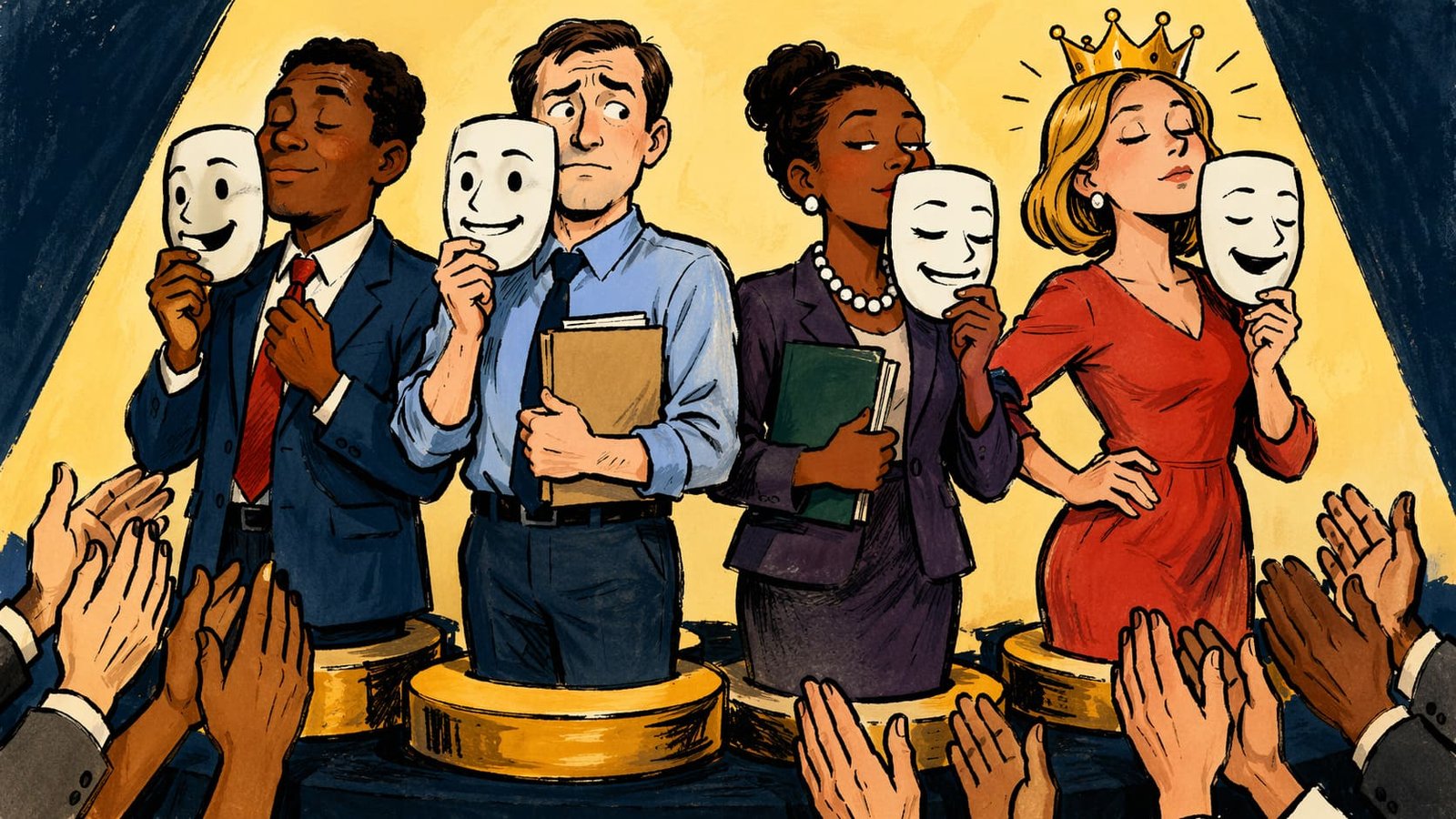
A mirror catches a face in passing, not for reflection, but for rehearsal. The expression adjusts slightly, almost imperceptibly. A posture straightens. A tone softens before a call begins. Somewhere between waking and stepping outside, a version of the self has already been selected, calibrated for the rooms ahead. Nothing about it feels false. Nothing about it feels entirely fixed either. Identity moves, adapts, performs, often without announcing the shift.
What once felt stable now behaves more like a role that updates across contexts. Work demands one register. Social spaces invite another. Online platforms amplify yet another layer, one that can be edited, refined, and repeated. The self becomes a series of expressions, each one responsive to an audience, each one shaped by expectation. This is not necessarily deception. It is navigation. Yet the line between adaptation and performance grows thinner with each adjustment.
A product manager named Imani once noticed how her communication style changed across environments. In meetings with executives, her language became precise, controlled, almost restrained. With her team, it softened, became more open, more collaborative. Online, her voice shifted again, curated to reflect clarity and confidence. Imani did not feel inauthentic. She felt effective. Still, a quiet question lingered. Where did these versions converge, if they converged at all?
Identity today is deeply intertwined with visibility. What is seen often becomes what is recognized. Profiles, posts, presentations, each one acts as a fragment of self, assembled into a narrative others can interpret. The feedback loop is immediate. Responses signal alignment or deviation. Over time, certain expressions are reinforced while others fade. The self becomes partially shaped by reception.
Consider platforms like Instagram, where identity is curated through images, captions, and interactions. The platform does not demand performance explicitly, yet its structure encourages it. Visual coherence, aesthetic consistency, narrative clarity. These elements create a sense of identity that feels intentional, even when it is selective. What is shared becomes a version of truth, one that may not capture the full complexity of experience.
There is also a professional dimension to this performance. Personal branding has become a common expectation, especially in knowledge-driven industries. Individuals are encouraged to articulate their value, define their narrative, and present it consistently. This can be empowering. It provides clarity, direction, recognition. At the same time, it introduces pressure to maintain a coherent image, even as circumstances evolve.
A consultant named David built a strong personal brand around strategic thinking and decisive leadership. His content attracted attention. Opportunities followed. Over time, David encountered situations where uncertainty was more appropriate than decisiveness. Expressing that uncertainty felt risky. It did not align with the established narrative. David faced a choice between maintaining consistency and embracing complexity. The decision was not simple. It reflected a broader tension between identity as expression and identity as expectation.
Pop culture has long explored this dynamic. Films like The Truman Show present identity as something observed, constructed, and influenced by external forces. The protagonist’s life unfolds within a controlled environment, shaped by unseen producers. While the scenario is extreme, it resonates because it mirrors a softer reality. Many environments subtly guide how identity is performed, even without explicit control.
Sociologist Erving Goffman described social interaction as a form of performance, where individuals present themselves differently depending on context. His ideas feel increasingly relevant. The stages have multiplied. The audiences have expanded. The performance has become more continuous. What was once occasional now feels constant.
A designer named Aisha once experimented with sharing less curated content online. The posts felt more spontaneous, less refined. Engagement dropped initially. Over time, a different kind of interaction emerged. Comments became more personal, conversations more meaningful. Aisha noticed a shift. The performance had softened, and with it, the connection deepened. The trade-off between reach and resonance became visible.
There is a subtle cost to continuous performance. Maintaining multiple versions of the self requires energy. It demands awareness, adjustment, consistency. Over time, this can lead to a sense of fragmentation, where identity feels distributed rather than integrated. The question is not whether performance exists. It always has. The question is how much of it is conscious, and how much is automatic.
A startup founder named Karim once built his company culture around transparency and authenticity. Meetings encouraged open dialogue. Mistakes were discussed openly. As the company grew, maintaining this culture became more complex. New hires brought different expectations. External pressures increased. Karim noticed that authenticity itself had become a value that needed to be performed, sometimes intentionally. The irony was not lost on him.
The tension at the center of identity performance is not easily resolved. Expression allows adaptation. Adaptation enables growth. Yet excessive performance can obscure clarity. When identity becomes primarily responsive, it risks losing its anchor. The challenge lies in navigating this space without collapsing into rigidity or dissolving into constant adjustment.
In a quiet room lit by the soft glow of a screen, a person pauses before posting a thought that feels slightly unfinished, slightly uncertain. The instinct is to refine it, to align it with expectation, to present it clearly. The pause lingers. For a brief moment, the possibility of sharing it as it is remains open.
And in that suspended space, where expression meets hesitation, a question settles with quiet intensity: if identity is shaped by what is shown, what happens to the parts of you that are never displayed?
