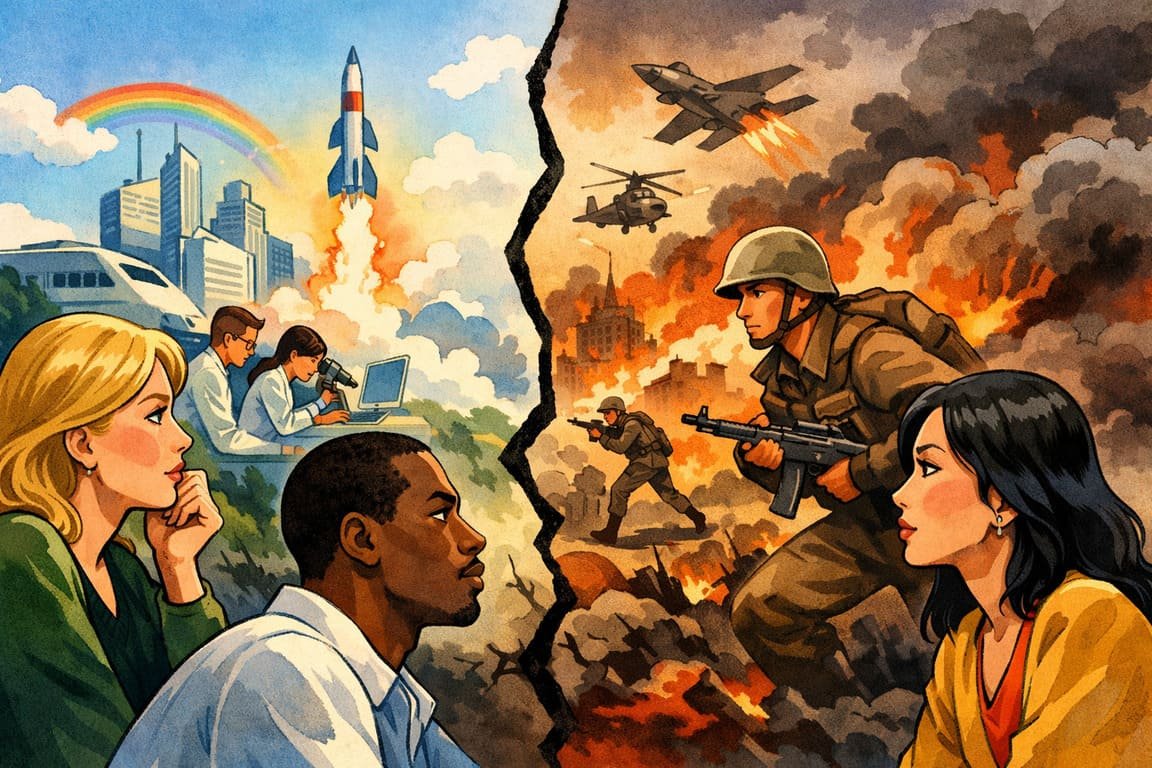
The gallery is quiet, polished, and carefully curated. Innovations sit behind glass, lit to suggest inevitability. Visitors move slowly, absorbing a story of steady advancement, as if progress emerged through patience and goodwill alone. What the plaques omit is the pressure that forced these ideas into existence. Fear. Rivalry. Urgency. The kind that collapses decades of hesitation into a single, irreversible moment. Progress rarely arrives during calm. It breaks through when stability fails.
The modern imagination clings to peace as the natural state of history. Conflict is framed as deviation, tragedy, interruption. The record tells a different story. Long periods of calm tend to refine what already exists. They improve efficiency, aesthetics, comfort. Transformation appears elsewhere. It appears when systems collide and survival demands speed over elegance.
This does not sanctify violence. It recognizes its catalytic role. Competition compresses time. Under pressure, inefficiency becomes intolerable. Bureaucracy thins. Innovation shifts from optional to essential. War accelerates invention not because it is noble, but because it removes the luxury of delay. The moral cost is immense. The effect is undeniable.
Conflict operates beyond battlefields. Ideological clashes reshape institutions. Labor unrest redraws economic contracts. Social movements force moral expansion through disruption, not politeness. These struggles are loud, divisive, and exhausting. They are also the mechanisms through which stagnant systems are forced to change.
Comfort breeds illusion. When survival feels guaranteed, urgency fades. Societies protect procedure rather than outcomes. Conflict interrupts that complacency. It demands prioritization. People discover capacities that routine never reveals. Entire populations reorganize values when dignity or survival is threatened.
Critics point to devastation, and they are right. The human cost of conflict cannot be justified retroactively. Lives lost do not become acceptable because later generations benefit. Yet denying conflict’s role in progress does not erase its influence. It only prevents honest reckoning with how advancement actually occurs.
Rights expansions follow this same pattern. Labor protections emerged after unrest disrupted economies. Civil rights followed protests that shattered comfort. Independence followed resistance that destabilized empires. These milestones were not gifted by calm consensus. They were extracted through struggle that made neutrality impossible.
Peace, when it arrives, often codifies outcomes shaped by conflict rather than replacing its function. Treaties formalize new balances. Laws institutionalize hard-won changes. The calm that follows is not the engine. It is the moment of stabilization after acceleration, when societies catch their breath and sanitize the memory of how change occurred.
Philosophically, this challenges the belief that humanity progresses by becoming gentler. Evidence suggests it progresses by becoming more capable under pressure. Ethical frameworks often adapt after material and institutional change has already altered reality. Morality follows structure more often than it leads.
This perspective unsettles because it implies that wishing for peace is insufficient. Avoiding conflict at all costs may slow the very progress societies claim to protect. The task is not to eliminate struggle, but to channel it, limit its damage, and learn from its force rather than pretending it is an anomaly.
Late nights in quiet cities reveal unresolved tensions beneath declared calm. Inequality persists. Power concentrates. Fear simmers. Declaring peace does not dissolve these forces. It postpones their confrontation. Eventually, pressure resurfaces, demanding resolution in forms no one can fully control.
The myth of permanent peace comforts those who benefit most from stability. For everyone else, progress has always arrived through disruption that exposes what no longer works. The absence of conflict does not guarantee justice. It often guarantees delay.
And when the next rupture inevitably arrives, the question is no longer whether conflict should exist, but whether society has learned how to endure its force without surrendering its humanity.
