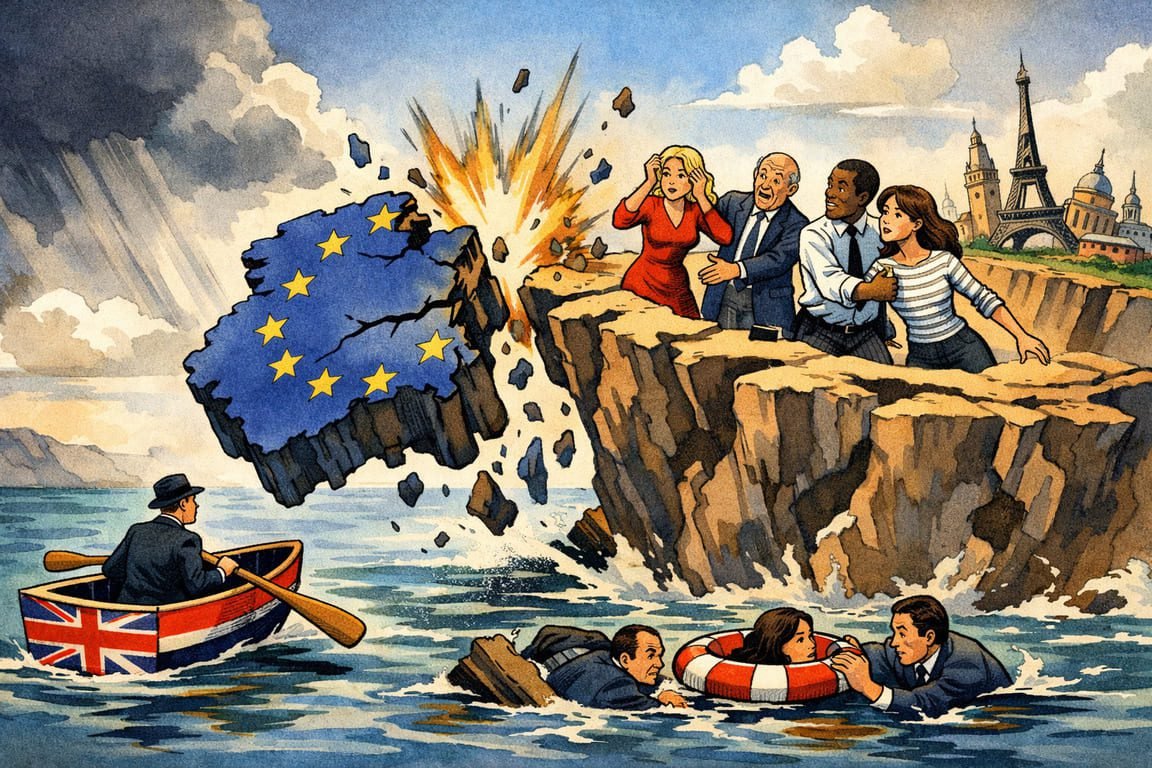
The ferry eased into the harbor as it always had, engines humming with practiced familiarity. Seagulls hovered, indifferent to paperwork. Dockworkers waited, hands in pockets, watching passengers line up not for coffee or taxis, but for documents. Nothing dramatic happened. No arguments. No shouting. Just a pause where none had existed before. Brexit announced itself not with fireworks, but with friction.
For years, the European project sold inevitability. Integration moved forward with the quiet confidence of something permanent. Trade flowed. Borders softened. Disagreements stayed bureaucratic. Britain’s departure shattered that assumption. The shock was not economic first. It was psychological. A union that defined itself as irreversible had discovered that exit was not only possible, but executable.
The referendum fractured more than policy. It exposed a divide between abstraction and experience. Supporters spoke of sovereignty, control, dignity. Opponents warned of complexity, interdependence, loss. Both were right, and both underestimated the cost of translating feeling into governance. Identity rarely fits neatly into treaties.
Inside the United Kingdom, consequences unfolded unevenly. Some sectors adapted with agility. Others stalled under new layers of administration. Northern Ireland became a geopolitical riddle that slogans never solved. Promises of simplicity collided with geography. Compromise arrived quietly, then loudly, labeled betrayal from multiple sides.
Across the Channel, the European Union stiffened its posture. Access would require alignment. Privilege would demand obligation. The message was deliberate. Leaving must look costly. Deterrence mattered. Yet firmness reinforced existing critiques. Brussels appeared distant, fluent in regulation yet awkward in empathy. The effort to protect cohesion risked deepening alienation.
Generational contrasts sharpened the tension. An older logistics manager named Peter accepted delays with resignation. Borders, to him, had always been lines. A younger colleague named Sofia stared at the same forms with disbelief. She had grown up inside seamless movement. For her, the pause felt like regression, not sovereignty. The same queue carried different meanings.
Populist movements elsewhere watched carefully. Brexit became both warning and inspiration. Economic disruption discouraged some. The symbolism emboldened others. Leaders selectively cited outcomes that suited narratives. Facts mattered less than the permission Brexit granted to imagine departure as defiance rather than failure.
The EU did not crumble. Institutions held. Markets adjusted. Cooperation continued. Yet cohesion thinned. Crises exposed strain. Energy debates. Migration pressures. Defense coordination. Each challenge tested solidarity built more on procedure than shared conviction. Brexit removed the comfort of assumed alignment.
Culturally, Europe remained intertwined. Students crossed borders. Artists collaborated. Families stayed blended. Politics lagged behind lived reality. The question shifted from whether Europe belonged together to how governance could reflect connection without flattening difference. Unity imposed feels brittle. Unity chosen demands trust rebuilt continuously.
Philosophically, Brexit forced an uncomfortable reckoning about scale and democracy. Large unions promise stability and leverage. Smaller sovereignties promise intimacy and control. Neither delivers perfectly. Efficiency competes with representation. The tension was never resolved. It was postponed until a vote dragged it into daylight.
Predictions of collapse overreach. Systems resist disintegration. Yet endurance alone does not equal vitality. A structure can persist while losing emotional legitimacy. Brexit signaled not an ending, but a demand for recalibration that many institutions still resist.
The harbor remains busy. Ferries still arrive. Paperwork still stacks. Life adapts. Yet beneath routine movement, Europe listens to the echo of one departure, not because it expects immediate collapse, but because it knows that once inevitability breaks, every union must learn how to justify itself anew, every single day.
