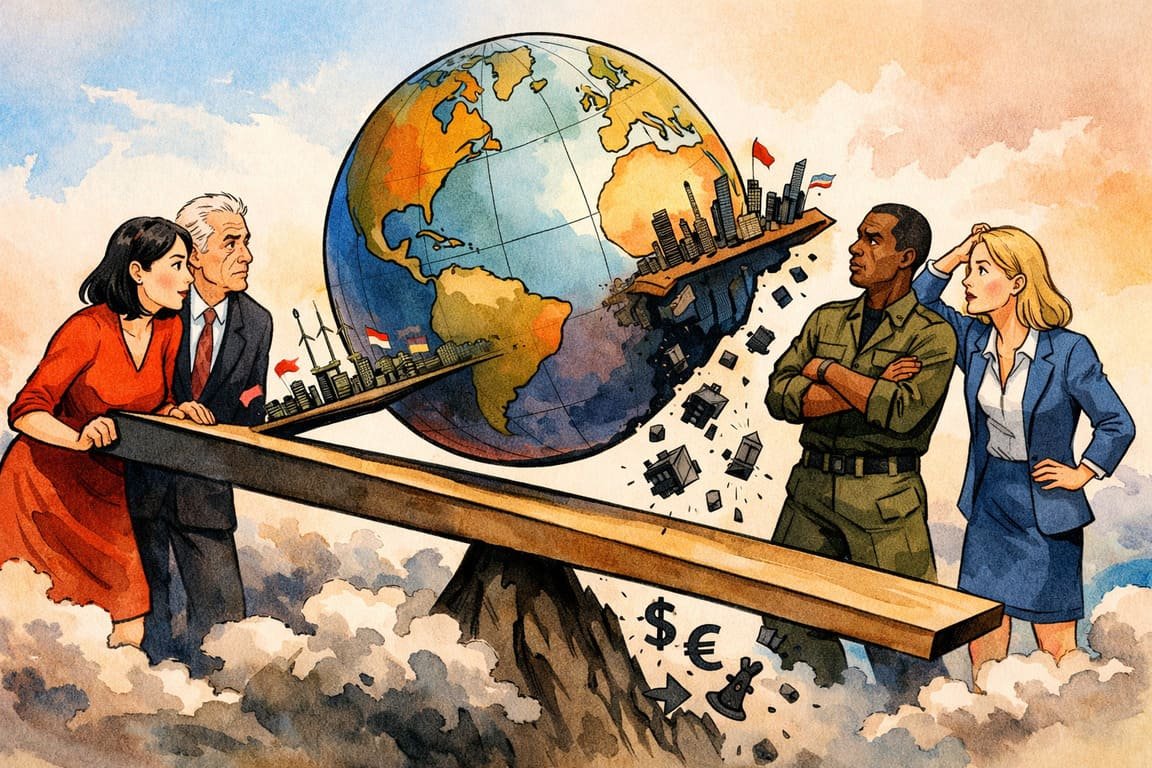
In a softly lit conference hall, nameplates rest where they always have. Some carry the weight of long memory. Others sit with a new confidence that feels almost impatient. The seating chart looks unchanged, yet the atmosphere suggests something quietly irreversible. Influence no longer follows the old choreography. Power is drifting away from the familiar, not through collapse or conquest, but through accumulation elsewhere and inattention at the center.
For much of the modern era, global power felt settled. A small group of nations wrote rules, shaped institutions, and enforced norms. Their dominance rested on economic scale, military reach, and cultural authority. The system was flawed, often exclusionary, yet predictable. Allies understood expectations. Rivals understood limits. That predictability is dissolving. Power still exists. It simply moves through different channels now.
Economic gravity provides the clearest signal. Growth has shifted toward regions once treated as peripheral. Manufacturing, consumption, and innovation spread outward. Middle powers gain influence by becoming essential rather than dominant. They do not announce replacement. They sidestep hierarchy. Trade corridors deepen. Regional partnerships multiply. Influence accumulates without waiting for acknowledgment.
Demographics reinforce the shift. Younger populations cluster outside traditional power centers. Their markets expand. Their political leverage grows. Aging societies struggle to sustain momentum while managing legacy commitments. Labor shortages collide with entitlement systems. Politics turns inward. Power follows vitality. History rarely rewards those running out of time.
Technology accelerates redistribution unevenly. Access matters more than ownership. A small state with digital infrastructure can exert outsized influence. Cyber capability, platform economies, and financial networks compress distance. Physical size loses relevance. Agility gains value. Power begins to resemble a web rather than a ladder.
Institutions reveal the strain openly. Structures built for an earlier balance struggle to reflect present reality. Representation lags. Decision making stalls. Frustration grows among those who feel undercounted. Some create alternatives. Others disengage quietly. Legitimacy weakens not because institutions failed outright, but because they failed to evolve at the pace power demanded.
Traditional powers respond defensively. Decline is framed as theft rather than transition. Rules tighten. Access narrows. Competition becomes threat. Protecting advantage replaces renewing it. Meanwhile, emerging players experiment. They accept risk. They build parallel systems. Innovation flourishes where fear does not dominate strategy.
Culture shifts alongside economics. Narratives once exported confidently now compete with local stories. Influence fragments. Entertainment, language, and values diversify. Soft power becomes contextual rather than universal. What resonates in one region falls flat in another. Authority learns to speak many dialects or fades into irrelevance.
Military strength remains significant, but its role changes. Deterrence still matters. Projection grows costly. Asymmetric tactics complicate superiority. Conflict avoids direct confrontation between giants. Power contests play out through proxies, economics, and information. Victory looks less like triumph and more like endurance.
Alliances adjust under pressure. Loyalty competes with flexibility. Partners hedge commitments. Multipolarity encourages choice. States refuse binary alignment. They extract benefit from multiple relationships. This frustrates leaders accustomed to clear blocs. The world resists tidy camps.
Psychology shapes outcomes as much as structure. Power depends on belief. Societies that assume decline act cautiously. Those that sense momentum behave boldly. Confidence compounds. Complacency erodes. The reordering accelerates not only through material change, but through expectation.
This transition carries risk. Old maps mislead. Familiar assumptions fail. Policymakers trained for a different era misread signals. History warns that such moments invite miscalculation. Power shifts are rarely smooth. They punish rigidity and reward perception.
Yet possibility emerges alongside danger. Diffusion reduces monopoly. More voices shape outcomes. Regional solutions gain legitimacy. Innovation appears from unexpected places. The challenge lies in managing competition without catastrophe. Cooperation becomes harder, and more essential.
In cities once synonymous with authority, lights dim in offices built for command. Elsewhere, new towers rise without ceremony. No announcement marks the transfer. The world simply adjusts. And as power settles into unfamiliar hands without asking permission, one question lingers with unsettling clarity: when influence belongs not to those who inherited it but to those who adapted fastest, who is prepared to release yesterday’s certainty and learn how to lead without the comfort of being central?
