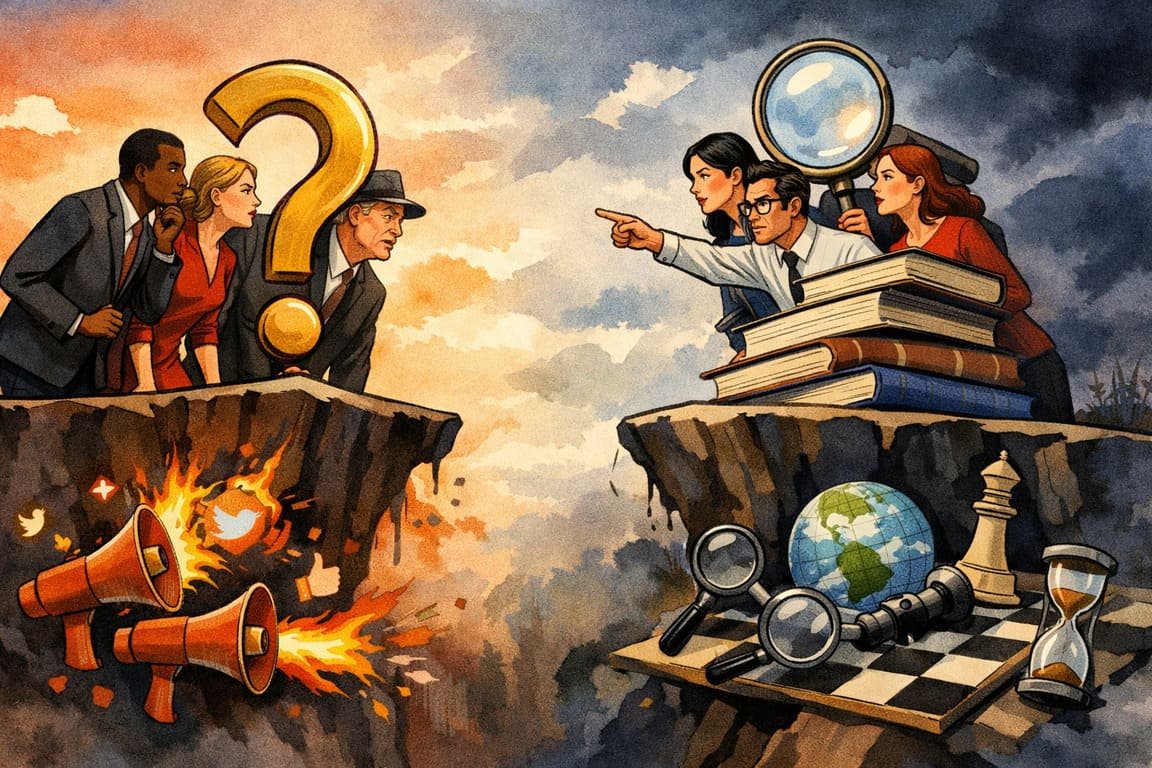
Under bright lights, a debate unfolds with familiar choreography. Voices sharpen. Applause arrives on cue. Screens flash charts, headlines, fragments of evidence. Yet the room responds less to accuracy than to confidence. Certainty outperforms correctness. Facts wait politely while emotion takes the floor. The shift is subtle but unmistakable. Politics no longer revolves around what is true, but around what feels true enough to win.
For much of modern democracy, disagreement still rested on shared reality. Arguments were fierce, but evidence anchored them. That anchor has loosened. Competing narratives now operate in parallel, rarely intersecting. What counts as fact depends on identity, not verification. This is not ignorance alone. It is fragmentation. Information no longer gathers people around common ground. It sorts them into insulated worlds.
Technology accelerated the fracture. Algorithms reward engagement over accuracy. Content that provokes spreads faster than content that explains. Emotion travels instantly. Correction arrives late, if at all. A misleading claim can dominate attention before truth finishes tying its shoes. The architecture of attention quietly trains politics to value speed over substance.
Political actors adapted quickly. Messaging shifted from persuasion to reinforcement. Speaking to everyone lost value. Energizing a base became the objective. Facts complicate that mission. They introduce uncertainty. They invite challenge. Simpler stories travel better. Repetition hardens belief into identity. Questioning it feels personal, even hostile.
Media ecosystems mirror these incentives. Outrage pays. Nuance does not. Commentary outruns reporting. Opinion fills gaps once occupied by verification. This is not sabotage. It is survival economics. Attention funds journalism now, and attention prefers conflict to complexity. The result is a public sphere rich in noise and poor in trust.
Experts feel the consequences acutely. Credentials once commanded authority. Now they trigger suspicion. Expertise is reframed as elitism. Data becomes just another opinion. The irony is brutal. Societies face challenges that demand technical understanding, from public health to climate systems, while confidence in those who study them erodes.
The pandemic exposed the cost vividly. Scientific guidance evolved as evidence accumulated. That evolution was misread as deception. Political certainty rushed in to fill gaps left by honest uncertainty. The public watched disagreement unfold in real time, often without tools to interpret it. Confusion hardened into cynicism. Cynicism hardened into defiance. Facts struggled not because they were wrong, but because they were human.
Identity deepened the divide. Political beliefs fused with culture, morality, and belonging. Changing one’s mind began to feel like betrayal. Facts threatening identity triggered defense rather than reflection. Psychology explains what politics exploits. Reason rarely penetrates when belonging feels at risk.
Institutions designed to arbitrate truth face similar erosion. Courts, universities, statistical agencies, and watchdogs rely on perceived neutrality. Accusations of bias weaken that foundation, whether justified or strategic. When referees are booed by all sides, rules feel optional. Power fills the vacuum.
Facts still matter, but differently. Policies built on false premises eventually fail. Reality asserts itself through consequences. Systems strain. Markets react. Lives are affected. The problem is delay. Damage accumulates long before correction arrives. The gap between error and consequence becomes fertile ground for manipulation.
Some actors exploit that gap deliberately. Short term gain outweighs long term cost. Accountability feels distant. Bold claims today promise relevance. Explanations later feel optional. The electorate grows overwhelmed. Fatigue replaces engagement. Democracy weakens not from indifference alone, but from exhaustion.
Resistance exists, but it is slower. Journalists experiment with depth over speed. Educators teach media literacy. Fact checkers adapt their methods. None of this offers spectacle. Rebuilding trust demands humility and patience. It requires admitting uncertainty without surrendering rigor, and telling truthful stories that resonate emotionally without distorting reality.
The deeper crisis is not factual. It is existential. People search for coherence in a noisy world. When institutions fail to provide meaning, alternatives rush in. Conspiracy fills explanatory gaps. Simplicity soothes anxiety. The challenge is not shouting facts louder, but weaving them into narratives that people are willing to carry.
In a control room filled with silent screens, data streams endlessly, precise and indifferent. Outside, crowds argue, share, and choose. The numbers keep telling their quiet story whether anyone listens or not. And as politics barrels forward powered by belief as much as evidence, one unsettling question refuses to fade: when truth no longer commands attention but only competes for it, what kind of decisions will shape the future, and who will slow down long enough to hear what reality has been saying all along?
