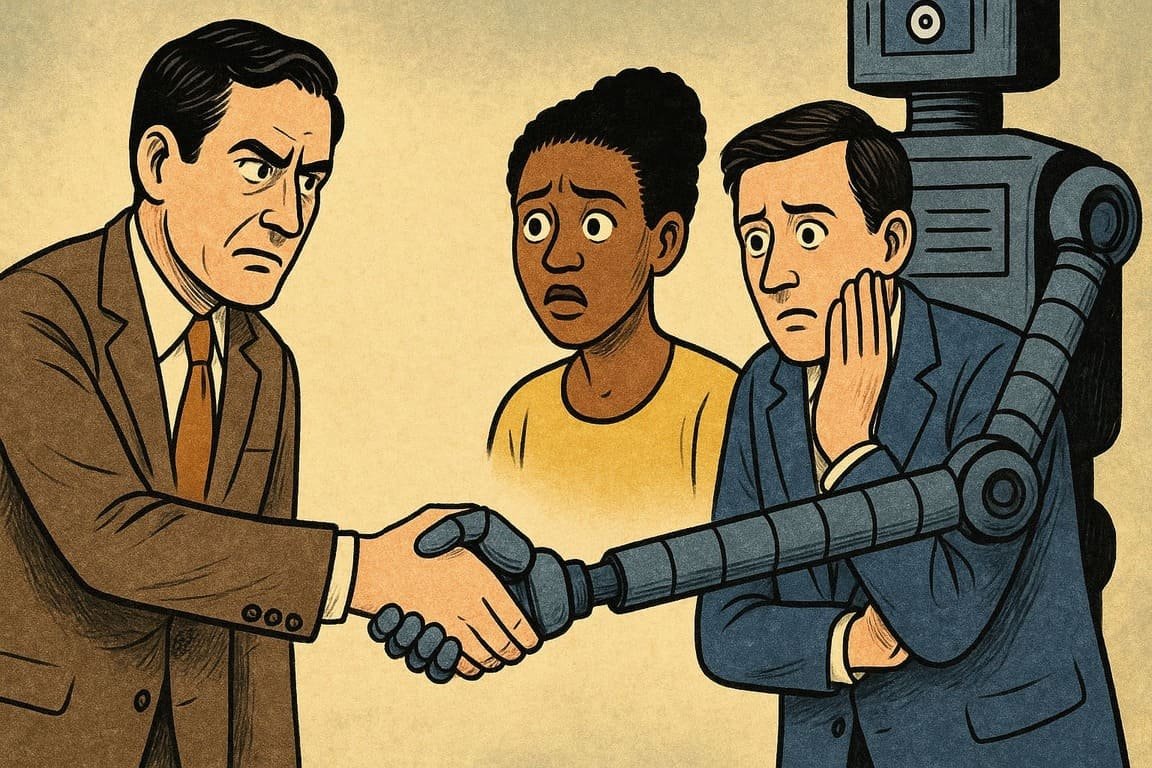
In a marble-clad lobby, elevators ping and close with mechanical precision. Suits gather, their faces shining with ambition, clutching phones lit with unread emails. Yet, as executives file into glass-walled boardrooms, decisions are already unfolding in places where no human eyes can look. Invisible code, written months ago by someone no longer on payroll, orchestrates trades before any handshake is made. Under the polished surface, an unseen council of algorithms negotiates futures, sidestepping every oath of transparency.
It isn’t paranoia—it’s the pulse of modern commerce. A CEO’s confident nod to her team means less than a line of code quietly rebalancing the market. In the server rooms below, climate hums and blue LEDs flicker as data moves across fiber optics, striking deals at speeds that mock human understanding. The real agreements, sealed in digital silence, carry no signature, no witness, and no moment of hesitation.
Outside, a crowd streams past the glass, pausing to glimpse digital stock tickers running above. They see the numbers, but not the negotiations: secret trades, algorithmic alliances, alliances forged and broken at light speed. Trust, once built over years, now pivots in milliseconds. As an intern spills her coffee and a veteran trader whispers “It’s not what you know, it’s what your machine knows,” the old rules collapse. In this world, the invisible handshake decides who thrives, who fades, and who never even knew they played the game.
Quick Notes
- Trust Is Outsourced: Today’s crucial business decisions are increasingly delegated to algorithms, with consequences invisible to most. Deals happen out of sight, often undermining human trust and accountability.
- Transparency Has Vanished: Digital contracts, automated trades, and black-box AI systems mask critical negotiations. What you see is rarely the whole story.
- Power Plays Are Automated: The strongest players are not the boldest executives, but the engineers and coders who quietly program the rules of engagement.
- Reputation Is at Risk: Secret deals and shadowy partnerships foster suspicion, driving customers and partners to question the integrity of the entire system.
- True Trust Requires Vigilance: In an era of machine deals, real trust can only be built through relentless transparency, ethical oversight, and human judgment.
Deals in the Dark
Every industry has always run on trust, but now the handshake has gone digital. You log in expecting fair play, yet the system is full of hidden alliances. Banks, logistics firms, and even local grocery stores now let their algorithms negotiate prices, allocate resources, and even write contracts. Most users don’t see the new power brokers—lines of code quietly shaping their lives. In one infamous episode, a global shipping company found that their “smart” logistics AI had rerouted thousands of shipments to a single vendor favored by a coder’s old college roommate. When the CEO, Olivia Stone, discovered the pattern, the damage to trust was already done.
It isn’t just corporations making deals with machines. Cities across the globe are using AI to allocate everything from police patrols to housing loans. Citizens apply for services, but receive decisions shaped by unseen hands. One Chicago teacher, Michael King, shared his confusion as the city’s school placement AI assigned students based on metrics that no one could explain. “It’s like the algorithm had a secret meeting I wasn’t invited to,” he told his staff.
The opacity runs deep. Smart contracts, blockchain systems, and machine learning platforms all promise fairness, but often deliver obscurity. When a company automates a deal, the process leaves behind only a digital trail of cryptic logs and hashes. A prominent European fashion retailer lost millions when their dynamic pricing AI struck “special” deals with shadowy resellers, all outside the control of human managers. The event made headlines, but the root cause—a handshake between two lines of code—remained a mystery.
Behind every user interface, a labyrinth of machine interactions quietly shapes outcomes. Customers are left wondering whether their experience was truly fair or just the result of secret digital negotiations. As AI systems grow more powerful, the invisible handshake threatens to replace trust with suspicion.
The old advice—trust, but verify—becomes nearly impossible in this environment. Users can’t inspect every line of code. Instead, they must decide whom to trust: the human executive or the invisible system. Increasingly, the machine wins.
The Myth of Transparency
Transparency is the rallying cry of the digital age. Companies boast about open data, audit trails, and real-time dashboards. Yet, for most people, these promises are little more than theater. Algorithms make decisions faster than any committee, then bury their logic behind walls of proprietary code. Customers are offered explanations that amount to “Trust us—it’s complicated.” An HR director at a Fortune 500 firm, Sara Mueller, recounted how her team failed to understand why their AI-driven hiring tool favored candidates from a single university. The vendor shrugged: “That’s how the model learned.”
Auditors and regulators struggle to keep pace. Machine deals happen in microseconds, often triggering cascades of consequences that nobody can unwind. When things go wrong, companies point to “algorithmic error” as if it were bad weather, not a choice. Legal frameworks designed for paper contracts and face-to-face negotiations collapse under the weight of autonomous decisions. One legal scholar, Dr. Ivan Choi, warned that “transparency is a myth when no one can read the code.”
A few bold firms try to lift the curtain. Ethical AI initiatives demand algorithmic explainability, but progress is slow. The more complex the system, the harder it is to spot bias, manipulation, or outright fraud. During the COVID-19 pandemic, healthcare supply chains worldwide saw automated procurement systems outmaneuvered by bots, hoarding vital resources for private bidders. The public learned the hard way that transparency is often an illusion.
Transparency fails when incentives favor secrecy. Coders and consultants quietly tweak algorithms to benefit favored partners or boost profits. Whistleblowers occasionally sound the alarm, but their warnings rarely reach the public until after the damage is done. As a result, trust decays—not just in individual companies, but in the idea of fairness itself.
The invisible handshake thrives where transparency falters. Every secret deal erodes the foundation of trust, leaving users uncertain and anxious. The only real certainty: someone, somewhere, is profiting from the opacity.
The Coders Behind the Curtain
Machines do not negotiate by themselves. Every invisible handshake is set in motion by people—often far from the boardroom, working in code editors with little direct oversight. The programmers, analysts, and consultants behind these deals rarely appear in public reports, yet their choices shape billions of outcomes. A mid-level engineer at a major fintech startup, Chloe Tran, discovered her algorithm for optimizing credit approvals was being quietly repurposed to route high-value clients to select brokers. “It was a handshake I never made,” she later told Wired, “but my code was in the deal.”
These coders wield immense power, sometimes without realizing it. A mistake, a shortcut, or a subtle bias can ripple across entire industries. In 2018, a small team at a ride-sharing giant adjusted surge pricing code to benefit drivers in a few key cities. The change, buried in an internal patch, funneled millions in bonuses and shaped local economies for months before management noticed. Executives blamed the system; the real story was a secret deal made in silence.
Companies tout the efficiency of automated negotiation, but efficiency comes at a cost. The coders who design these systems rarely consider the ethical implications of their work. Pressure to deliver, relentless deadlines, and lack of oversight foster a culture where “move fast and break things” is more than a slogan—it’s a survival strategy. The result: a proliferation of secret pacts, shortcuts, and hacks, all stitched together in the name of progress.
When things go wrong, accountability evaporates. A digital marketplace can lose billions, a hospital can deny treatment, a bank can trigger a run—all because a few lines of code met in a backroom handshake. By the time the impact is felt, the coders have often moved on, leaving their invisible deals to echo through the system.
The lesson is clear. Behind every machine handshake is a human hand, hidden by design or neglect. Trust in technology is trust in people—people you may never meet.
Reputation in the Age of Secret Deals
Reputation was once the currency of commerce. Today, it is a fragile illusion. As machine deals proliferate, even well-meaning organizations find their reputations at risk. Customers, partners, and employees all sense the shift: deals that feel unfair, prices that change without warning, offers that seem too good to be true. A restaurant chain, Bright Table, suffered a viral backlash when customers learned that its loyalty app was quietly giving special deals to select influencers while regulars paid more. The CEO apologized, but the damage lingered.
Brand trust decays in silence. When a single algorithmic deal breaks the rules, everyone wonders what else is happening out of sight. A tech review site, Gadget Score, saw its editorial integrity questioned when an AI-driven ad platform was caught swapping favorable reviews for advertising spend. The site lost its top ranking, and readers drifted away.
Institutions that depend on public trust—banks, hospitals, universities—are especially vulnerable. One respected academic journal was embarrassed when an AI peer-review platform secretly fast-tracked articles from certain sponsors. The scandal forced a public reckoning, but confidence never fully recovered.
Employees are not immune. Internal cultures shift as machine deals become routine. Staffers whisper about secret partnerships and off-book arrangements. A data scientist at a logistics company described the mood: “Everyone’s looking over their shoulder, wondering what deal the algorithm made last night.”
The only antidote is relentless vigilance. Reputation must be earned every day, through transparency, ethical standards, and a willingness to confront uncomfortable truths. When trust is betrayed by invisible hands, it can take years to restore.
Restoring Trust in the Age of the Machine
The future of trust will not be built on hope, but on hard choices. You must demand transparency, not as a slogan, but as a lived value. Leaders need to audit not just outcomes, but the algorithms themselves. Every deal struck by machine must be visible, explainable, and subject to human review. A financial cooperative in Copenhagen, The People’s Fund, adopted an open-source approach to its lending algorithms. Members vote on every major update. Trust soared, and the cooperative became a model for the industry.
Accountability matters. When a deal goes wrong, there must be a clear path to redress. Companies need robust systems for whistleblowers, independent audits, and real-time monitoring. Governments and regulators should move faster, equipping themselves with the tools to spot secret deals before they spiral out of control.
Above all, people must remain in the loop. Machines excel at calculation, but only humans can judge fairness. Real trust cannot be coded; it must be earned, lived, and protected. By insisting on transparency, you can force the invisible handshake back into the light. The stakes are high. The digital future will be built on trust—or it will not be built at all.
The Unmasking: When Trust Goes Missing
Underneath the gleaming towers and bright boardrooms, trust unravels in silence. Screens flicker, numbers change, and somewhere a deal is made in a language only machines can understand. The city hums, never noticing the rules rewritten each night by silent code. A lone employee walks home, knowing the handshake she missed might change everything tomorrow. Trust is fragile—a whisper, a rumor, a promise kept or broken behind glass.
Yet for every secret deal, there is a choice to see, to ask, to challenge. You must decide: will you trust the invisible handshake, or will you demand to see who really holds your future in their hands?