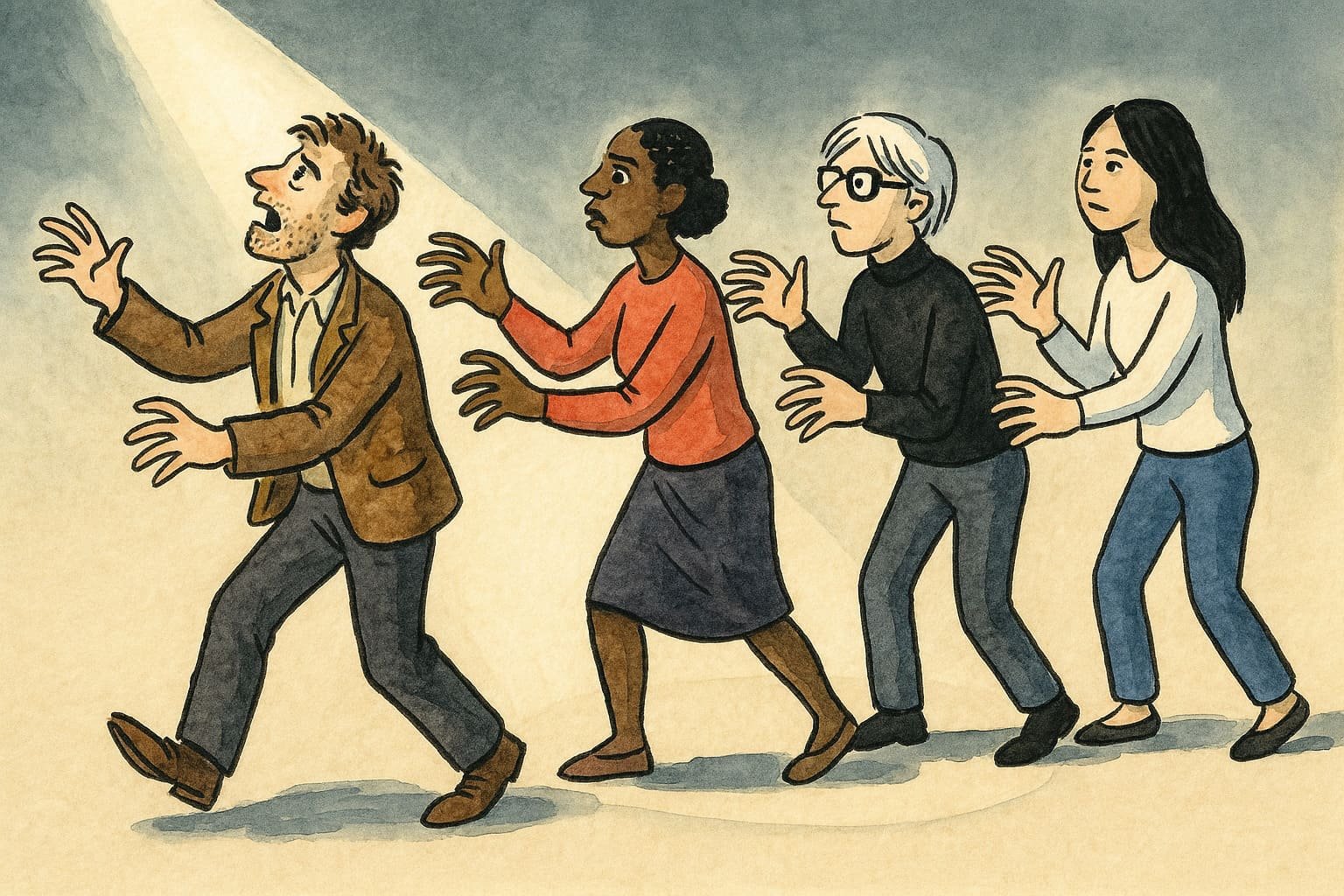
A monsoon of screens pulses through an endless midnight city. Billboards scream the same slogans in different fonts, neon lights buzz with tired energy, and a hundred TikTok dances spin in sync behind glass. The echo of a viral catchphrase drifts across crowded sidewalks where everyone moves together, phones raised like shields against the silence. Behind the laughter, a strange emptiness hums; the feeling you get when every flavor in the world starts to taste the same, no matter how wild the packaging looks.
In a corporate skyscraper’s mirrored lobby, a dozen executives file into a conference room. Each wears the same blue blazer, eyes darting to the boss for clues about today’s “authenticity strategy.” A junior staffer fidgets, clutching her sketchbook; her idea was dismissed last week as “off-brand,” replaced by a safer template borrowed from a trend report. Down the street, a café owner flips through Instagram, trying to guess which coffee art will trend next. The copy-paste rhythm runs deeper than marketing: classrooms grade creativity by how closely it mirrors the teacher’s own mind, musicians remix samples in infinite loops, even activists coordinate their outrage in carefully hashtagged swarms.
Somewhere in that noise, a voice tries to whisper something real. Most days, it gets drowned out by algorithms programmed to reward sameness with the pure dopamine rush of more likes, faster clicks, and safer bets. The world’s brightest minds gather at innovation summits to talk disruption, but their slide decks are identical. No one remembers who said what first.
The spirit of originality once sparked movements, rewrote rules, and built legends. Now it fights to survive beneath the tidal wave of mimicry where being “inspired” is an excuse and copying is the new confession booth. This is the crisis at the core of today’s culture: not a lack of talent, not a shortage of technology, but a vanishing courage to be different. As the curtain rises on this era, the stakes become clear. Whoever dares to break the script may shape the world that follows.
Quick Notes
- Originality in Chains: Today’s culture rewards mimicry over originality, stifling creativity in business, art, and even activism. Everyone claims to want new ideas, but those who actually dare to bring them risk exile or ridicule.
- Copycat Currency: Imitation drives profit in tech, fashion, media, and startups, creating an endless loop where even innovation is recycled. The viral “template” becomes the law; daring to break it is punished by algorithms and gatekeepers.
- Human Cost of Cloning: The pressure to conform destroys self-worth and mental health, leading to burnout, identity crises, and an epidemic of impostor syndrome. People become caricatures of their potential, haunted by the feeling that nothing they do is truly their own.
- Case Studies of Rebellion: Stories from Apple, Kanye West, and small indie brands show the immense risk and reward of fighting copycat culture. Some win loyalty and reshape markets; others are swallowed by the mob and erased from memory.
- The Way Back to Spirit: Rediscovering originality requires vulnerability, risk, and a willingness to lose. The only way to break the cycle is to remember that true legacy is never built by blending in; it’s earned by leaving a mark no one else can duplicate.
The Cloning Effect – When Copy Beats Creator
Step into any startup incubator, and you’ll notice a peculiar sameness cloaked in the language of disruption. Rows of young founders pitch nearly identical apps, each promising to “revolutionize” something mundane. Slide decks swap out colors and icons, but the structure remains: inspiration drawn from the latest Silicon Valley darling. The myth of innovation is everywhere, but true originality feels nearly extinct.
The fashion world knows this cycle intimately. Designers spend months crafting a look, only for fast-fashion giants to unleash near-replicas within days. What was once shocking becomes generic by the weekend. Hedi Slimane’s trailblazing silhouettes are copied in street markets from Seoul to São Paulo. The thrill of the new evaporates in the heat of relentless imitation.
Pop music offers no refuge. Algorithms decide what will be a hit by churning out songs in familiar structures. Melodies echo past chart-toppers, lyrics lean on catchphrases mined from social media trends. Fans clamor for fresh voices, but the machine delivers safe echoes, pushing genuine originality to the edges of the mainstream.
Social media magnifies this loop. Viral dance moves, challenges, and memes are repackaged, reposted, and recycled at light speed. Platforms reward those who follow the herd, not those who wander off-script. Original content risks obscurity; copycats rake in millions of followers.
A former Google product manager, Michael Sayman, once described pitching an original app idea to a panel of investors, only to be told it was “too different.” Months later, a less daring, safer version—shamelessly derivative—earned massive funding and headlines. The message was clear: innovation pays lip service to originality but invests in what’s already been proven.
Algorithm Anxiety – How Machines Train the Copycat Mind
Modern life runs on algorithms, and those algorithms have learned to optimize for the familiar. Your feed shows you more of what you already like, your search results echo back what’s already popular, and recommendation engines push the tried-and-tested above all else. Over time, this turns personal taste into a carefully curated echo chamber.
Entertainment companies design stories for virality, using data to analyze plot points that guarantee binge-worthy content. Streaming platforms commission sequels, prequels, and reboots instead of taking chances on untested ideas. As a result, original voices like those from Barry Jenkins or Greta Gerwig become rare exceptions. Even they feel the pressure to conform, forced to negotiate between artistic vision and commercial viability.
The psychological toll is enormous. A study by the World Economic Forum showed that Gen Z and millennials feel overwhelming pressure to fit in, both online and off. The need for social approval means fewer people risk standing out. Instead, they adopt trends, mask their quirks, and anxiously scan for cues about what’s “cool.” The result: a mass identity crisis hiding beneath the surface of influencer culture.
YouTube creator Marques Brownlee, known for his deep dives into tech reviews, once revealed how even he feels compelled to chase viral trends to satisfy algorithms. Stray too far from the script, and the views vanish. Stray too close, and the brand risks becoming a parody of itself. It’s a paradox; originality is celebrated in words but punished in practice.
A small indie bookstore in Brooklyn, “Books Are Magic,” tried to break the mold by hosting only offbeat, debut authors for a year. The result? The store built a cult following among readers desperate for something real, but traditional publishers warned the owners they risked alienating mainstream customers. The experiment underscored a harsh truth: bucking the copycat system takes guts and often a willingness to accept short-term losses for the sake of soul.
Stolen Fire – The Hidden Cost of Imitation
Creativity, once seen as a sacred gift, is now commoditized at scale. Corporate workshops sell “innovation in a box,” promising instant genius by following step-by-step blueprints. Schools reward perfect imitation over genuine thought. Even entrepreneurship has turned formulaic, with startup playbooks peddled as magic recipes for success.
The cost? Human spirit wilts in environments where difference is penalized. Employees at major consulting firms whisper about “career suicide” if they push too many unconventional ideas. Musicians like Lorde, who soared with a unique debut, struggle to avoid being pigeonholed into the sound that made them famous. Brands that once stood for originality; think Ben & Jerry’s or Innocent Drinks eventually succumb to the sameness demanded by global expansion.
Impostor syndrome thrives in this climate. Workers, creators, and students question whether any of their achievements are truly theirs or simply borrowed brilliance. A fashion designer in Lagos shared how seeing knockoffs of her designs sold on Instagram left her doubting her own worth. The theft stings, but the real damage comes from the creeping suspicion that uniqueness isn’t valued at all.
Burnout follows. Constantly chasing the “next big thing” in a world that only rewards proven formulas drains the psyche. Mental health clinics now treat young adults whose sense of identity has crumbled under the weight of copycat pressure. The demand to blend in has never been higher, even as the cost grows unbearable.
There are glimmers of hope. Pixar’s “Soul” tells a story about rediscovering purpose beyond surface success, resonating with millions who feel adrift in a culture of performance. That film became a touchstone for creators yearning to be more than cogs in a machine. For a moment, the audience saw itself and its own lost spirit reflected on the big screen.
Outlaws of Originality – Case Studies in Rebellion
Despite the dominance of copycat culture, rebels still walk among us. Apple’s 1997 “Think Different” campaign didn’t just sell computers; it sparked a global conversation about what it means to break the mold. Steve Jobs risked the company’s survival on designs that bucked market norms, betting that people craved uniqueness more than conformity. The gamble didn’t just pay off, it changed the way the world thinks about creativity.
Kanye West, for all his controversy, built a brand on relentless innovation. The Yeezy sneaker line; once ridiculed for its audacity redefined the fashion industry. West’s journey, filled with missteps and backlash, remains proof that the market sometimes rewards those who risk everything on the altar of originality.
But not all stories end in triumph. Kodak clung to film in the digital age, unable to escape the comfort of old templates. Blockbuster ignored Netflix, failing to see that true disruption never comes from copying. The lesson is stark: in a world obsessed with sameness, those who hesitate are left behind.
Small brands have their moments, too. Glossier exploded by letting customers co-create the brand’s aesthetic, fostering a wild sense of ownership and creativity. When competitors tried to mimic the formula, the magic fizzled. The original spark could not be reverse-engineered.
These stories teach that rebellion is risky, costly, and sometimes lonely. But it’s also the only way to build something that matters. When everyone copies, only the outlaws make history.
The Road Back – Recovering the Lost Spirit
Escaping the grip of copycat culture begins with unlearning what safety feels like. Every act of originality is, at heart, an act of vulnerability. It means putting something of yourself on display with no guarantee of applause, no template to hide behind. The artist who paints outside the lines, the founder who bets on an unproven idea, the activist who speaks before the crowd is ready; these are the ones who risk it all for meaning.
Companies can change, too. Patagonia built a billion-dollar brand by refusing to chase trends, focusing instead on relentless authenticity and environmental activism. Customers followed not because of clever marketing, but because the spirit behind the brand felt unmistakably real. The lesson: authenticity isn’t a slogan, it’s a practice, and it never scales by copying.
Communities need to reward difference, not just tolerate it. When Google adopted a “20% time” policy allowing employees to pursue passion projects; it unleashed a wave of inventions, from Gmail to Google News. The freedom to fail without fear proved more valuable than any incentive program.
Individuals can reclaim their originality by disconnecting from the endless scroll and tuning into their own curiosity. Comedian Bo Burnham turned personal struggle with social media into a Netflix special, “Inside,” that went viral precisely because it dared to be uncomfortable, strange, and painfully honest. The show’s cult following is a testament to the hunger for something real.
There’s a deeper truth: legacy is never built by playing it safe. The most beloved artists, entrepreneurs, and thinkers all risked being misunderstood, even forgotten, in pursuit of what felt true. If culture is to recover its lost spirit, it will come from those willing to step off the well-trodden path and light a match in the dark.
The Last Original – The Final Mirror
Night falls on the city, and a lone figure lingers by a cracked window above the grid of flickering lights. The hum of copied voices, looping ads, and recycled laughter fades to a hush, almost reverent. The air tastes different now; like rain before a storm, or the scent of new books hidden on an old shelf. A single canvas rests on the desk, blank except for a bold, trembling stroke: evidence of a risk taken, a line no algorithm could have drawn.
Somewhere else, a musician closes his laptop, choosing the guitar over the playlist. A coffee shop owner rearranges the tables just because it feels right, ignoring the “proven” floor plan in a bestselling guide. Across the world, a teacher lets her students finish stories their own way, defying the rubrics. The room fills with surprise, and for a brief moment, you can hear the original spirit breathe.
The legacy of a culture isn’t written by those who blend in, but by those who break ranks and demand more. Originality always costs more than imitation, but it pays in moments that matter; a look, a note, a word, a ripple through the still surface. As long as someone chooses to risk being different, the spirit is never truly lost.
You carry the last match. Are you willing to light it?
Partnered. Provocative. Worth Your Scroll.
This is a Promoted Post by ESYRITE—yes, it’s paid, but never filtered. Our voice stays raw, real, and razor-sharp. We team up with bold ideas, game-changers, and stories that spark something real. If it’s here, it earned its place—no fluff, just impact. We don’t just promote—we provoke. Stay sharp. Dive deeper.
