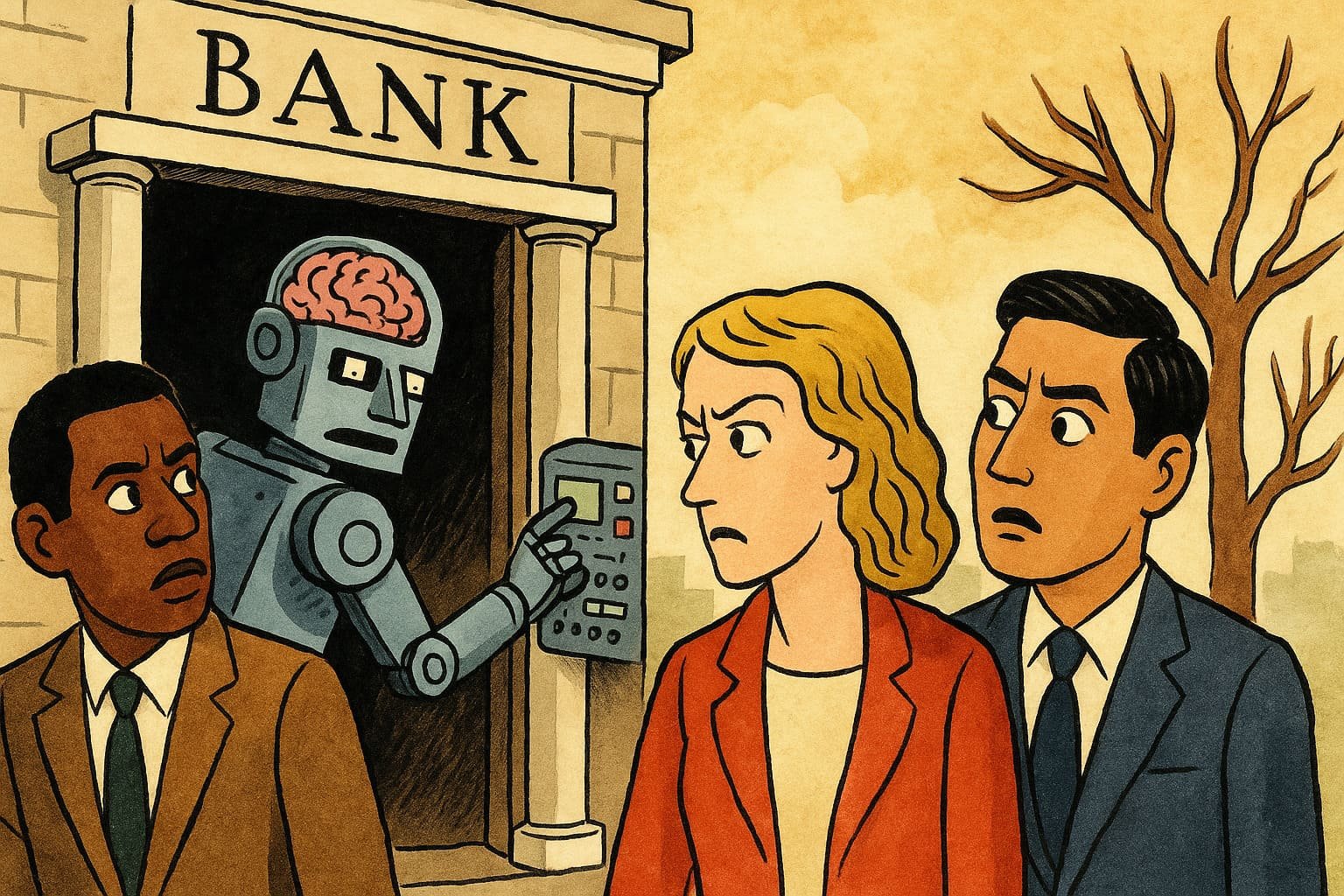
Picture this: you walk into your neighborhood bank, where the marbled floors echo your footsteps and the teller’s smile is warm almost familiar. But beneath the surface of every welcoming gesture and polished promise, an invisible intelligence is quietly orchestrating your every financial move. This isn’t the plot of a futuristic thriller. It’s the reality humming through every transaction you make. The greatest revolution in banking is unfolding in plain sight, yet almost no one dares to talk about it.
Imagine asking your banker who really approves your loan or flags your “unusual” activity at midnight. Watch for that polite, nervous smile. Because the truth is, artificial intelligence has become the real decision-maker, quietly redrawing the map of wealth, trust, and risk in our world. Banks will never tell you that your credit fate, your savings safety, and even your life dreams are being weighed; not by human judgment but by silent, unseen algorithms.
This is the secret story no banker wants in their annual report. It’s a story with everything: high-stakes drama, hidden power, and a philosophical riddle about what it means to be free in a world where code shapes destiny. If you think you’re just a customer, think again. In the coming paragraphs, you’ll step behind the velvet rope to glimpse how the banking world’s “AI whisper” is reshaping not only your money but the very concept of value and agency. And the biggest twist? The revolution isn’t coming. It’s already here, and you’re living in it.
Quick Notes
- Algorithms Have Quietly Become Gatekeepers: AI now decides who gets loans, mortgages, and even jobs, reshaping life chances in ways most people never realize or question.
- Data Is the New Currency of Power: Banks are no longer simply protecting your money; they’re mining your habits, choices, and even emotions to feed ever-hungrier algorithms.
- Risk, Trust, and Bias Are Reprogrammed-Not Erased: AI promises impartiality, but hidden biases and automated risk models can entrench old inequalities in new, inscrutable ways.
- Human Agency Is in Flux: The comforting fiction of human oversight is fading as decisions slip into algorithmic “black boxes,” raising profound questions about accountability and freedom.
- You Are Already a Participant, Not Just a Customer: Whether you know it or not, your every banking interaction trains the next generation of AI, making all of us co-authors of a financial system that is less transparent and more powerful than ever before.
Digital Shadows: How AI Became the Bank’s Silent Brain
Step into any major bank’s headquarters and you won’t see lines of abacus-wielding accountants or stern loan officers with green visors. Instead, you’ll find screens glowing with endless streams of data; purchases, payments, credit scores, all being feasted upon by artificial intelligence. Banks rarely advertise this, but AI now makes the most crucial decisions before a human even blinks. Those warm customer service emails, those risk alerts, and those eerily accurate spending insights? All courtesy of code.
Look at how quickly algorithms now screen for fraud. Once, a seasoned investigator might have noticed a sketchy transaction in Paris after you’d used your card in Nairobi. Now, deep-learning models flag anomalies in milliseconds, analyzing not just locations but the subtlest behavioral patterns. Maria, a single mother in Manila, found her account frozen after an “unusual” late-night transaction. She was bewildered. The bank’s support agent offered little help. It was an AI model trained on billions of global transactions that had decided she was a risk, with no room for her story.
Decision-making isn’t confined to fraud. Your eligibility for a home loan, a new credit card, or even an entry-level banking job is increasingly determined by AI scoring models. Take the case of Jamie, a software engineer in London. After being rejected for a mortgage, Jamie requested an explanation. The response? “You didn’t meet the automated lending criteria.” No appeal to a human manager, no second chances just the cold verdict of a machine.
Behind the scenes, banks fiercely guard these AI models as trade secrets. The logic is proprietary, the reasoning hidden behind layers of “intellectual property” and “regulatory compliance.” As customers, we’re left with little more than faith; faith that the algorithms are fair, that our data is safe, that our humanity still matters.
While banks love to tout AI’s promise of efficiency, cost savings, and precision, they seldom discuss the uncomfortable truth: the more decisions are delegated to AI, the less control and understanding the average person has over their own financial life. The very tools designed to make money management more “intelligent” are quietly shifting the balance of power in ways that go mostly unseen.
Now, the most consequential question is rarely “What does my banker think?” but “What does the algorithm say?” And most people never even realize the game has changed.
Data Alchemy: When Every Click Turns Into Currency
Today, every financial move you make is a golden thread woven into a tapestry of behavioral data. Gone are the days when your bank’s most valuable asset was the money in its vault. Now, your digital footprint; what you buy, when you travel, even the way you type your password is the real treasure. AI thrives on these raw, personal details, converting them into forecasts, risk profiles, and profit opportunities.
Banks have become data miners, digging deep into their customers’ daily lives. A single purchase at a coffee shop, an online subscription, a skipped loan payment; all of it gets fed into algorithms hungry for patterns. Consider Ravi, a small business owner in Nairobi. His application for a credit line was denied not because his business was struggling, but because an AI detected “unusual spending” after a family emergency. The story behind the numbers never made it past the model’s cold logic.
Financial institutions claim that this data-powered intelligence helps protect customers and personalize experiences. Yet personalization can be a double-edged sword. As algorithms grow more sophisticated, they can anticipate your needs before you know them yourself. Special offers, loan upgrades, and investment “advice” arrive with uncanny timing. But who really benefits? The bank, which boosts its bottom line, or the customer, whose choices are subtly nudged by invisible hands?
The boundaries between privacy and profit have become blurred. Banks now have the power to predict divorces, health crises, and even job changes by analyzing your spending habits. What was once confidential is now fair game in the quest for “customer insight.” This isn’t a tinfoil hat scenario; major banks have acknowledged using these predictive tools, often with little transparency or recourse for customers who feel violated.
Ethical questions abound. If an algorithm predicts you’re likely to default on a loan, should the bank proactively cut your credit or increase your rates even if you haven’t missed a single payment? What if a model mistakenly flags you as high-risk, locking you out of opportunities? These aren’t theoretical puzzles; they’re dilemmas playing out every day in the digital trenches of finance.
In a world where data is destiny, every click, swipe, and tap shapes your future in ways you may never see. The idea that you’re just a number in a system? That’s not an insult. It’s the new reality. The most valuable asset banks own isn’t your cash. It’s you.
The Mirage of Impartiality: Bias in the Age of Algorithms
AI promises fairness. No more human prejudice, no more “gut feelings” skewing decisions, just pure, data-driven logic. But the dream of impartiality is a mirage. Algorithms inherit the biases of their creators and the data they’re fed. Even the most sophisticated models can entrench discrimination, locking in historical injustices behind a veneer of objectivity.
Consider the saga of Marcus, an immigrant entrepreneur in Berlin. He applied for a loan to expand his bakery. The rejection felt clinical, impersonal. Later, an industry insider quietly revealed that the algorithm had trained on years of historical data; data reflecting decades of lending patterns that quietly penalized applicants from certain neighborhoods. The AI didn’t see a passionate baker. It saw a “risk profile” built on echoes of old prejudices.
There’s little room for redress. Most customers have no way to challenge or even understand an AI-driven decision. The reasoning is buried in code, explained only as “the system’s requirements.” This opacity is no accident. Banks protect these black boxes as fiercely as any vault. Public scrutiny or appeals threaten not only proprietary models but also the illusion of unassailable logic.
Even regulatory efforts struggle to keep pace. Auditors try to probe AI systems for fairness, but models grow more complex every month, evolving in ways that escape easy oversight. When questioned, banks tout robust “ethical AI” guidelines usually as glossy as their annual reports, and just as vague.
Pop culture often portrays AI as coldly logical, but in finance, the opposite can be true. Algorithms sometimes amplify the worst aspects of human judgment, making them harder to see and challenge. The “machine” that denies your loan or flags your payment is shaped by all-too-human hands only now, there’s no one to look in the eye and demand an explanation.
The dream of algorithmic justice remains just that: a dream. Until we confront the hidden biases in our data and demand real transparency, the promise of AI in banking will be little more than a glossy PR story. For every tale of increased efficiency, there’s a shadow story of quiet exclusion and nobody at the counter to listen.
Vanishing Humans: The Disappearing Face of Accountability
Once upon a time, banking meant relationships. Your local manager knew your name, your story, and maybe even your dog’s favorite treat. Decisions felt human, even if they weren’t always fair. Today, those faces are disappearing, replaced by screens and scripts. Accountability, once embodied by a handshake, has been outsourced to black boxes.
Picture Lillian, a retiree in Toronto, who struggled with a payment glitch that left her utilities unpaid. She called her bank, only to be told the system had “flagged her account for security reasons.” After three hours and five different customer service representatives, no one could explain why. The power that once rested in the hands of people had been handed off to lines of code; lines no one at the call center truly understood.
Human oversight is fast becoming a comforting myth. Executives reassure the public that “people are always in the loop,” but those loops grow wider and looser every year. Decision-makers rely on AI recommendations, often rubber-stamping outcomes they barely comprehend. And when mistakes happen? The blame ricochets between human and machine, vanishing into the digital ether.
Accountability has entered a strange new era. Regulators demand clarity, but banks offer only technical jargon and shifting responsibility. Customers, lost in the labyrinth, rarely find satisfaction. The digital transformation promised convenience, but delivered a new kind of loneliness; one where problems can’t be solved by empathy or even persistence.
Some innovators are fighting back. Startups like Lemonade in insurance or Monzo in banking try to blend AI with radical transparency, showing customers how decisions are made and inviting feedback. It’s a start, but the mainstream remains opaque. For most of us, the reality is simple: we’re no longer negotiating with humans, but with faceless logic.
As the human element fades, so does our ability to hold anyone responsible. We’re left asking: if an algorithm gets it wrong, who fixes it? The answer, for now, is as elusive as a banker’s promise.
Unmasking the Future: Are We Co-Authors or Spectators?
Here’s the paradox: the more AI invisibly shapes banking, the less we feel its presence and the more it shapes us in return. We become not only customers but participants, feeding the system every time we swipe, sign in, or save. The lines between user and product, subject and object, have blurred in ways few predicted.
Think about Maya, a freelance designer in New York, who found herself locked out of her account after traveling abroad. Her efforts to regain access only trained the bank’s AI further, teaching it how “real” fraudsters behave. She was both victim and test subject, caught in a feedback loop of learning and control.
Our collective trust in the financial system now rests on a paradox: the more we rely on technology for security, the less we understand or influence its choices. Algorithms reflect us, learn from us, even anticipate us yet remain just out of reach, like mirrors with minds of their own. The question isn’t whether AI is running our banks. It’s whether we are shaping the AI, or simply being shaped by it.
Philosophers and futurists debate what comes next. Are we witnessing the dawn of truly intelligent finance, or the sunset of human agency? Some, like Daniel Pink, argue that the quest for autonomy, mastery, and purpose will always find a way through. Others warn that unchecked automation leads to a world where empathy and personal connection are crowded out by efficiency.
The reality is less binary and far more complicated. We are co-authors of this new era, whether we admit it or not. Our choices demanding transparency, challenging unfairness, insisting on human judgment can steer the system toward greater justice. Or, by accepting every algorithmic verdict without question, we can let the secret takeover become the new normal.
So the next time you log in to check your balance or apply for a loan, ask yourself: Who’s really in charge? And more important; who should be?
Why Your Money’s Fate Is No Longer Yours Alone
We started this journey in a marble-floored bank, surrounded by human faces and warm handshakes. Now, as the curtain falls, we see a world run by invisible architects; silent, tireless, and all-seeing. Banks will never tell you just how deeply AI runs the show, how thoroughly your fate has been woven into its secret circuits. But that silence is the greatest alarm of all.
This isn’t the dystopian nightmare of Hollywood, nor the utopian fantasy of Silicon Valley. It’s the new ordinary. Every day, you are both the subject and the source of the banking system’s intelligence. The real revolution isn’t the technology itself; it’s the shift in who, or what, holds the reins of trust and control.
Your story, your data, your power; they all matter more than ever. But only if you choose to see the game for what it is, to demand answers, to challenge the silent takeover. Because in a world where the algorithm is king, the most rebellious act is to insist on being seen, heard, and truly understood.
So next time you find yourself facing the cool logic of an “automated decision,” remember: the bank may never tell you, but you already hold the secret. The future isn’t written in code alone. It’s written by those bold enough to ask who’s really running the show and wise enough to rewrite the rules. Are you ready to take your seat at the table, or will you let the silent puppeteer pull the strings for you?
Partnered. Provocative. Worth Your Scroll.
This is a Promoted Post by ESYRITE—yes, it’s paid, but never filtered. Our voice stays raw, real, and razor-sharp. We team up with bold ideas, game-changers, and stories that spark something real. If it’s here, it earned its place—no fluff, just impact. We don’t just promote—we provoke. Stay sharp. Dive deeper.
