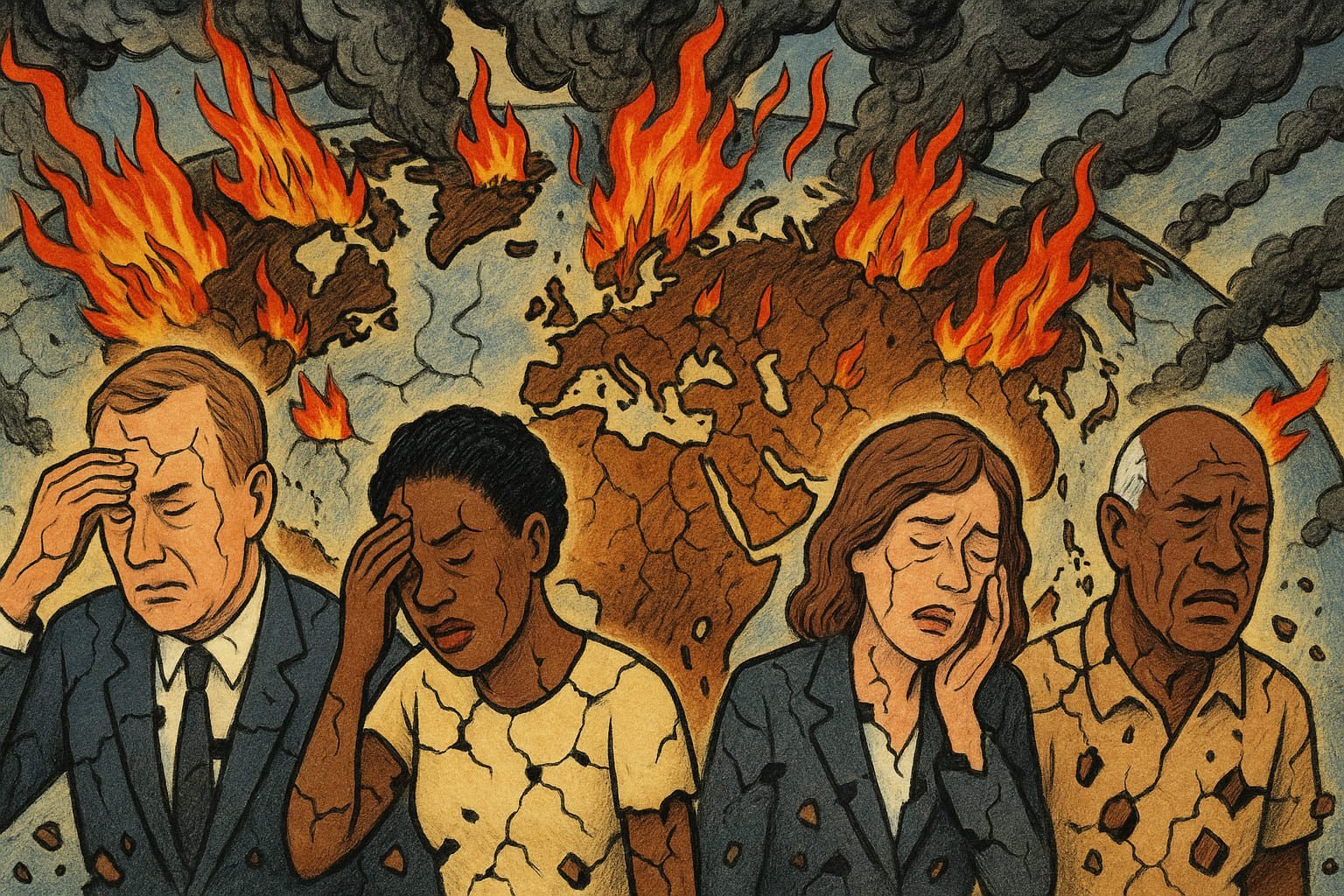
Picture this: A world where every morning feels like the aftermath of a storm. Not just a downpour, but a total power-out, trees-down, neighbors-on-the-street kind of tempest. Leadership once stood as the lighthouse in such gales, but now that light flickers. People glance at their screens and see presidents panic, parliaments fracture, and crowds screaming for change or running for cover. Every social feed drips with anxiety, every headline hints at collapse. Is this how civilizations break, not with a bang, but a million exhausted sighs?
Behind the chaos lies something more profound; a global unraveling where the scaffolding of trust, authority, and hope splinters on both sides. Politicians make grand promises and crumble under pressure, while ordinary people trade optimism for outrage or apathy. Power no longer feels sturdy. It seems brittle, like thin glass. Citizens who once believed they could steer the ship now watch, white-knuckled, as the wheel spins wildly. From massive protests to silent, simmering discontent, humanity teeters on the edge. But chaos, paradoxically, often opens the door to transformation. Every unraveling is a chance to weave something stronger, if only we’re brave enough to face the real reasons why both leaders and followers are losing their grip.
What follows isn’t another doomsday dirge. This is the anatomy of collapse; diagnosis, confession, and blueprint. We’ll slice through today’s crisis of leadership and citizenship, blend in the lessons from real-world case studies, and dare to imagine how a broken world might rediscover its heart. If you’re ready for uncomfortable truths, hard questions, and the audacity to hope in the darkest hour, strap up. The storm has just begun but so has the reckoning.
Quick Notes
- Leadership Meltdown: Political authority is unraveling as leaders lose public trust, fumble crises, and get trapped by their own narratives. Real-life breakdowns; from tech billionaires to elected heads prove no one is immune to modern pressures.
- Citizen Disarray: Ordinary people are more anxious, divided, and cynical than ever. Social movements spark hope, but mass apathy and misinformation stall real progress.
- Institutions in Freefall: Structures designed to provide stability; governments, courts, even the media, now look fragile and sometimes complicit in fueling the chaos.
- Case Studies of Collapse: From Brazil’s polarized elections to Sri Lanka’s economic implosion, real stories show how fast order unravels when both leaders and citizens lose their moorings.
- Rebuilding the Social Contract: Out of crisis comes the opportunity for a new kind of leadership and citizenship; one rooted in humility, shared sacrifice, and a willingness to rebuild trust, one act at a time.
The High-Stakes Game of Political Freefall
Power has always come with peril, but in today’s world, the margin for error is razor-thin. Modern leaders must perform on a stage lit by 24/7 media, where every stumble is instantly viral. The fall of Boris Johnson in Britain or the chaos surrounding American elections are not just stories about individuals; they are seismic warnings about the brittleness of current authority. Once, a leader’s private doubts stayed behind closed doors; now, even a nervous cough trends worldwide.
Pressure mounts from all sides. One moment, leaders face public adoration; the next, they are targets of digital mobs who organize faster than any press office can respond. Remember when Angela Merkel guided Germany through years of storms? Even she, the so-called “Iron Chancellor,” eventually bowed out exhausted by the weight of relentless expectation. That exhaustion is now contagious, spreading to heads of state, mayors, CEOs, and activists alike.
The chaos extends to corporate titans. Elon Musk, for example, went from revered innovator to divisive figurehead, trapped in a relentless cycle of tweets and backlash. It’s not just politicians at risk; everyone who claims the mantle of leadership is now expected to fix systemic problems with a flick of the wrist, while critics circle like sharks. The cult of personality that once propped up the powerful has mutated, amplifying their every misstep.
Leaders themselves confess to feeling isolated. A confidential conversation with a European prime minister (shared off-the-record at Davos) revealed a deep fear: “We are making it up as we go, hoping the public never finds out.” It’s not just humility, but genuine bewilderment. People at the top are human too, but the world rarely forgives mistakes or confusion anymore.
Underneath the spectacle, a deeper crisis simmers: authority no longer flows from competence or vision, but from survival. To stay afloat, many leaders pander, posture, and promise the impossible. This downward spiral of credibility infects the entire system, poisoning the very soil from which future leaders must emerge.
The Shattered Faith of the Ordinary Citizen
Once upon a time, voting felt like a small but sacred act. Now, it’s more like flipping a coin in a rigged casino. Citizens everywhere feel the ground shift beneath their feet, unsure whether their voices matter. In France, the yellow vest movement showed how quickly frustration morphs into street protests. Elsewhere, apathy blooms. Millions opt out of elections, choosing Netflix over the ballot box, convinced nothing will really change.
Daily life now comes with a low thrum of anxiety. Conversations around kitchen tables drift toward “What’s the point?” or “They’re all the same.” The pandemic turbocharged this malaise. One American nurse, burned out by endless shifts and government flip-flopping, admitted she stopped listening to official briefings altogether. When citizens stop caring, democracy slides toward decay.
Misinformation acts as a corrosive force. Fake news is no longer a joke; it’s an existential threat. In Brazil, WhatsApp rumors fueled chaos during elections, leaving voters confused and angry. Many people fall prey to wild conspiracies because the truth feels slippery, tangled in layers of half-facts and media spin. Fact-checkers race against a tidal wave of viral nonsense, but trust keeps sinking.
Social media promised connection but delivered division. Instead of lively debate, there’s often just shouting or echo chambers. People are quick to cancel, slow to listen, and quick to judge. The world feels smaller and scarier when every disagreement spirals into culture war. This isn’t the healthy skepticism that keeps democracy honest; it’s cynicism, pure and paralyzing.
But hope isn’t entirely dead. From climate marches in Sweden to pro-democracy rallies in Hong Kong, citizens have shown that collective action still matters. These moments flicker like candles in a storm. The problem is sustaining them. For every Greta Thunberg or Joshua Wong, millions remain silent, locked in private frustration or distracted by daily survival.
When Institutions Collapse, Everything Shakes
Institutions once promised stability. Today, they inspire as much suspicion as confidence. Courts, parliaments, and regulatory agencies frequently look overwhelmed or outright compromised. In the United States, the Supreme Court’s perceived partisanship has fueled distrust across generations. In Eastern Europe, anti-corruption bodies are often accused of being pawns in larger political games.
Media, once the watchdog of power, faces its own crisis. Fake news, clickbait, and declining public trust have left traditional outlets scrambling. Even respected organizations like the BBC or New York Times find themselves under siege from both ends of the ideological spectrum. Meanwhile, social media platforms are criticized for everything from stoking violence to silencing dissent, with no clear solution in sight.
The economic safety nets meant to protect citizens now feel threadbare. In Sri Lanka, the collapse of government institutions sparked a humanitarian disaster. Banks shuttered, shelves emptied, and people took to the streets in despair. The lesson is brutal: when institutions break, the pain is felt first and worst by the powerless.
Consider the case of Zimbabwe’s once-mighty currency. Hyperinflation gutted savings, and years of misrule left ordinary citizens scrambling to barter for basics. The courts were unable to defend property rights, and schools fell apart. Trust, once broken, is not easily repaired. It takes years to build up the slow drip of confidence then only days to wash it away in a flood of bad decisions.
Philosophers like Hannah Arendt warned about the “banality of evil”; the quiet collapse of moral standards when institutions fail. Today, the banality of chaos feels just as dangerous. People adjust to dysfunction, making the abnormal seem normal. The challenge is to resist this slide, to demand more from the systems that claim to serve us.
The Anatomy of Collapse: Lessons from Real-World Meltdowns
History doesn’t just repeat; it reinvents its tragedies with modern twists. Brazil’s presidential elections were a masterclass in polarization. Rival camps weaponized social media, rumors supplanted policy, and violence simmered on the streets. Even after the votes were counted, legitimacy remained in question. Citizens watched, anxious and divided, as their nation’s fate hung in the balance.
Sri Lanka’s financial meltdown was another case study in cascading chaos. Years of mismanagement culminated in mass protests, government resignations, and empty shelves in supermarkets. Neighbors banded together to survive, trading food and favors when formal systems failed. The resilience of communities offered a flicker of hope, but the scars will last for generations.
In the corporate world, Facebook’s ongoing scandals reveal a different kind of collapse. A company that once promised to connect the world became a byword for data abuse and political manipulation. Whistleblowers spoke out, but institutional inertia kept problems festering. Employees confessed privately that the culture of “move fast and break things” had, in the end, broken something essential: trust.
Hong Kong’s pro-democracy movement demonstrated both the courage and fragility of collective action. People filled the streets, risking arrest for a taste of real freedom. The world watched as a city fought for its soul, only to see hopes dashed by relentless crackdowns. Still, the memory lingers, a testament to how quickly the line between stability and chaos can blur.
Pop culture isn’t immune. Look at the wave of dystopian movies and shows like “The Handmaid’s Tale” or “Black Mirror” which echo the anxieties of a generation. Artists reflect what institutions and leaders try to hide: that beneath the glittering surface, society is rattling itself apart. If nothing changes, these stories may soon seem less like fiction and more like instruction manuals.
How to Rebuild: Toward a New Kind of Leadership and Citizenship
Collapse isn’t the end. Sometimes, it’s the only way to force a reckoning. In every crisis, there’s a chance to begin again, armed with lessons learned in pain. For leaders, the future lies in humility, not hubris. The best modern leaders like the former Prime Minister of New Zealand Jacinda Ardern show vulnerability, admit mistakes, and invite citizens to participate in rebuilding. Leadership must become less about power and more about stewardship.
For citizens, the challenge is to rediscover agency. It starts with small acts; joining local initiatives, helping neighbors, or simply refusing to share that sensational fake story online. Communities that survived economic or political collapse did so by fostering trust at the most basic level. The path back to stability is paved by a thousand ordinary acts of courage.
Institutions must evolve or perish. The most resilient societies are those that can self-correct, adapt, and invite criticism. From South Korea’s rapid COVID-19 response to Germany’s post-war reconstruction, history is full of examples where openness to change made all the difference. Reform isn’t glamorous, but it’s the daily work of democracy.
Real-world transformation begins with honest conversation. One city mayor in Italy, facing post-pandemic malaise, invited local artists, business owners, and activists to literally redraw the city’s future on a wall-sized map. The result wasn’t perfect, but it started a wave of small, meaningful changes. The lesson: leadership and citizenship thrive on participation, not passivity.
None of this is easy. Fear, cynicism, and anger remain powerful forces. But hope is stubborn. People have rebuilt from ruins before, and will again. The question is not whether chaos can be overcome, but whether we will find the courage to do so together, step by imperfect step.
Finding Strength in the Rubble
Every generation faces its storm. Ours just happens to be global, televised, and personal. As the dust swirls and old certainties fade, the temptation is to look for villains or scapegoats. But the truth is more complicated, and more hopeful. Collapse hurts, but it also reveals what truly matters. Power that crumbles reveals the need for empathy. Citizens who despair find solidarity in shared struggle. Institutions that fail force innovation and grit.
Transformation rarely begins with triumph. It starts in the ashes with people who choose, quietly but stubbornly, to believe things can change. Maybe you’re one of them. Maybe you’ve watched the news and felt the ache of helplessness, then gone out and helped someone anyway. That’s how new contracts are forged; not on marble floors, but in daily life.
Chaos is both the fire and the forge. The world is crumbling, yes. But every ending plants seeds. The real heroes aren’t waiting for perfect leaders or magic bullets. They’re already building, connecting, and dreaming on the edges of ruin. So ask yourself: In a world that seems to be falling apart, what part will you play in putting it back together?
The storm won’t last forever. But what comes after depends on us. Are you ready to help write the next chapter?
Partnered. Provocative. Worth Your Scroll.
This is a Promoted Post by ESYRITE—yes, it’s paid, but never filtered. Our voice stays raw, real, and razor-sharp. We team up with bold ideas, game-changers, and stories that spark something real. If it’s here, it earned its place—no fluff, just impact. We don’t just promote—we provoke. Stay sharp. Dive deeper.
