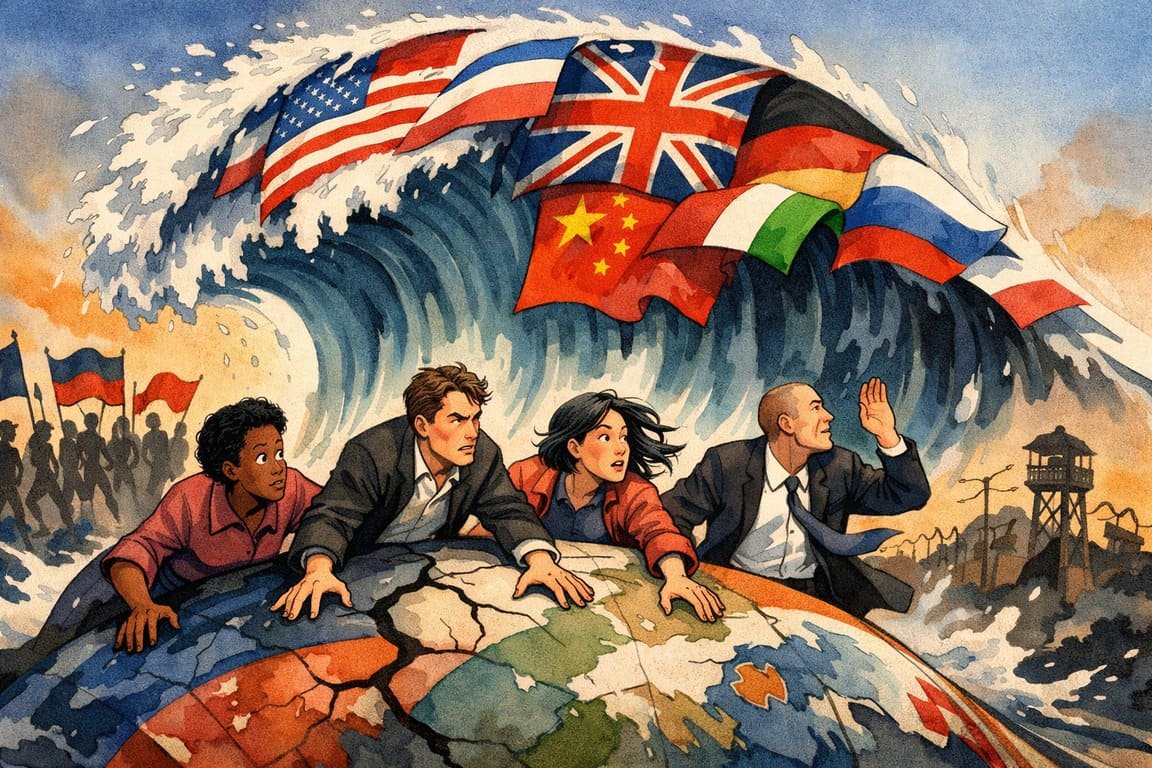
The crowd is already assembled before the speaker arrives. Some hold flags folded carefully, others clutch phones ready to record a moment they feel is bigger than themselves. The air vibrates with anticipation, not joy exactly, but recognition. Something familiar is being summoned, something that promises certainty in an age that rarely offers it. Nationalism no longer waits quietly in history’s margins. It has returned with confidence, threading itself through politics, culture, and identity with a force that feels both comforting and dangerous.
This resurgence did not begin with anger. It began with unease. As globalization accelerated, many people felt the ground shift beneath their feet. Jobs became abstract, cultures blended faster than traditions could adjust, and institutions spoke in language that felt distant and managerial. Nationalism stepped into that gap offering a simple message. You belong. You matter. Someone sees you. That promise, repeated often enough, became persuasive regardless of policy details.
Modern political movements have learned that identity mobilizes faster than ideology. Campaigns speak less about systems and more about stories. The nation is framed as a living character under threat, noble yet misunderstood. Voters are cast as guardians rather than participants. This emotional framing bypasses complexity and lands directly in the gut. It explains why nationalism thrives even where its economic claims fall apart. Feeling recognized can outweigh feeling correct.
Technology amplifies this pull with ruthless efficiency. Social platforms reward loyalty, outrage, and repetition. Nuance dissolves under pressure to perform belonging. National pride becomes content. Disagreement becomes betrayal. Once politics migrates into identity, compromise feels like self erasure. That shift reshapes democratic norms quietly, normalizing extremes while punishing moderation.
History offers uncomfortable parallels, yet the present version carries a twist. Unlike earlier nationalist waves driven by scarcity or war, this one unfolds amid unprecedented connectivity. People can see how others live, what they consume, and what they demand. Comparison fuels resentment. Nationalism reframes that resentment as injustice inflicted from outside rather than imbalance created within.
Global institutions struggle under this pressure. Agreements built on cooperation now face skepticism framed as sovereignty. International law feels optional when domestic audiences reward defiance. The irony is sharp. The more global problems become, climate, migration, pandemics, the more national solutions are demanded. The mismatch creates paralysis disguised as strength.
At the social level, nationalism reshapes everyday relationships. Accents invite suspicion. Media diets narrow. Cultural exchange feels transactional rather than curious. Communities begin sorting themselves emotionally even before policies change legally. Division hardens not because people stop interacting, but because they stop listening generously.
A quiet contradiction plays out daily. Economies remain deeply interconnected while rhetoric insists on separation. A factory relies on foreign components while speeches condemn foreign influence. Citizens cheer border control while ordering goods delivered overnight from across the world. Nationalism simplifies identity while daily life exposes its limits.
Philosophically, the appeal rests on a fundamental human tension. People crave belonging, yet fear constraint. Nationalism offers both by defining who is included and who is not. It provides meaning through exclusion, purpose through contrast. That mechanism works because it feels ancient and instinctive, even when deployed through modern channels.
Not all expressions of national identity are destructive. Pride can anchor civic responsibility. Shared stories can motivate public service. The danger appears when identity becomes defensive rather than aspirational. When the nation is defined by what it resists instead of what it builds, politics narrows into permanent conflict.
Young generations experience this differently. Raised in digital spaces without borders, many hold layered identities naturally. Nationalism feels loud, sometimes theatrical, sometimes hollow. Yet its consequences still shape their futures through policy, conflict, and opportunity. The generational divide is less about values and more about lived reality.
Economic outcomes further complicate the narrative. Protectionist promises often collide with market responses. Prices rise. Innovation slows. Blame shifts. Nationalism thrives in that confusion by redirecting frustration outward. Failure becomes evidence of sabotage rather than miscalculation.
There are moments when the spell breaks. Local cooperation succeeds despite hostile rhetoric. Communities discover that coexistence feels easier than constant vigilance. These moments rarely go viral, but they matter. They reveal that nationalism’s grip is strong, not absolute.
The wave continues to rise because it answers emotional questions politics long ignored. Who am I in this system. Who notices my loss. Who speaks my language. Until those questions are addressed honestly, nationalism will remain persuasive. The challenge ahead is not to erase identity, but to expand it without fear, to build belonging that does not depend on exclusion. The future will be shaped by whether societies can hold pride without hardening it into a weapon, and whether they can remember that strength rooted only in defiance eventually forgets how to grow.
