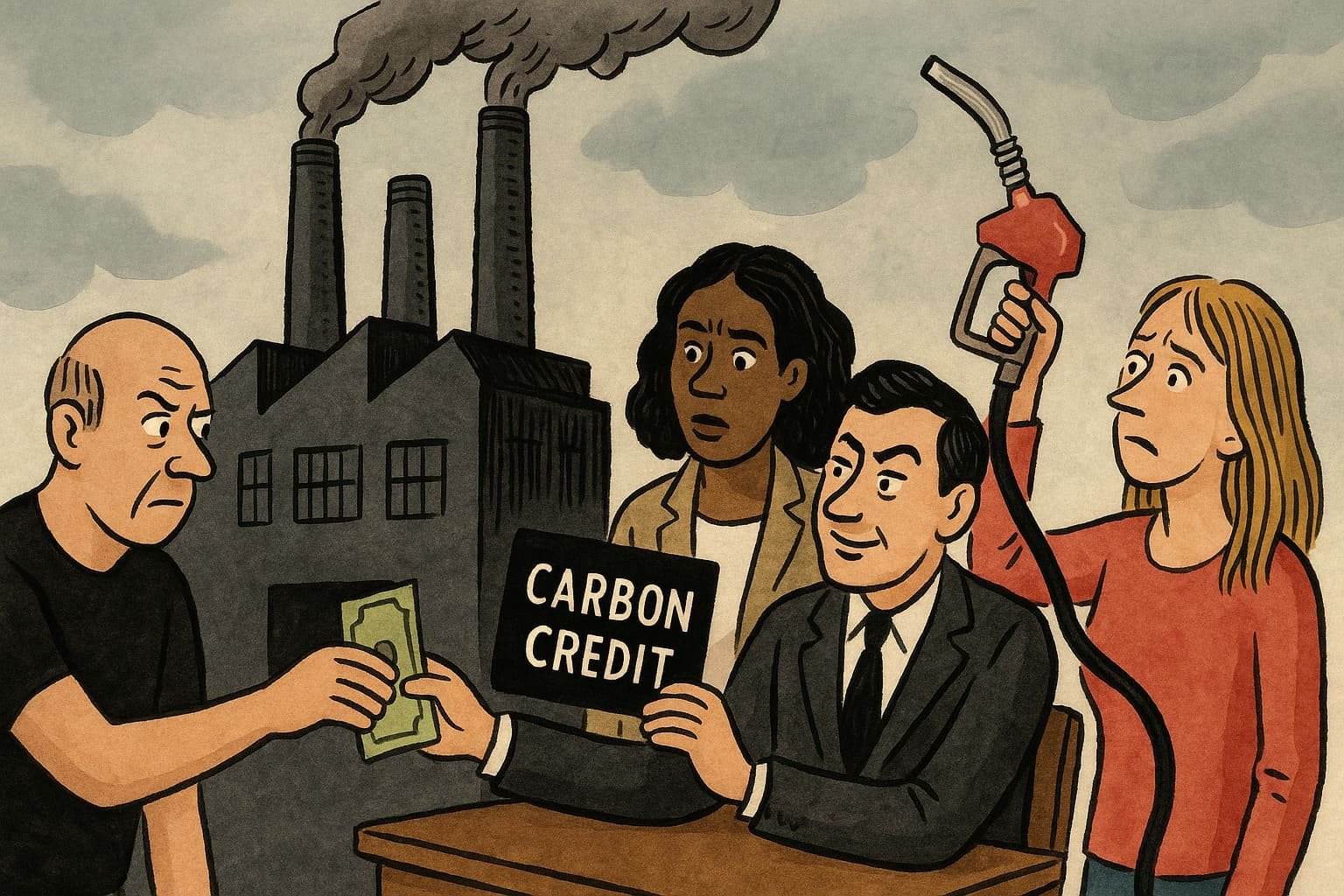
Picture a boardroom where executives toast to “net-zero” while their factories belch smoke in the background. That’s the paradox fueling today’s carbon credit marketplace; a system hailed as our salvation, yet haunted by accusations that it lets polluters off the hook. The world is hungry for climate solutions, but are we simply throwing cash at the problem and buying ourselves a license to keep polluting? Under the glossy surface of sustainability reports, a messier, more troubling story unfolds. This is not a tale for the faint of heart. Welcome to the carbon credit conundrum; a world where money, power, and morality collide, and where paying to pollute more is the cost of doing business as usual.
Quick Notes
- Sustainability or Smoke Screen? Carbon credits, in theory, reward green innovation, but in reality, they risk masking continued pollution and stalling true progress.
- Profit in Disguise: Companies can exploit loopholes, using credits as PR tools rather than genuine pathways to emission reduction.
- Invisible Victims: Communities on the front lines pay the true price, as climate justice gets sidelined in favor of corporate convenience.
- Reform or Collapse? The system can be fixed but only if accountability, transparency, and local impact are prioritized above financial engineering.
- You Hold the Power: Conscious consumer choices, activism, and ethical investment can force companies to step beyond greenwashing and face real climate action.
The Green Mirage: How Carbon Credits Promise Change but Deliver Confusion
At first glance, carbon credits seem like magic beans. Corporations promise the planet they’ll clean up their act, then hand over money to fund tree planting or wind farms somewhere far away. For every ton of emissions, a credit is purchased, and abracadabra! the slate appears clean. But if you’ve ever watched a magician up close, you know the trick depends on what you don’t see. Behind the scenes, the system often resembles a shell game, shuffling accountability rather than erasing harm.
The promise is alluring. Companies showcase their “carbon neutral” badges on everything from water bottles to jet engines. Shareholders and consumers feel good, believing they’re supporting brands committed to the planet. Yet the real magic trick is how these credits can create the illusion of progress while pollution persists. Instead of reducing emissions at the source, many companies use credits to keep business as usual humming along. The actual reductions? Sometimes hypothetical, sometimes years away, sometimes never materializing at all.
Consider the story of a major airline, lauded for its ambitious climate commitments. Instead of cutting flights or investing in cleaner fuel, it poured millions into credits supporting forest conservation in distant countries. Local news outlets later revealed that the same forests had been “saved” multiple times by different buyers, and the airline’s own emissions kept climbing. The illusion of action was shattered, but the PR campaign soared on.
This isn’t to say carbon credits can’t work. At their best, they direct real money into projects that change lives; protecting rainforests, building wind farms, or financing new technology. Yet when the rules are lax, the market attracts players who see opportunity, not responsibility. The green mirage persists, casting a shadow over genuine sustainability work.
Consumers are growing wise to the trick. They want receipts, not just promises. The next time you see a “carbon neutral” label, ask: Was this magic or just misdirection?
The Polluter’s Dilemma: When Green Becomes a Get-Out-of-Jail-Free Card
Behind every glossy sustainability report is a hard truth: it’s often easier to buy a carbon credit than to overhaul a dirty process. Companies face a dilemma; invest heavily in new technology, or take the shortcut and purchase credits for a quick fix. The temptation is obvious, especially when credits cost less than meaningful transformation. As a result, the market breeds what critics call “climate complacency.”
A well-known beverage giant faced this choice when emissions from its global supply chain threatened its green image. Instead of slashing waste or switching to renewables, the company spent millions on credits, funding tree planting in a country thousands of miles away. Meanwhile, single-use plastics and fossil-fuel transport continued unchecked. The company celebrated “carbon neutrality,” but activists dubbed it “greenwashing” all sizzle, no steak.
This dynamic is not lost on financial markets. Investors clamor for ESG (Environmental, Social, and Governance) funds, rewarding companies with bold climate pledges. The result? An explosion of demand for credits, often with little scrutiny of the projects’ real impact. A senior analyst at a global bank once joked at a conference, “We don’t need fewer emissions. We need more forests to offset them!” The laughter rang hollow for those who understood the stakes.
In some cases, credit schemes have even funded projects that do more harm than good. Large landowners have cleared local communities from their forests to make room for lucrative “carbon sinks.” The people who live closest to the land “the true stewards” end up displaced, while faraway polluters claim a green halo. The disconnect couldn’t be more stark.
This is not just a moral hazard; it’s a business risk. Brands caught gaming the system lose trust and sometimes, their social license to operate. The polluter’s dilemma is real, but so are the consequences of abusing a system designed for good.
The Hidden Toll: Communities Pay the Price for Corporate Convenience
For every carbon credit snapped up by a corporation, there’s a story playing out in a community far from the boardroom. These stories rarely make the annual report, yet they define the real cost of trading pollution for profit. In the Amazon, Indigenous leaders recount how outside investors have swooped in, buying rights to local forests as “carbon reserves.” Villages suddenly find their traditions upended, their land managed for someone else’s bottom line.
In one poignant case, a woman in Kenya watched outsiders fence off the ancestral land her family had grazed for generations. The reason? A foreign company purchased credits to offset luxury flights in Europe, locking locals out in the name of “forest protection.” She described feeling invisible; her story lost in a global transaction that promised to save the planet but erased her community’s rights.
These experiences are not isolated. Around the world, carbon offset projects reshape landscapes in ways that privilege global capital over local needs. Sometimes, farmers are pushed out to make room for monoculture tree plantations, touted as climate solutions but disastrous for local biodiversity. The promise of green jobs rarely materializes, replaced by broken promises and dashed hopes.
Corporate leaders rarely confront these stories directly. Instead, impact assessments are buried in technical language, and community concerns are treated as public relations hurdles. The gap between intention and impact grows wider each year, creating a system where the loudest voices are farthest from the front lines.
Yet hope is not lost. Groups like the Ogiek in East Africa and the Yawanawa in Brazil are fighting back, asserting rights to their land and demanding a seat at the climate table. Their message is simple: climate solutions must work for people as well as the planet. The next frontier in sustainability is not about credits but about justice, inclusion, and dignity.
The Broken System: How Loopholes, Fraud, and Greenwashing Undermine Real Progress
Every marketplace attracts both innovators and opportunists, and the carbon credit market is no exception. Where rules are vague and oversight is patchy, loopholes bloom like algae on a warm pond. Some companies, eager for cheap credits, fund projects that would have happened anyway like protecting forests never threatened or supporting wind farms already built. The credits are counted, sold, and celebrated, but no real emissions are avoided.
Scandals erupt periodically, shaking public faith. Investigations into carbon offset registries have revealed “ghost credits”; projects that exist on paper but not in reality. In one infamous case, a project claiming to restore mangroves in Southeast Asia turned out to be a fiction, the trees never planted. The company behind it boasted about its green leadership, raking in accolades before the truth emerged. The backlash was swift, but the system endured.
Greenwashing has become an art form. Ad agencies concoct emotionally charged campaigns showing CEOs planting saplings or schoolchildren learning about the climate crisis. Consumers are moved, yet the carbon math rarely adds up. One oil company, eager to rebrand, invested heavily in carbon credits while lobbying against clean energy regulation. The hypocrisy was breathtaking, yet the headlines told a different story.
The lack of international standards makes fraud easy and accountability rare. Credits are traded like commodities, bundled, and resold with little transparency. Even well-intentioned buyers struggle to know if their money funds real change or just lines someone’s pocket. Calls for reform grow louder, with demands for traceability, third-party audits, and clear rules.
Fixing the broken system won’t be easy. But the stakes are too high for half-measures. As climate risks mount, trust is the ultimate currency. Real progress demands a marketplace built on honesty, rigor, and relentless scrutiny not creative accounting.
A Path Forward: From Pay-to-Pollute to Real Climate Solutions
The carbon credit conundrum is not destiny. It’s a fork in the road; a moment to decide whether we will settle for convenience or insist on transformation. True sustainability means cutting emissions at the source, not outsourcing responsibility. Some companies are leading the way, investing in renewables, redesigning products, and changing how they operate from the inside out.
Patagonia, for example, doesn’t just buy credits. It invests in regenerative agriculture, restores degraded lands, and pushes suppliers to meet rigorous standards. The brand’s ethos is clear: nature is not a ledger entry. Its customers respond, creating a movement that transcends commerce. The Patagonia story proves that real climate action builds trust, loyalty, and lasting value.
Innovation offers hope. Tech startups are developing blockchain tools to track credits from origin to impact, promising a future where green claims are easy to verify. Scientists pioneer methods for carbon removal that don’t displace communities or sacrifice biodiversity. Investors demand clearer metrics, forcing companies to back up sustainability talk with real results.
Citizens and consumers hold power, too. Boycotts, shareholder activism, and viral campaigns force brands to confront uncomfortable truths. When ordinary people demand more; when they ask tough questions, reward transparency, and punish greenwashing; change ripples across the system.
No climate solution is perfect. Every path involves tradeoffs and tough decisions. But the time for easy answers is over. The future belongs to those bold enough to reject shortcuts and invest in solutions that honor both people and planet.
Don’t Buy the Hype: Demand More from the Carbon Credit Game
Imagine waking up tomorrow to headlines that say: “World’s Largest Polluter Goes Carbon Neutral.” Would you cheer or check the fine print? The carbon credit system, once full of promise, now stands at a crossroads. Will it be a tool for real progress or a fig leaf for polluters desperate to keep business as usual?
History teaches us that easy fixes rarely deliver lasting change. The carbon credit conundrum is our climate wake-up call; a warning not to confuse accounting for action. We can choose the hard path: to cut emissions at the source, to include communities in every decision, and to insist on honesty above hype. Or we can keep paying to pollute, comforting ourselves with green badges while the world grows hotter.
The future is not written. It is shaped by the questions we ask, the standards we set, and the courage we summon. So here’s your challenge: next time you spot a “carbon neutral” claim, don’t take it at face value. Dig deeper, demand proof, and remember real sustainability isn’t bought. It’s earned, together.
Are you content with business as usual or ready to fight for solutions that truly matter? The choice, and the power, is yours.
Partnered. Provocative. Worth Your Scroll.
This is a Promoted Post by ESYRITE—yes, it’s paid, but never filtered. Our voice stays raw, real, and razor-sharp. We team up with bold ideas, game-changers, and stories that spark something real. If it’s here, it earned its place—no fluff, just impact. We don’t just promote—we provoke. Stay sharp. Dive deeper.
