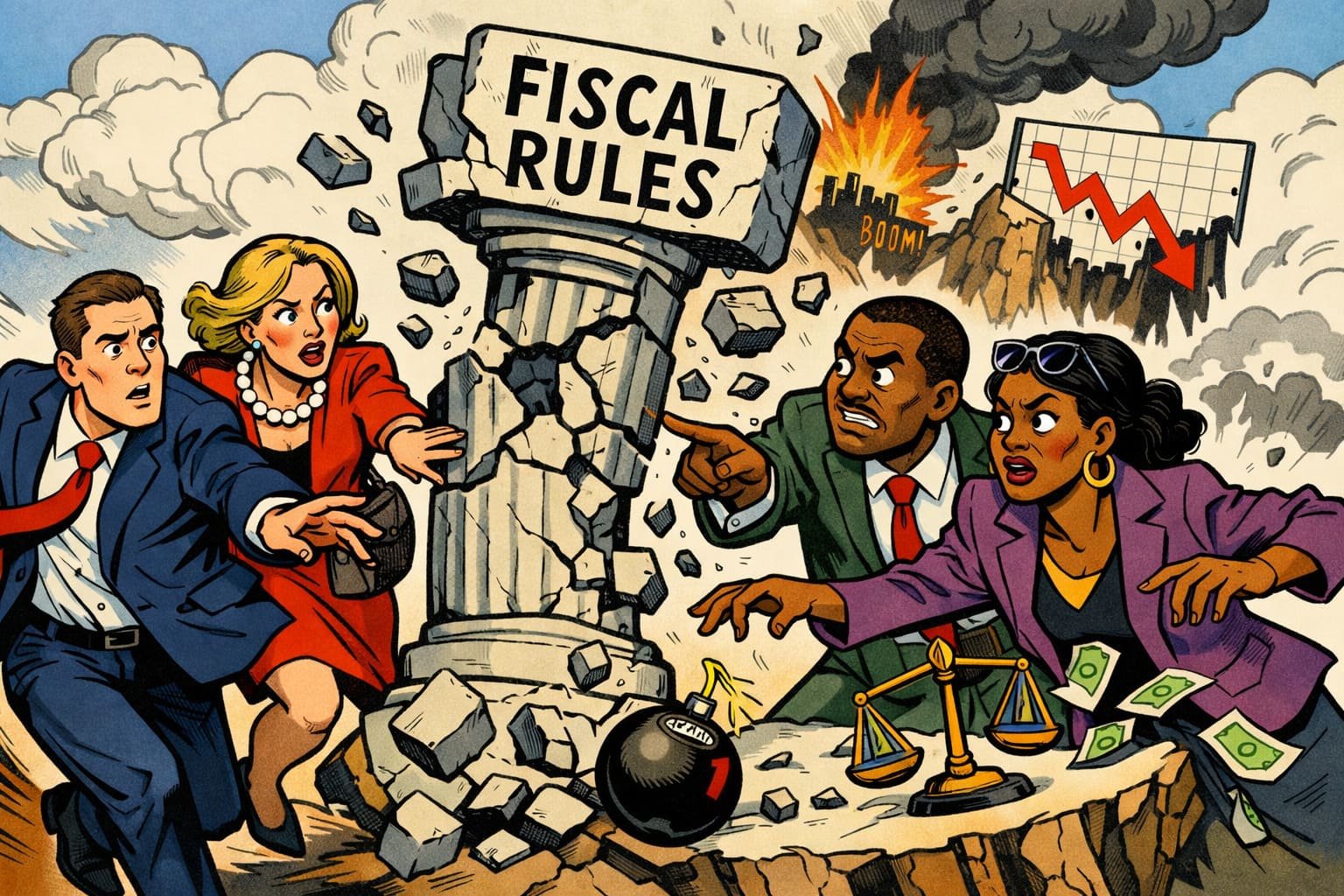
Fiscal rules are the kind of institution people praise in peacetime and resent in storms. They sound tidy on paper, debt anchors, deficit ceilings, expenditure paths, escape clauses. They promise discipline, credibility, and a little protection from the political habit of spending optimism like it is free. Then a crisis arrives, priorities shift, elections loom, or geopolitics bites, and suddenly the guardrails look less like wisdom and more like inconvenience. That is when the rulebook starts to crack, and the crack says something bigger than noncompliance. It says politics wants discretion back.
At their best, fiscal rules are not chains. They are guardrails. The IMF describes them as lasting constraints meant to curb deficit bias and support credibility, while OECD work emphasizes that well-designed rules enhance trust only when they remain clear, usable, and resilient to shocks. Escape clauses matter because no sane country should run a fire drill according to peacetime choreography. But flexibility that preserves credibility is very different from flexibility that dissolves it. That line is thin, and politics likes to dance on it wearing heavy boots.
Rules crack for obvious reasons and less obvious ones. The obvious reason is crisis. Pandemic, war, recession, energy shock, banking stress. Governments need room. The less obvious reason is design failure. Some rules are too rigid, too complex, too procyclical, or too detached from political reality to survive real pressure. A rule that cannot handle bad times without becoming absurd invites suspension. Once suspended, it can lose moral force even after the emergency passes. Citizens begin to suspect what insiders already know, that some rules were decorative all along.
Europe has spent years living inside this tension. The history of fiscal frameworks there is not simply one of restraint versus irresponsibility. It is a story of trying to impose credibility on diverse political economies while still allowing room for investment, shocks, and national difference. That is a difficult balancing act, and each reform quietly admits the previous model was not sufficient. The existence of new frameworks and revised clauses is not proof that rules failed entirely. It is proof that static rules in dynamic politics rarely survive without revision.
What makes cracking rules so dangerous is not just the breach. It is the signal. Once governments show that limits can be bent whenever the political temperature rises, markets and voters start asking whether future commitments mean much either. Credibility is a strange public asset. It accumulates slowly, then evaporates with startling speed. A finance minister who treats escape clauses like emergency exits can preserve trust. One who treats them like revolving doors cannot. The difference lives in explanation, timing, institution, and the sincerity of the path back.
A deputy minister in a middle-income country once joked that the national fiscal rule was “a fitness plan with excellent typography.” It looked disciplined, was often quoted, and quietly adjusted whenever political appetite returned. That remark was unkind, but it captured the central weakness of many frameworks. They are sold as constraints, then administered as aspirations. The public hears the original promise. The political class learns the hidden flex. Over time the rule stops organizing behavior and starts organizing excuses. That is when chaos enters wearing the language of procedure.
Still, critics who mock fiscal rules as useless miss the alternative. Pure discretion is not noble realism. It is often a polite name for selective memory. Governments under pressure almost always have reasons to spend more, tax less, delay adjustment, or define urgency broadly. Rules exist because elected systems, left alone, often drift toward short horizons. The cure for bad rules is not no rules. It is better rules, supported by institutions strong enough to make bending them politically costly and technically visible.
That means simplicity matters. Transparency matters. Independent fiscal councils matter. Medium-term planning matters. So does public communication that treats citizens like adults. When a rule is activated, suspended, or revised, the explanation should be clear enough that a schoolteacher, shop owner, or nurse can understand the trade-off without needing a legal decoder ring. Rules fail socially before they fail numerically. Once people see them as tricks used against opponents or ignored by allies, the framework may still exist on paper, but its legitimacy has already started to leak.
A city government in eastern Europe once adopted a spending rule after years of volatility. At first it felt irritating and small-minded, especially to departments hungry for expansion. Then a downturn hit. The same rule, paired with a transparent escape mechanism and a published return path, became a strange source of calm. Officials could still respond, but they had to explain how and for how long. That tiny ritual of explanation changed behavior. It turned discretion into accountable discretion. The crack never widened because the public could see the scaffolding holding the wall together.
The fiercest challenge ahead is not theoretical. It is political overload. Aging raises costs. Defense demands rise. Climate investment cannot wait forever. Debt service grows teeth. Voters expect relief. Under that weight, every fiscal rule will feel too tight to somebody. The temptation will be to keep the language of discipline while hollowing out its substance. That is the modern budgetary version of lip-syncing, all the choreography of commitment, none of the breathing. Markets may tolerate it for a while. Citizens may even clap. Then reality starts asking for live vocals.
The latest institutional thinking on fiscal frameworks keeps circling the same truth: rules need flexibility, but that flexibility must be bounded, explained, and connected to a believable medium-term plan. Otherwise the framework becomes a costume for improvised politics.
In the end, fiscal rules crack when politics decides it wants the comfort of discipline without the discomfort of discipline. That contradiction cannot hold forever. A nation either builds rules sturdy enough to survive pressure or keeps staging little dramas of commitment followed by predictable retreat. The dangerous part is not the crack itself. It is the habit that grows around it, the belief that a framework can keep its authority after being treated like a suggestion. Once that belief spreads, chaos no longer chases politics. Politics starts running toward it.
