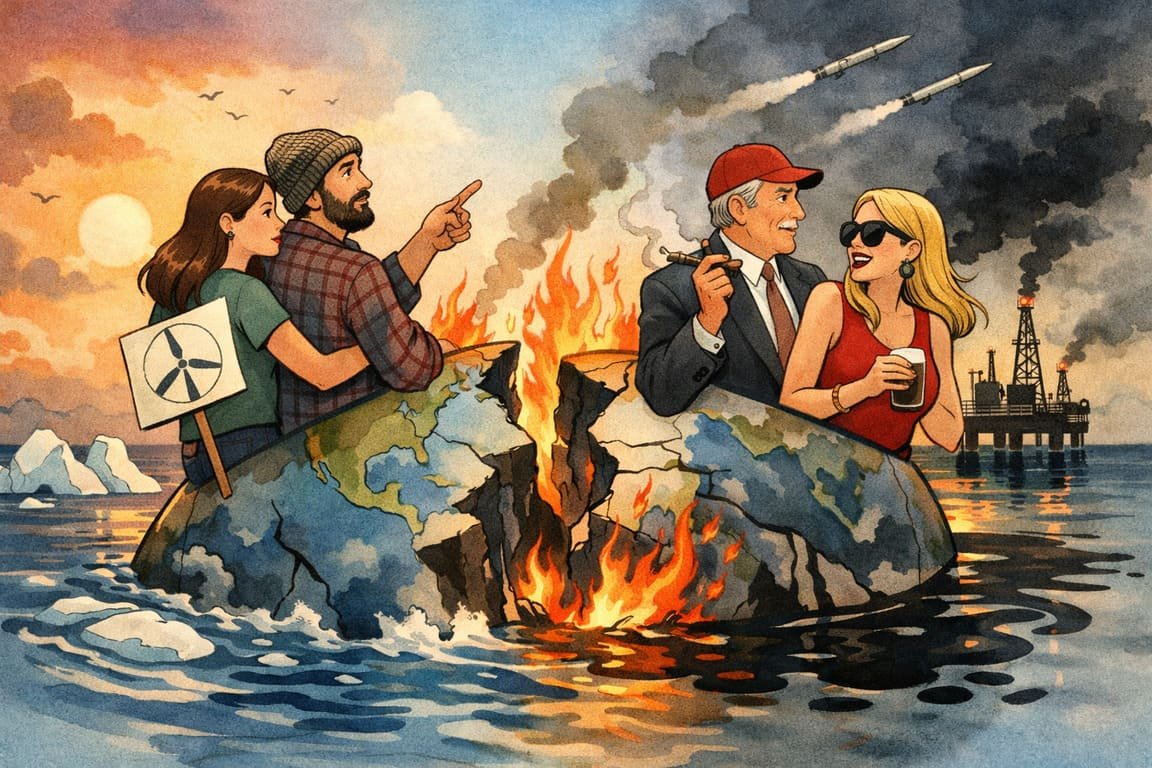
The argument plays out like a ritual performed so often it no longer surprises anyone. One side speaks in moral absolutes, warning of catastrophe with the urgency of prophecy. The other side counters with confidence and dismissal, promising prosperity without sacrifice. Both sound convinced. Neither sounds effective. Outside the debate, the planet continues warming, oceans shift, and seasons lose their old rhythms. Nature does not pause to hear closing statements.
The political left approaches climate change as a test of virtue. The language is heavy with moral certainty and existential stakes. This framing mobilizes attention, but it also hardens positions. Policies become symbols of righteousness rather than tools subject to revision. Costs are waved away as temporary or necessary, even when they fall unevenly. Doubt is treated as betrayal. Complexity becomes suspect.
On the right, the failure takes a different form. Climate concern is framed as hysteria or elitism. Growth is positioned as incompatible with restraint, as if extraction were a cultural inheritance. Markets are praised while external costs are ignored. Innovation is invoked like a magic spell, expected to appear without coordinated investment or regulation. Delay is sold as prudence.
Both camps share a deeper flaw. They confuse narrative victory with physical outcome. Climate systems respond to emissions, infrastructure, and land use, not to messaging. Winning the argument while losing the atmosphere is a uniquely modern failure, one that rewards rhetorical dominance over material competence.
The left often overplays prohibition. Bans arrive before alternatives are reliable. People feel punished for systems they did not design. Backlash follows predictably, feeding the very resistance that stalls progress. Climate action framed as sacrifice without payoff breeds resentment, not commitment.
The right, meanwhile, underestimates limits. Efficiency gains matter, but they are not infinite. Ignoring boundaries does not preserve growth. It defers its cost. When disasters arrive, the bill lands on public systems that were never funded to absorb it. Reality collects what ideology postpones.
Technology sits trapped between these failures. One side celebrates it rhetorically while regulating it into paralysis. The other praises it rhetorically while starving the public goods that allow scale. Clean energy, resilient grids, and adaptation require coordination. Ideological purity fractures that coordination before it begins.
The most effective climate progress rarely announces itself as such. It arrives through pricing pollution rather than preaching. Through building systems that make better choices automatic. Through infrastructure that absorbs shocks quietly. These solutions lack drama. They do not flatter tribes. They work anyway, which is why they struggle for airtime.
Culture wars have turned climate into an identity test. Beliefs signal belonging more than understanding. Compromise feels like surrender. Policy becomes theatre. The planet pays the price for human insecurity. When survival becomes symbolic, solutions slow to a crawl.
Philosophically, the impasse reveals an outdated imagination. The left dreams of salvation through restraint alone. The right dreams of salvation through expansion alone. Reality demands synthesis. Limits and ingenuity. Discipline and creativity. Neither side wants to share authorship of success.
The most damaging myth is that climate action must look a certain way to count. That it belongs to one moral camp. This belief poisons collaboration. It turns engineering into ideology and adaptation into confession. Meanwhile, floods do not check voter registration.
Late afternoons in overheated cities expose the cost of this stalemate. Power grids strain. Air thickens. People adapt quietly while leaders argue loudly. Resilience becomes personal rather than systemic, expensive rather than shared.
This is not a failure of intelligence. It is a failure of courage. Courage to abandon comforting stories. Courage to admit trade-offs without spinning them. Courage to act before agreement feels emotionally satisfying.
As debates recycle and temperatures rise, one question refuses to fade for anyone still arguing in good faith: if ideology keeps winning the fight, who exactly is losing the planet?
