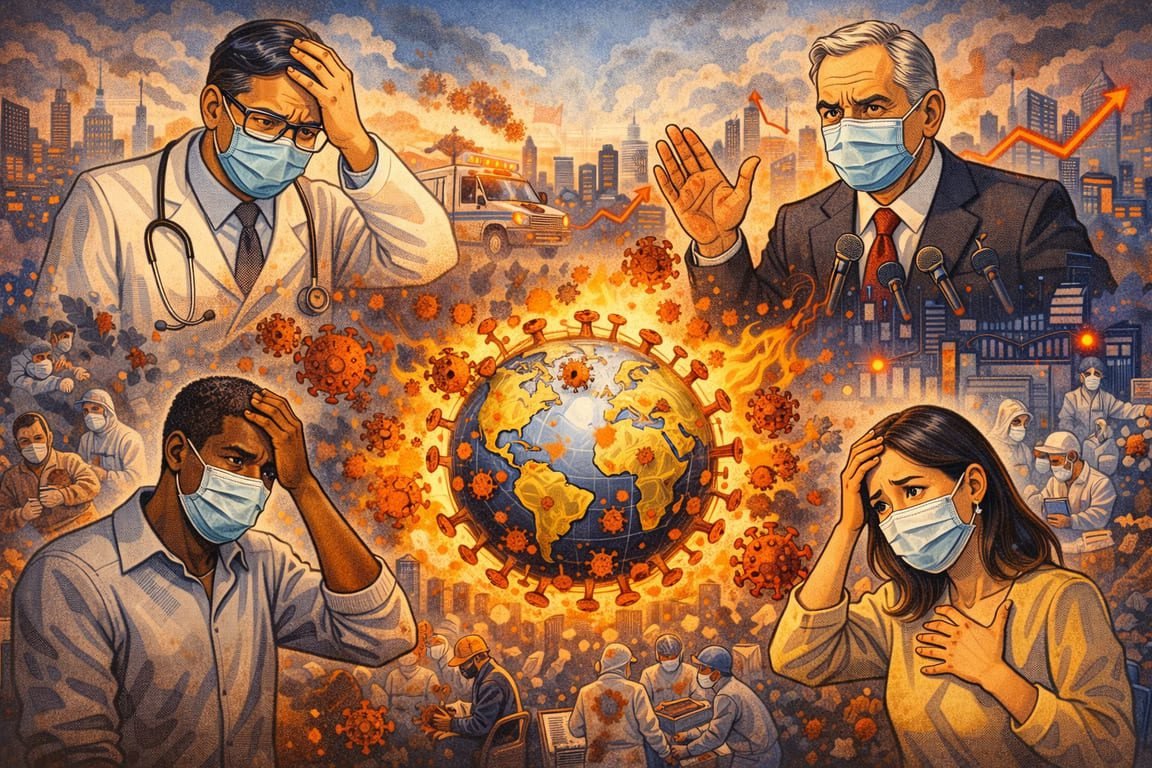
The city did not fall silent. It held its breath. Streets emptied without warning. Time bent around briefings, dashboards, and the dull anxiety of waiting for numbers to refresh. Windows became boundaries between safety and risk. What unfolded was not a single crisis but a slow revelation, peeling back layers of confidence modern societies carried without questioning. The pandemic arrived as a health emergency and stayed long enough to expose everything else.
At first, the disruption felt biological. A virus moved faster than borders, protocols, and political instincts. Very quickly, it became clear the deeper failure was structural. Supply chains snapped with alarming ease. Hospitals strained under assumptions that capacity would always be enough. Information fragmented across platforms that rewarded speed over accuracy. Science did not fail. Systems built around convenience and optimism did.
Politics struggled to keep pace with uncertainty. Emergency powers expanded unevenly. Public health guidance collided with economic fear. Leaders were asked to perform certainty while operating inside evolving evidence. Every decision landed personally. Every revision looked like weakness. The expectation of flawless authority met the reality of learning in real time, and trust absorbed the impact.
Global coordination revealed uncomfortable limits. Organizations like the World Health Organization** were expected to lead without the authority to enforce. Cooperation depended on goodwill that fluctuated with national pressure. Coordination became negotiation. Solidarity bent under scarcity. The architecture of global health proved thinner than public rhetoric had suggested.
Societies responded in fragments. Mutual aid groups formed overnight while shelves emptied just as quickly. Applause echoed for healthcare workers as exhaustion drove many to leave the profession. Inequality sharpened at speed. Some people worked safely from home. Others faced exposure daily without protection or choice. The pandemic did not invent these divides. It illuminated them under unforgiving light.
Information became its own contagion. Data evolved. Guidance shifted. Misinformation filled emotional gaps faster than corrections could follow. Trust proved as critical as treatment, yet far harder to distribute. Where communication felt transparent and human, compliance followed. Where it sounded dismissive or absolute, resistance hardened quickly.
A small clinic story captured the difference. A nurse called elderly patients each evening, explaining updates in plain language, answering the same fears patiently. Appointments were kept. Guidance was followed. Relationship carried more weight than authority. Scale makes that intimacy difficult, but the lesson remains. People respond better to honesty than perfection.
Economically, the shock lingered long after lockdowns lifted. Small businesses closed quietly. Careers stalled unevenly. Governments mobilized resources at a scale previously described as impossible. The contradiction did not go unnoticed. If such action was feasible under emergency, why had slower crises been left to fester. The question unsettled assumptions about political will.
Mental health surfaced as a quiet casualty. Isolation blurred days together. Grief went unprocessed. Young people absorbed disruption during formative years. The language of resilience sounded hollow without support. Recovery became more than reopening. It required acknowledging loss without rushing past it.
Philosophically, the pandemic challenged the myth of radical individualism. Personal choices carried collective consequences. Masks, distancing, and vaccination were not just preferences. They were social acts. That reality unsettled societies built on autonomy, forcing a reckoning with interdependence many resisted but could not escape.
The greatest risk now is forgetting. As urgency fades, preparedness drifts. Plans gather dust. Budgets tighten. The temptation is to treat the pandemic as an anomaly rather than a warning. History suggests memory softens faster than vulnerability disappears. The next crisis rarely announces itself politely.
There are gains worth protecting. Scientific collaboration accelerated. Data sharing improved. Communities rediscovered forms of solidarity once assumed obsolete. These advances are fragile. They survive only if chosen deliberately rather than remembered nostalgically.
The pandemic was not just a catastrophe. It was a mirror. It reflected how societies value expertise, how they distribute risk, and how quickly compassion competes with fatigue. The disruption revealed truths that will not disappear simply because daily life feels normal again. The final lesson remains unsettled, waiting quietly for a decision. Will the world treat this moment as a brutal interruption, or as a warning that arrived early enough to still change what comes next.
