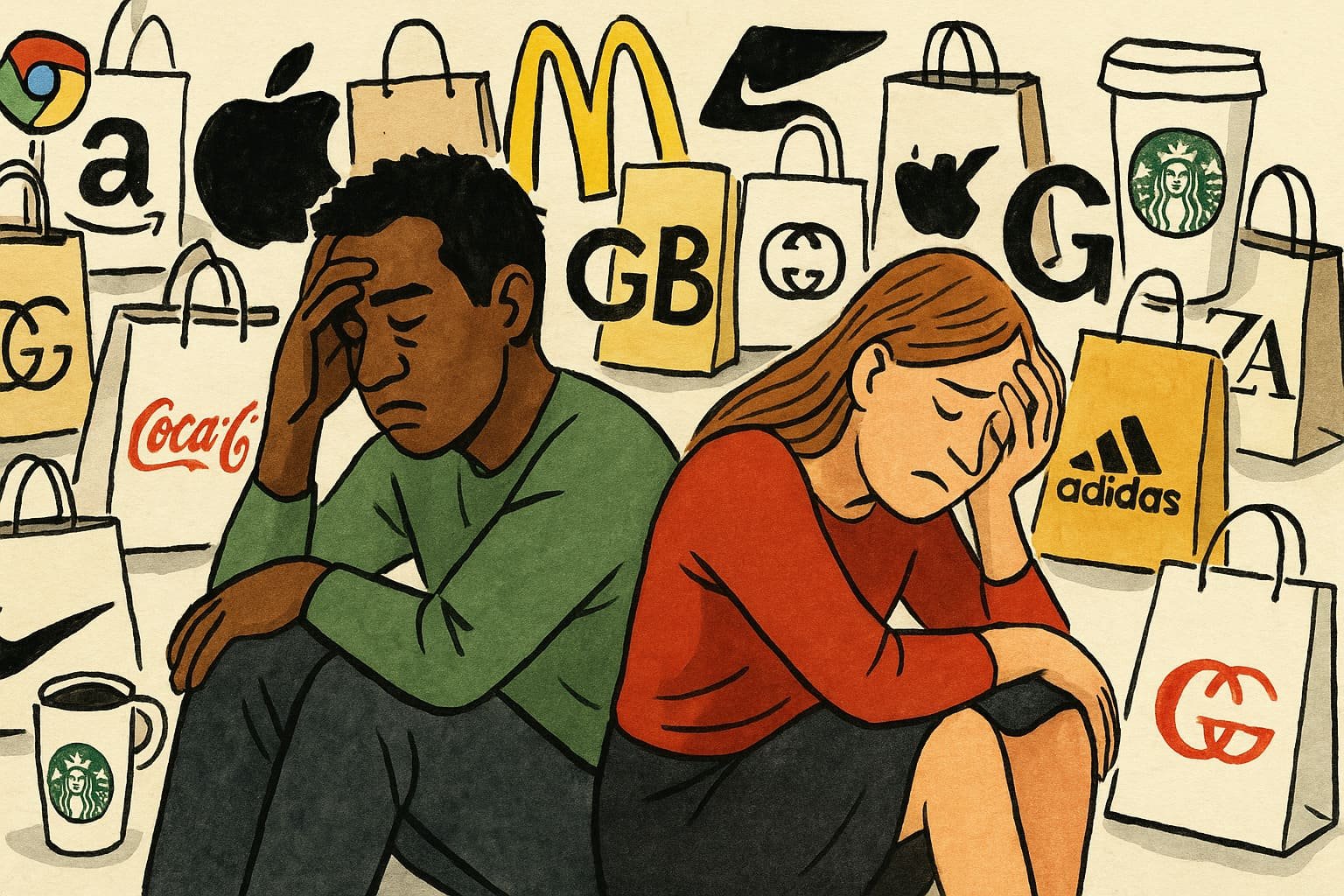
The lights in the digital bazaar flicker, burning white-hot against a backdrop littered with neon icons and scrolling slogans. In this crowded carnival, a thousand brands jostle for attention, each whispering promises sweeter than the last. There’s no silence here; only the static buzz of relentless campaigns and dopamine-laced notifications, swirling around bodies adrift on the current of constant comparison. The scent of burnt coffee mingles with plastic wrap and ambition, as exhausted souls wander from one glowing booth to another, searching for something that feels real. This isn’t a marketplace built for things; it’s a theater for the performance of self, with every click a standing ovation for the loudest, cleverest mask.
A man in a faded hoodie scrolls past billboards in a subway that doesn’t exist, every wall painted with slogans telling him what he’s missing. His thumb stutters over a feed that never ends, each image promising transformation: shinier skin, smarter tools, stronger brands, purer purpose. The air is thick with irony; everyone’s selling authenticity, but nobody remembers what it smells like. He tastes a metallic tang of envy, frustration, hope, and a strange hunger that nothing in the display windows can fill.
Somewhere above this chaos, a meeting room vibrates with energy drinks and optimism. A consultant in all-black presses remote controls, cycling through slides with the calm of a conjurer. “Emotional connection is the new ROI,” she intones, her voice sliding across the glass table, cool as a lake at midnight. Yet in her eyes, a shadow flickers: even the architects of the spectacle feel their own foundations shaking. Everyone in the room nods, masking fatigue with the practiced grin of high performers, repeating mantras about disruption and engagement. The mask is seamless; until someone’s phone buzzes with an alert about “mindful wellness,” a cruel joke delivered with algorithmic precision.
Amid the blinding surge of logos and lifestyles, a small child’s voice rises from behind a crate of discounted dreams. She asks why every cereal box wears a smile, why every sneaker box glows, and why her parents’ laughter sounds more tired when the TV is on. The question is simple, but its echo ricochets through the cavernous hall, unanswered and almost embarrassing in its honesty. At that moment, the parade of curated personas stutters, falters, and for a heartbeat, reveals the fragile humans crouching underneath.
A cool breeze drifts through an open door at the end of the row, carrying the scent of rain on concrete and forgotten freedom. Nobody notices it at first, hypnotized by the spinning wheels of fortune, the influencers’ confessions, the clickbait testimonials of lives remade overnight. Yet for those who pause, who dare to breathe, the wind carries a promise: something unbranded, unclaimed, quietly waiting beyond the endless transaction.
In a backroom stacked with empty packaging, a woman named Nina stares at her reflection in a smudged mirror. She’s worn every label, chased every algorithmic carrot, built a digital persona that shimmers with borrowed light. Tonight, she wipes away the foundation and counts the lines around her eyes, each one a memory that cannot be bought. She laughs softly, a sound that feels alien yet ancient, as if rediscovering a forgotten language. Outside, the city pulses with the rhythm of relentless self-promotion, but inside Nina’s room, a new kind of silence blooms; a space where she might finally hear her own heart.
Quick Notes
- Identity in Disarray: The constant pressure to curate and promote an ever-evolving brand identity fragments your sense of self, forcing you to trade genuine connection for digital applause.
- Fatigue Is the Price Tag: Every badge of “authenticity” comes with exhaustion, as the relentless grind to keep up with trends, likes, and expectations erodes your spirit and breeds quiet burnout.
- Illusion of Control: The myth of self-invention promises power, but you find yourself entangled in algorithms and narratives that profit from your deepest insecurities, not your dreams.
- Cracks in the Armor: Even the most celebrated founders, employees, and influencers admit (in whispers) that the masquerade has a cost: real relationships, creative freedom, and inner peace are casualties in the war for relevance.
- Hope After the Flood: The secret nobody wants to advertise is this—when the lights go out, what matters isn’t the brand you built, but the moments of honesty and the unbranded courage to stand alone. That’s where freedom lives.
The Tyranny of Self-Curation—When Image Devours Identity
When your reflection blurs into an avatar and the mirror feels more like a marketing department, the boundaries of identity dissolve. The tyranny of self-curation asks you to sculpt your digital persona until the raw edges disappear, leaving behind a sleek surface that’s impossible to maintain. Every decision becomes a brand choice; what to wear, how to caption a sunrise, even which feelings to display on public timelines. Behind this performance, the human urge for belonging transforms into a competition for attention, and sincerity is edited for maximum reach.
One corporate intern, Maya, recalls the night she spent retaking selfies until her smile felt frozen, desperate to match the branded energy of her employer’s “people-first” campaign. That same week, a mid-level manager at a rising tech startup privately confessed to journaling about her “real” feelings only in a locked notebook, terrified that even vulnerability could be turned into content. Their stories illustrate a paradox: as more brands preach transparency, the pressure to appear perfectly authentic multiplies, making actual intimacy a rare, almost rebellious act.
The world’s most visible CEOs; think Richard Branson or Oprah Winfrey have mastered the choreography of vulnerability, broadcasting confessions and setbacks in a way that fuels their brand narrative. Yet behind the scenes, lesser-known founders like Ethan Zhao of Brewbyte Studios admit that maintaining a public face is its own exhausting job. Zhao describes the anxiety of crafting every LinkedIn post, knowing that an offbeat comment or honest misstep could spark viral backlash, not empathy. For him, the mask sometimes becomes a second skin, and taking it off requires as much bravery as any investor pitch.
Philosophers from Seneca to Sartre have warned that the quest for applause is a prison built of mirrors, each reflection warping your core identity. In a time where everyone is urged to be “their own brand,” the wisdom lands with fresh urgency. Ancient Stoics counseled detachment from public opinion, but today, public opinion is piped directly into your phone, your inbox, even your bedroom. Escaping the feedback loop is harder than ever.
Yet if you listen closely, cracks appear in the narrative. Employees at leading creative agencies share whispered tips on digital detoxes and the thrill of “posting and ghosting.” Even social media managers admit that their most resonant campaigns come from moments of unexpected honesty: a poorly lit photo, a fumbled announcement, or a quiet admission of uncertainty. Beneath the armor of curated selfhood, the hunger for unfiltered connection endures.
The High Cost of Engagement—When the Spirit Pays the Bill
Chasing relevance has a hidden tax: spiritual exhaustion. Each day you juggle shifting trends, industry jargon, and relentless comparison, another piece of your inner peace slips away. The grind rarely feels like a sprint; it’s more like a treadmill where the speed keeps increasing but the scenery never changes. This kind of exhaustion is different from simple tiredness; it settles in your bones, turning ambition into anxiety and innovation into mimicry.
Sarah, a brand strategist at a global fashion label, once celebrated her ability to stay “on message” through crises. Yet she confided to a friend after a grueling campaign launch that she’d forgotten what she actually liked; her tastes, her favorite music, even her sense of humor had become focus-grouped. On her rare days off, she wandered aimlessly, phone in hand, scrolling through influencer feeds to remind herself what to aspire to. This spiritual weariness is the shadow side of a life spent selling stories rather than living them.
Stoic philosophy warns against “the disease of more,” the restless urge to accumulate status, followers, and praise. In this new economy, more is always possible, but never enough. Even mindfulness apps, meant to provide relief, become another brand performance, gamified and measured by streaks. Your downtime becomes an extension of your hustle, and rest turns into yet another box to check on your self-improvement to-do list.
Team leads at a buzzy Los Angeles tech firm describe Friday meetings where wins are measured by metrics and mentions, not meaning. One developer joked, “We could ship a cure for loneliness and still get dinged for not hitting our engagement KPIs.” Laughter followed, but it was the brittle, nervous kind that reveals a shared truth nobody wants to admit. Even the search for significance becomes a transaction, and soul fatigue is the price of admission.
Yet in the quiet moments, when the phone battery dies or the power flickers out, there’s a different kind of clarity. True rest isn’t a luxury product or a calendar hack; it’s a return to a less performative self. The people who survive the deluge aren’t the most relentless, but the most willing to step away, let go, and remember what it feels like to be present without applause.
Algorithms, Anxiety, and the Illusion of Control
You may think you’re driving your own story, but the dashboard is rigged. Algorithms anticipate your choices before you make them, serving up content tailored to your insecurities, aspirations, and hidden fears. Brands promise empowerment, but the real power belongs to the engines that mine your every click and pause, shaping your identity to fit their narrative needs.
Case in point: During the rise of a viral dance challenge, a midwestern college freshman named Jordan believed his signature move would finally “break through.” He rehearsed for hours, splicing together music, outfits, and punchlines, watching views tick up and then stall for no clear reason. Months later, he discovered his most-watched post was one he barely remembered sharing—a blurry, unedited moment of laughter among friends, raw and unpolished. The realization hit hard: his pursuit of viral fame was never truly under his control.
You live in a paradox: every tool to “find yourself” online also fragments you further, splitting your attention, focus, and values into micro-targeted niches. Instead of self-invention, you’re handed a menu of prefab identities, curated for maximum stickiness. Social networks reward outrage and novelty, not reflection or nuance. Even your resistance to branding can be commodified and repackaged, as “anti-branding” quickly becomes its own lucrative brand.
Industry experts like Carla Reyes, who advises Fortune 500 companies on digital ethics, argue that the real crisis isn’t privacy; it’s the erosion of self-determination. In her view, when even your rebellion gets monetized, true autonomy becomes nearly impossible. Yet Reyes points to hope: consumers are increasingly savvy, organizing around movements for data dignity and algorithmic transparency, pushing back against manipulative tactics.
The myth of total self-invention is seductive, but real agency comes from a messier, riskier place: the willingness to be misunderstood, ignored, or even disliked in pursuit of something genuine. The brands and people who stand out aren’t always the most polished; they’re the ones who dare to defy the script, letting their rough edges show.
Unmasking the Performance—Case Studies in Real and Imagined Rebellion
Somewhere between the hype of hustle culture and the shadow of burnout, a quiet revolution stirs. It’s visible in the everyday micro-rebellions of employees who turn off their cameras during video calls, refusing to stage another performance for the gallery of floating avatars. It’s found in managers like Luis Ortega, who ended his agency’s “Monday Wins” meeting with an open admission: “Some weeks, the biggest win is just showing up honest.” His words didn’t trend, but the ripple in the room was unmistakable; a rare sigh of collective relief.
Even the world’s most iconic brands stumble when their scripts break. Recall when a global athletic brand tried to ride a viral cause, only to be called out by employees for hypocrisy. The apology video was awkward, unscripted, and unexpectedly powerful. For a brief moment, consumers saw real vulnerability; a glimpse behind the curtain that no focus group could have manufactured. Sales recovered, but more importantly, trust began to heal.
At the other end of the spectrum, a young entrepreneur named Clara Kim built her lifestyle label, Evergreen, by refusing to use influencer endorsements. Instead, she invited customers to submit unedited stories about failure and messiness. Evergreen’s community exploded, fueled by a hunger for stories that didn’t sound like ads. Clara’s gamble paid off because she understood that the most compelling brand is sometimes the one that dares not to act like one.
Sociologists have long warned that performative culture breeds a loneliness that no product can fix. When everyone is expected to market their lives, authentic friendship becomes an act of rebellion. Private group chats, analog hobbies, and even awkward silence over dinner reclaim a space where the self doesn’t need a filter. It’s in these small sanctuaries that spirit revives.
Contrary to the relentless optimism of the branding machine, what makes you magnetic isn’t perfect storytelling or metrics, but the willingness to risk being misunderstood for the sake of truth. These case studies remind you: the exit from the carnival begins not with a big gesture, but a single, unfiltered word spoken without fear.
After the Carnival—Where Spirit Is Rebuilt
When the show winds down and the last ad fades, something fragile remains. It’s the memory of your grandmother’s advice; never trust a man who can’t laugh at himself. In the quiet, post-performance space, self-awareness returns, humble and persistent as grass poking through cracked pavement. The world outside the digital bazaar feels emptier, but also lighter, as if you’ve put down a weight you didn’t know you were carrying.
Take Arjun, a mid-career creative who quit his job at a major agency to restore old furniture in his father’s garage. He’d spent years mastering the algorithms of attention, only to realize his real gift lay in hands-on craft, not digital storytelling. The transition was awkward, full of second guesses and empty afternoons, but the slow, physical labor taught him a different kind of satisfaction; one that comes without applause. Now, his shop’s only “branding” is the sound of hammers and the smell of wood polish.
The journey back to spirit isn’t glamorous, and it doesn’t sell well on social. It’s marked by mundane routines, awkward silences, and gradual, awkward healing. Employees who survived toxic work cultures describe the moment they stopped apologizing for “unproductive” days and started noticing the taste of lunch, the texture of rain on their skin, the freedom to feel bored. Here, identity is rebuilt not from applause, but from small acts of self-respect.
Psychologist Dr. Lina Romero, who specializes in post-burnout recovery, notes that the return to selfhood often begins with minor rituals; turning off notifications, spending afternoons offline, or even wearing clothes nobody will ever see. She tells clients, “Spirit comes back quietly. It likes being left alone for a while.” The lesson isn’t about escape, but about refusing to outsource your worth.
There’s a final twist: those who find their way out often become beacons for others, not by preaching, but by living with a kind of unbranded courage. Their stories don’t always go viral, but they’re contagious in a better way, inspiring quieter forms of rebellion. In the spaces where brands lose their grip, a different kind of loyalty emerges; one built on real connection, risk, and the willingness to be simply, beautifully, human.
The Moment the Masks Fell Away
In the amber glow of closing time, the last reveler in the branding carnival stands alone. Her makeup smudged, shoes in hand, she stares at the empty street, blinking as the artificial lights finally fade. Every slogan, every promise, every persona collapses into silence, and the city seems to breathe for the first time all night.
She hears her own footsteps, unaccompanied by music or applause, echoing against the wet asphalt. Somewhere in the distance, laughter floats up from a doorway where friends sit in comfortable, unbranded quiet, sharing stories that need no audience. The reveler hesitates, then walks toward the sound, curiosity fighting with fear, hope flickering in the space left behind by exhaustion.
A single, shivering question hangs in the air, heavier than any billboard: “If nobody is watching, who do you become?” You already know the answer. It’s the one thing no brand can sell you.
Partnered. Provocative. Worth Your Scroll.
This is a Promoted Post by ESYRITE—yes, it’s paid, but never filtered. Our voice stays raw, real, and razor-sharp. We team up with bold ideas, game-changers, and stories that spark something real. If it’s here, it earned its place—no fluff, just impact. We don’t just promote—we provoke. Stay sharp. Dive deeper.
