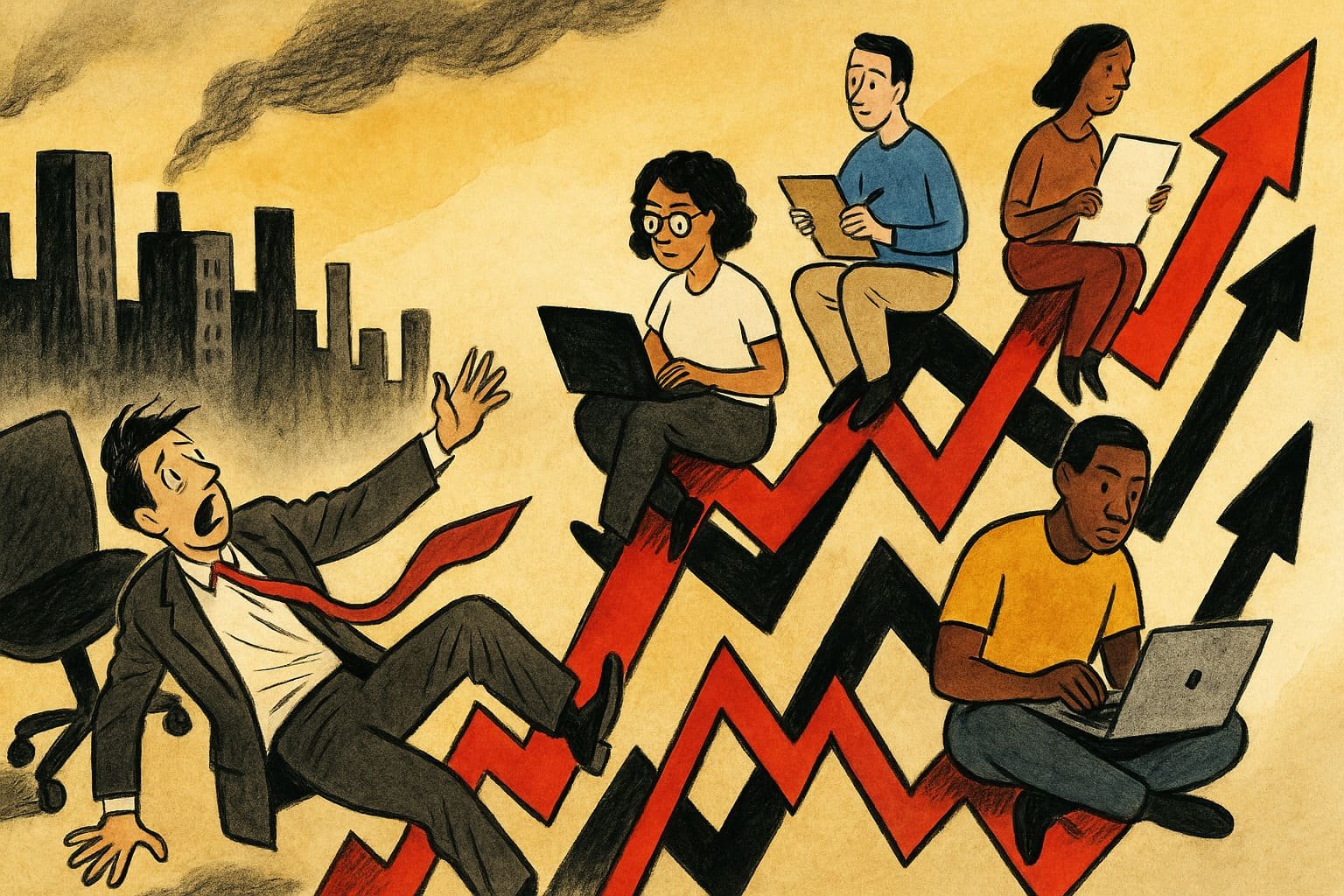
Picture this: a seasoned executive, once cocooned in corner-office certainty, logs in from his kitchen table only to discover he’s competing with a 22-year-old graphic designer in Bali, a coder in Nairobi, and a marketing whiz in Buenos Aires. Somewhere in this caffeine-fueled, chaotic reality, the traditional “job” gasps for breath. That’s the world we live in now; a seismic career quake cracking open the ground beneath every “secure” paycheck, every 9-to-5 illusion.
But beneath the rubble, a strange thing happens. Freedom blossoms. Creativity mutinies against monotony. Talent pools spill across time zones, and suddenly, everyone is a contender, armed with a laptop and a burning question: Who needs a boss, anyway? If you’ve ever wondered whether the so-called job crisis is really a death sentence or a long-overdue jailbreak; strap in. We’re not just watching the job market evolve; we’re living through a once-in-a-century transformation. The age of the freelancer isn’t a trend. It’s a tidal wave, and it’s coming for the sandcastles we built on old rules.
How did we get here? Why do so many quietly root for the underdog gig worker? And what happens when millions decide the only boss they’ll ever need… is themselves? This isn’t just about survival. It’s about revolution. Welcome to the age where “work” finally meets “meaning.”
Quick Notes
- Work’s Great Disruption: Old jobs are fading, but new freelance opportunities multiply for those willing to leap.
- Freedom vs. Security: The gig life delivers autonomy but demands resilience, adaptability, and relentless learning.
- The New Power Brokers: Freelancers are reshaping business, culture, and personal identity, flipping the script on old hierarchies.
- Philosophy of Work: This isn’t just economics; it’s a soulful shift in how people chase purpose and rewrite the rules of fulfillment.
- The Ultimate Question: Are you ready to gamble on yourself, or will you cling to the fading comfort of yesterday’s career blueprint?
The Job Market Meltdown: How We Got Here, And Why It Matters
No one forgets the moment when the ground beneath them shakes. For generations, the “job for life” promise looked rock solid until cracks started to show. Outsourcing swept away thousands of roles, automation arrived with ice-cold efficiency, and suddenly, resumes that once opened doors gathered dust in digital piles. Every industry felt the tremor. Retailers shuttered, factories hummed with fewer hands, and middle management once a badge of safety; became an endangered species. The so-called “job crisis” didn’t announce itself with sirens; it crept in, disguised as progress, and left millions questioning everything they thought they knew.
The truth? The old map no longer matches the territory. Ask Claire, a project manager from Detroit, who woke up one morning to an empty calendar and a gnawing sense of obsolescence. She didn’t disappear; she reinvented, picking up freelance copywriting jobs and, slowly, learning to steer her own ship. Stories like hers are everywhere. A Harvard-educated attorney designs Shopify stores between consulting gigs. A former teacher launches an online course empire after her district slashes funding. What binds them isn’t desperation, but a restless sense that the next act is theirs to script.
Institutions that once provided certainty; schools, companies, governments, have failed to keep pace. The pandemic only amplified what was already unfolding: hybrid work went mainstream, “side hustles” stopped being a punchline, and even CEOs started moonlighting as TikTok creators. It’s not that the world stopped needing talent. It just stopped needing it in neat, predictable packages.
We face more than a hiring freeze. We’re experiencing an existential reordering of value itself. Who wins when there are no gatekeepers? What becomes of loyalty when companies can vanish overnight? As unemployment numbers bounce and headlines scream “crisis,” beneath the noise, a quiet majority retools, retrains, and bets on their own ingenuity.
The old job market? It’s not just melting; it’s mutating. Like ice cracking underfoot, the safe path now looks riskier than leaping into the unknown. That’s both terrifying and, if you listen closely, exhilarating. The next chapter isn’t about patching up old systems. It’s about building something so new, even the word “job” might need a new definition.
Rise of the Free Agent: The Allure, The Myth, The Raw Reality
The idea of freelancing seduces with visions of coffee-shop creativity and sun-drenched laptop days, but real-life freelancing is a paradox: unchained freedom handcuffed to uncertainty. For every Instagram success story, there’s a freelancer navigating late payments, feast-or-famine months, and nights spent learning QuickBooks instead of Netflix binging. The lure is real. So is the learning curve.
Take Ajay, a Mumbai-based UI designer who walked away from corporate safety to chase projects that lit him up. He tells friends that every day is different, every client a puzzle. What he doesn’t mention at parties is the stress of hunting gigs, juggling taxes, and occasionally facing rejection that stings sharper than any performance review. The “set your own hours” pitch misses one key truth: when you’re the boss, you’re also the entire HR, sales, and tech support team.
Yet, the rewards aren’t just financial. Freelancers master resilience. They sharpen adaptability and learn the art of self-promotion in ways their cubicle-bound peers rarely attempt. The lows are lower, but the highs; landing a dream client, doubling your rate, watching a passion project go viral feel like rocket launches. That’s why more people stay than leave, even after the first year’s bruises.
Security, once the ultimate workplace prize, has become something else: an illusion, perhaps, or a moving target. The real win isn’t in chasing guarantees. It’s learning to create opportunity out of thin air. The gig economy is full of quiet heroes; single parents who make rent with virtual assistant gigs, retirees who find purpose coaching startups, artists who finally get paid for their obsession.
There’s no single template for making it work. Some join platforms, others cold-email strangers, a few build mini-empires on personal brands. What unites the best is an ability to stay fluid. They turn every client complaint into a lesson, every dry spell into a sprint toward something better. They write their own resilience story, sometimes in crayon, sometimes in code.
The romantic myth of freelancing fades fast. In its place, a sharper, richer truth emerges: those who thrive aren’t just hustlers. They’re creators of value, of connection, of futures that would never fit into a standard-issue job description.
New Power Structures: Freelancers Are Changing the Game (And Not Just for Themselves)
Old hierarchies aren’t just shaking; they’re being flipped upside down. Once, companies held all the cards. Now, talented freelancers set their terms, pick projects, and sometimes even name their price. The shift is subtle but seismic. The world’s biggest brands; Nike, Google, Netflix, routinely build teams out of gig workers. The definition of “employee” grows fuzzier by the day.
Consider Jasmine, a London-based brand strategist. Three years ago, she left a top agency after seeing her creative ideas watered down by committee. As a freelancer, she discovered she could work with three startups at once, play to her strengths, and reject projects that didn’t inspire. One startup credits her with a campaign that turned a near-bankruptcy into a viral sensation. Jasmine never looked back. Now, companies court her, not the other way around.
This isn’t just a numbers game. It’s a transformation in leverage. As more skilled workers refuse to be tied down, companies scramble to win over talent with flexible contracts, creative freedom, and global access. Freelancers become the new power brokers. They pick clients as much as clients pick them. Some even gather into collectives; virtual guilds that share leads, swap skills, and negotiate as a pack.
The rise of the solopreneur changes business DNA. Brands that once bragged about headcount now tout networks of “top 1% talent.” Office politics? Replaced by results. Annual reviews? Outsourced to project feedback. The new world order rewards innovation, not conformity. Even traditional businesses are being forced to adapt, or risk losing out in the race for fresh ideas.
Case studies abound. A food startup in Berlin credited its survival to a roving band of freelance marketers who reinvented their digital strategy overnight. An NGO in Nairobi partnered with freelance data analysts to tackle urgent humanitarian challenges in real time. These are not isolated incidents. They signal a larger truth: freelancers aren’t just surviving the job crisis; they’re driving the evolution of work itself.
Old-timers mutter about “the end of loyalty.” In reality, the new loyalty is to craft, to impact, to self-mastery. The most ambitious freelancers know: the game has changed, and this time, they’re the ones writing the rules.
Work Reimagined: The Philosophical Shift Behind the Freelance Tsunami
Work has never just been about a paycheck. Scratch beneath the surface, and you find questions that border on the existential: What am I here for? What does meaningful work look like? For generations, those answers arrived shrink-wrapped in job titles and retirement plans. The freelance boom shreds that packaging and forces us to confront the raw material of our ambition.
The shift is deeper than economics. It’s a revolt against monotony, a rebellion against the factory line of modern employment. Ikigai; the Japanese idea of “a reason for being” suddenly feels more relevant than ever. Freelancers chase not just money but alignment. Every project is a new puzzle, a chance to combine skill, joy, and impact. The search for meaning moves from watercooler gossip to the heart of every Zoom call.
Remember Maslow’s hierarchy? At the base, people need survival, but at the top; self-actualization, freelancers have found their playground. Sarah, a copywriter in Cape Town, tells of burning out at an ad agency only to rediscover her spark crafting stories for nonprofit causes. Her sense of purpose exploded once she stopped chasing promotions and started seeking impact.
Of course, this shift isn’t just about personal growth. It’s a philosophical challenge to business itself. If everyone’s a brand, what happens to old definitions of teamwork, leadership, and accountability? Many companies are already experimenting; hiring fractional executives, launching crowdsourced projects, measuring output by value, not attendance.
Work-life balance, too, takes on new meaning. The walls between “professional” and “personal” blur until the only question left is: Am I fulfilled? For some, the answer is still elusive. The freelance path isn’t always smooth. It’s often a wild ride through risk, rejection, and reinvention. But for millions, it’s the first time work has ever felt truly theirs.
This is not just a story about making a living. It’s a story about making a life. The freelance surge is proof that when people are freed from rigid molds, remarkable things happen; not just for individuals, but for culture, innovation, and society at large.
Betting On Yourself: The Hard Truths, The Golden Opportunities, The Ultimate Gamble
Taking the freelance leap isn’t for the faint of heart. Self-reliance sounds empowering, but it comes loaded with responsibility. Every gig is a fresh audition, every client a new boss. The comfort of a steady paycheck gives way to the rush and sometimes anxiety of uncertainty. Yet, for those willing to risk it, the rewards can be profound.
There’s a special satisfaction in winning a project on merit alone. Consider Julian, a former investment banker in New York who now consults for ethical finance startups from his Brooklyn apartment. His client list is global, his schedule his own, and his stress; while real comes with the sweet taste of autonomy. The flipside? No safety net. When work dries up, it’s on him to pivot, upskill, or even ride out a lean season.
Tools and resources for freelancers have never been better. Online platforms connect talent with demand, personal branding is accessible to all, and micro-credentials unlock new skillsets in weeks. Still, success depends on more than hustle. It demands vision, discipline, and an appetite for calculated risk.
The greatest challenge, though, is psychological. For decades, society trained us to equate “having a job” with stability and self-worth. Freelancers must rewrite this script daily. It takes courage to walk an untrodden path, to face the possibility of failure without the cushion of institutional support. But the most inspiring stories come from those who do.
When asked about their journey, many freelancers echo the same theme: It’s not just about money or freedom. It’s about becoming the author of your own life. The question isn’t whether the freelance revolution will win; it’s already here. The real question is: Who will answer the call to join it?
The Future Belongs to the Brave: Are You Ready for the Freelance Revolution?
If the job crisis feels like an ending, look again. It’s the wild opening scene of a new human drama; one where uncertainty is the spark, not the enemy. The world is splitting open, and those who dare to leap aren’t falling. They’re flying. Each story, each risk, each unlikely triumph is a line in the unwritten epic of tomorrow’s world of work.
Traditional careers may never vanish completely, but their grip is loosening with every gig, every contract, every entrepreneurial dream born in a midnight brainstorm. We’re all freelancers now at least in spirit navigating a world where resilience is the new currency, curiosity the best insurance, and meaning the ultimate reward.
So, here’s the real punchline: The boss you’ve been waiting for? Check the mirror. The revolution isn’t coming; it’s already arrived, one daring, messy, magnificent freelancer at a time. Will you cling to yesterday’s playbook, or will you write your own rules and claim your seat at the new table?
Ask yourself: When history looks back at this turning point, will you be one of the few who watched… or one of the many who jumped in and changed everything?
Partnered. Provocative. Worth Your Scroll.
This is a Promoted Post by ESYRITE—yes, it’s paid, but never filtered. Our voice stays raw, real, and razor-sharp. We team up with bold ideas, game-changers, and stories that spark something real. If it’s here, it earned its place—no fluff, just impact. We don’t just promote—we provoke. Stay sharp. Dive deeper.
