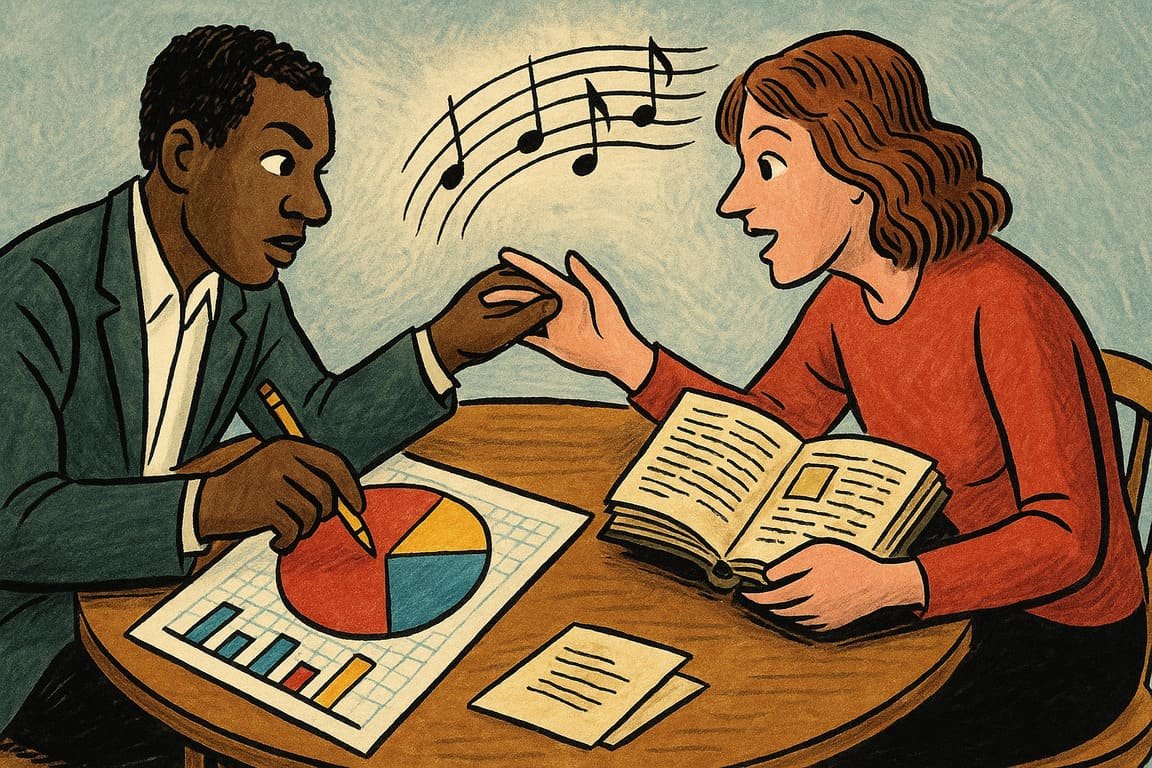
Dawn bleeds through the blinds of a tiny creative studio where designers and analysts pass battered mugs of coffee back and forth, trading sketches for spreadsheets. Walls are crowded with hand-drawn storyboards and whiteboard equations. No one here speaks in numbers alone, nor in stories untethered from fact. The room hums with an unspoken pact: if the data can’t dance with the narrative, nobody leaves satisfied. Each morning, the team plays a strange symphony—part improv jazz, part forensic audit—where every statistic has to prove its place in the plot, and every anecdote must withstand the logic of numbers. The day’s first light glints on the edge of a pie chart, illuminating the uncharted space where meaning and measurement collide.
Harmony between numbers and stories doesn’t happen by accident. You have watched business leaders fumble presentations that drown audiences in graphs without a single human face, or, worse, pitch grand tales with no proof in sight. The world is hungry for evidence wrapped in emotion. Pixar’s screenwriters famously obsess over research: each character arc is built atop mountains of user surveys, behavioral models, and even neuroscientific feedback. The result? Films that move both the heart and the head.
You sit at your own desk, wrestling a report into shape. On one tab: page after page of survey responses, ticked boxes and Likert scales. On another: half a dozen customer stories, raw and full of contradiction. The temptation is to choose one path—drown the audience in stats, or lean only on the tear-jerker. The secret is to blend them so tightly that each makes the other impossible to ignore. Real influence is born when you use numbers to anchor the unbelievable, and stories to make statistics unforgettable.
Think of Patagonia, the outdoor brand that redefined sustainable business. Their famous “Don’t Buy This Jacket” campaign exploded in reach not because of its clever tagline, but because they proved every claim. Numbers showed their reduced carbon footprint, but it was the story of a seamstress mending old coats by hand that made audiences care. People need the arc as much as the arithmetic.
You’ve seen sales pitches where numbers march across the screen in perfect formation, yet nobody remembers a thing. That’s not a failure of math—it’s a failure of meaning. Spotify’s annual “Wrapped” campaign goes viral every year for a reason. They don’t just show you the minutes you listened, they turn your habits into a personal saga: the soundtrack to your year, narrated by the numbers only you could generate.
Numbers, on their own, risk becoming a trap. In finance, a stunning quarterly gain might hide a silent customer exodus. In education, test scores can climb while student engagement plummets. The leaders who stay ahead don’t just ask, “what does the data say?” They ask, “whose story is missing?” It’s a relentless pursuit of context—a hunger for the piece nobody else has noticed.
At a Tokyo startup, a team of engineers noticed a spike in app usage late at night. The data alone couldn’t explain why. Interviews with users revealed a simple truth: the app had become a quiet companion to insomniacs and late-shift workers. Armed with this story, the team built a feature just for night owls, deepening loyalty and turning an anomaly into an asset. It was the marriage of narrative and numbers that unlocked growth.
There’s always a tension—an invisible tug-of-war between hard fact and soft feeling. Some executives want nothing but the spreadsheet. Others fear the complexity of numbers and default to intuition. True transformation comes when you invite both sides to the table. The best strategists play matchmaker, coaxing data and story into the kind of duet that sticks in memory long after the meeting ends.
Think about healthcare innovation. Data may reveal rising blood pressure in a city block, but it’s the story of one grandmother’s struggle with medication costs that stirs change. When a research hospital paired patient interviews with statistical models, their grants soared and their care became more targeted. Policymakers finally saw the face behind the figure.
You can test this harmony in your own work. Next time you present, lead with a number that shocks, then soften the edge with a story that makes it real. Or, tell a story so gripping that the audience craves the data to see if it holds up. Watch as even the skeptics lean in, hungry for both evidence and empathy.
Brands that live at the intersection of story and statistics create not just loyal customers, but passionate advocates. Nike, with its data-fueled performance tracking, ties every shoe release to tales of runners breaking personal barriers. The numbers give credibility, the stories deliver belief.
You don’t need a billion-dollar budget to achieve this. Even the smallest nonprofit can turn impact metrics into hero’s journeys. A community group in Cape Town mapped water delivery routes, using both satellite data and the testimonies of families waiting for the next tanker. Their report wasn’t just shared—it was championed, sparking donations and international coverage. The magic lived in the blend.
When you master this harmony, you earn something more powerful than applause: trust. Audiences, employees, and investors all crave honesty and nuance. When you show the numbers and the narratives, you signal respect for the intelligence and the emotions of your audience. That’s how movements are born.
In the studio’s fading afternoon light, the last chart flickers off and voices quiet. One designer wipes a smudge from the whiteboard, her mind echoing with numbers that pulse like a heartbeat behind every story. No single measure or anecdote survives alone—each is part of a melody that lingers.
The harmony of data and narrative is not a trick, but a testament: to pay attention, to seek meaning, to invite wonder into the coldest calculation. Perfect balance is a living thing, not a fixed equation. The bravest teams chase it daily, even when discord threatens to drown the tune.
You’re the conductor now. Will you orchestrate a tale that moves both the mind and the soul?
