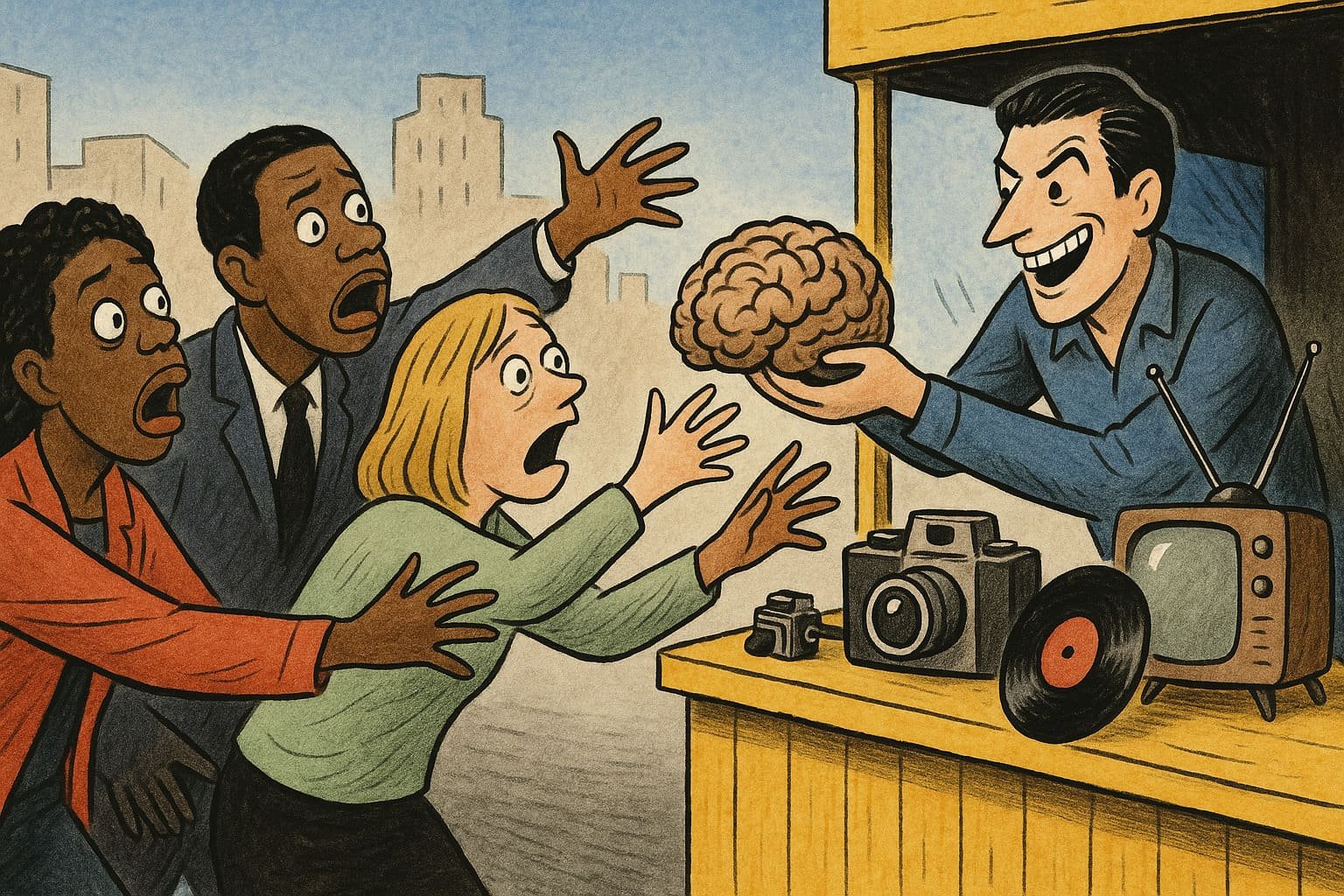
Inside a warehouse that feels like a forgotten spaceship, time sits stacked in neon-lit crates. Old lunchboxes grin from wire shelves. Faded concert tees hang like the flags of lost nations. The room hums with fluorescent light, the whirr of cash registers, and the faintest echo of dial-up internet, as if someone is selling not just relics but the electric ache of childhood afternoons and adolescent rebellion. Shoppers drift through the aisles in a trance, eyes glassy, fingertips brushing a Game Boy or an iPod like it’s a prayer bead. No one laughs, though every shelf overflows with objects once designed for joy. The price tags climb with every gasp of recognition.
At the center, a woman with silver streaks in her hair haggles over a vintage movie poster. Her voice shakes, and for a moment, it’s unclear if she is bargaining for a price or for permission to feel young again. The clerk, tattooed with the logos of dead brands, nods in silent understanding. This isn’t just retail therapy. It’s a hunt for meaning inside the detritus of lost years. The market’s air tingles with both electricity and exhaustion, like the last scene before the credits in a film you know too well but keep watching anyway.
An argument breaks out over a battered Tamagotchi. Nobody wants the digital pet, but nobody can bear to let someone else own it. The crowd swells, a feverish congregation worshipping at the altar of nostalgia. Outside, the city blinks; billboards flash promises that happiness is always just a memory away. The world has become a bizarre museum where memories sell, and madness is offered as the upgrade. Is anyone truly buying the past, or are they selling pieces of themselves to stay afloat in a world unmoored from meaning?
In the far corner, a forgotten song begins to play from a dusty radio. For a heartbeat, every shopper stands still, arrested by the sudden, involuntary pull of longing. Here, in this surreal marketplace, desire and regret swirl like cigarette smoke. There is no exit, only the next aisle, the next memory, the next rush of bittersweet déjà vu. This is the new economy: nostalgia as both product and prison.
Quick Notes
- Nostalgia Sells Because Reality Hurts: You’re drawn to the comfort of old brands and childhood memories because the present is relentless. The Memory Market thrives by promising escape, even if that escape is a lie.
- Corporations Turn Your Longing into Currency: Nostalgia marketing isn’t harmless; it’s a calculated business that hijacks emotion and attention. Even your favorite cereal box is weaponized for profit.
- Every Click Is a Bidding War for Sanity: Scrolling through retro memes or “vintage” playlists offers momentary comfort, but the dopamine crash leaves you emptier than before. The more you chase the past, the more fractured the present becomes.
- Buying Back Lost Time Breeds Madness: Case studies show that those who try to recapture their youth with collectibles or revival trends often end up feeling more lost. Nostalgia, when commodified, becomes a trap.
- Escape Is Possible, But Only Through Honesty: The only way out is to see the game for what it is. Find meaning in the mess, laugh at the absurdity, and build new memories without selling your soul to the market of yesterday.
The Nostalgia Trap: Why the Past Is a Bestseller
You scroll through social media and spot a photo of the cereal aisle: suddenly, your chest tightens at the sight of a cartoon mascot you thought was extinct. The world outside demands resilience, but the past only asks for your attention. Every company now auctions off your childhood, from movie studios rebooting old franchises to soda brands reviving forgotten flavors. The Memory Market is a machine designed to remind you how simple things used to feel, even if it’s an illusion.
Marketing experts at agencies like Wieden+Kennedy have long recognized nostalgia’s superpower. Their campaigns for legacy brands stitch together memory and desire, convincing you that joy can be bought back for the price of a new sneaker drop. But the promise is always out of reach. You buy the shoes, but the swagger of youth refuses to return. Nostalgia becomes the bait, and you are the fish leaping for a memory.
Remember Kevin, the IT manager who spent a fortune collecting every action figure from his childhood? He lined them on shelves, posted pictures, and waited for the joy to land. “I thought these would bring back the old days,” he confessed at a reunion, “but all I got was clutter and a feeling I’d lost something else.” His story isn’t rare. All around you, people clutch souvenirs, mistaking them for anchors in a world swept by change.
The trap tightens when nostalgia becomes tribal. Online forums devolve into flame wars over which Saturday morning cartoon was superior or whether vinyl sounds “warmer.” People defend the past not because it’s better, but because it’s theirs. This is how madness creeps in; when identity is forged from memories nobody can actually return to.
Case in point: the McRib sandwich, vanishing and reappearing like a culinary ghost, always triggering a frenzy. It’s not about taste. It’s about the ritual of chasing a memory, the shared absurdity, and the bittersweet truth that the things we crave most are never quite as we remember them.
Selling the Dream: How Corporations Weaponize Nostalgia
You spot a sneaker commercial on YouTube. It’s shot in soft focus, a montage of home videos, boom boxes, and grainy skate parks. The brand isn’t selling footwear; they’re selling your adolescence. Big companies have mastered the science of nostalgia, repackaging the past as a product, a lifestyle, a way to reclaim feelings the present can’t provide.
This isn’t innocent. It’s a calculated tactic, fine-tuned by data scientists and cultural analysts. At Coca-Cola, entire teams study which jingles spark the sharpest emotional spike in focus groups. Their findings shape billion-dollar ad campaigns designed to bypass your critical mind and reach the tender center of longing. Your taste buds might crave the sugar, but your brain craves the memory of summer break and first kisses.
The tactic works across industries. Gaming companies flood digital storefronts with “classic editions,” urging you to buy what you already own, now updated for a world where fun never ages. The profits keep growing, but the satisfaction keeps shrinking. Each purchase delivers less thrill and more emptiness, like a comedian repeating the same punchline until nobody laughs.
Consider the Blockbuster pop-up bars appearing in big cities. For a fee, you can drink cocktails among fake VHS tapes and faded movie posters, pretending the past never ended. One attendee, Sandra, shared, “I spent the whole night waiting for that rush of nostalgia. Instead, it felt like I was drinking in a museum built on my own memories.” Her hangover lasted longer than the illusion.
Even tech giants like Apple and Google now lean into retro design. Every update mimics the look of old operating systems, convincing users that innovation means returning to what was familiar. It’s not progress. It’s a well-marketed loop; one you pay to enter again and again.
Madness in the Marketplace: When Memory Becomes Currency
You join an online auction for a first-edition comic book. Bidding spikes in seconds, chat explodes with GIFs and desperate pleas. The price rockets to a figure that would make your grandparents faint. Why? Because in this digital coliseum, memories are gladiators and your sanity is the prize. Nostalgia is now a currency, and everyone is willing to gamble.
The chaos doesn’t end online. Vintage markets draw crowds eager to buy vinyl, polaroids, and old-school gadgets. The atmosphere feels electric but frayed. Sellers whisper stories about provenance and rarity, each tale a half-truth designed to spark longing. Collectors become hoarders, hoarders become dealers, and soon, the line between sentiment and obsession blurs.
At the center of this storm, you meet people like Martin, who liquidated his 401(k) to invest in rare sneakers. “I thought it would fill the gap,” he told a journalist, “but it became a bottomless pit.” His collection grew as his peace of mind shrank. The madness escalates as markets invent scarcity. Limited releases, time-limited events, and artificial shortages turn nostalgia into an arms race for the soul.
Retailers fan the flames, launching “throwback” events and exclusive drops to drive up FOMO. Each campaign hooks the crowd with a promise: Buy now, or regret it forever. But regret never fades; it just morphs into new desire. The more you chase lost moments, the more lost you become.
Some escape by rejecting the circus altogether. A small group of creators like the founders of the “Analog Resistance” art collective; choose to make new memories by crafting experiences that can’t be sold. Their mantra: “Don’t buy back your childhood. Build something worth remembering now.” The rest of the world keeps scrolling, bidding, and hoping for the next high.
The Psychological Toll: When Nostalgia Consumes the Self
You think buying a bit of your past will cure your present pain. It feels like self-care, but it’s more like self-erasure. Nostalgia becomes addictive, a cycle that promises meaning but delivers confusion. Psychologists warn that clinging to idealized memories can breed anxiety, alienation, and depression. The market profits from your vulnerability.
Pop culture amplifies the madness. TV shows reboot themselves into infinity, actors reprise roles they outgrew decades ago, and fans treat criticism as heresy. The line between entertainment and identity vanishes. People begin to speak in memes, share only clips from childhood favorites, and mourn the loss of things that never truly existed. Nostalgia isn’t just a comfort; it’s a contagion.
Stories like that of Marcus, a software developer, surface everywhere. After a brutal layoff, he dove into retro gaming to cope. “For a while, it felt like home,” he said. “But then I realized I hadn’t made a new friend or memory in months. My life was just a rerun.” His story echoes in countless forums, podcasts, and therapy sessions: the more you consume the past, the less you inhabit the present.
The Memory Market fuels comparison and envy. Social feeds overflow with images of “the good old days,” curated to perfection. Nobody posts about the boredom, heartbreak, or fear that haunted those years. The lie multiplies until reality feels like a pale imitation of a golden memory that never really was.
Escaping this trap demands honesty and courage. Some break free by creating new rituals, reconnecting with the present, or laughing at the absurdity of nostalgia gone wild. Others surrender, buying the next limited edition in the hope that meaning can still be purchased if the price is high enough.
Breaking Free: Finding Meaning Beyond the Memory Market
You aren’t doomed to buy madness in the marketplace of memory. The first step is to see nostalgia for what it is: a trickster, not a teacher. Instead of chasing a perfect past, you can build a meaningful present by embracing the mess, the risk, the unfiltered now. True satisfaction grows when you create rather than collect.
Companies that reject nostalgia’s lure often thrive on authenticity. Brands like Patagonia invest in future-focused storytelling, sharing stories of reinvention and resilience instead of recycling old logos. Their campaigns don’t trade in yesterday’s dreams but invite customers to join a living, evolving story. It’s a rare kind of courage; one that pays off with loyalty and genuine connection.
Community, not commodity, is the antidote. Take the story of Ava, a teacher who started a storytelling club for teens overwhelmed by social media nostalgia. They write new legends together, sharing mistakes and triumphs in real time. “It’s not about erasing the past,” she explains. “It’s about making the present count.” These moments aren’t for sale.
You might find freedom by practicing digital minimalism. Instead of chasing every reboot or retro drop, curate your own experiences. Organize real gatherings, write letters, savor slow meals, or craft playlists that capture your current mood. Each new memory created is a small rebellion against a world determined to monetize your longing.
The future isn’t found in a box of old toys or a rebooted TV show. It waits for you in uncertainty, in honest conversation, in the courage to face the chaos of the present. The Memory Market may always be open, but you can choose what currency you spend: madness, or meaning.
Where Madness Ends and Meaning Begins
Beneath flickering neon in the city’s oldest pawnshop, a boy pauses before a glass case packed with plastic dinosaurs and love letters nobody ever mailed. The air smells of cold metal and lost hours. At the counter, the shopkeeper, older than any artifact in the room, observes without judgment as customers surrender coins and confessions for the privilege of holding something almost forgotten. Nobody speaks, but everyone aches. Eyes dart, hands tremble, each transaction a silent plea for release from the hunger that nostalgia breeds.
Shadows collect in the corners as laughter from another decade leaks through an ancient radio. A woman in a rain-soaked coat exchanges her wedding ring for a Walkman that doesn’t work. Her face glows with relief. Outside, thunder rattles the windows, threatening to sweep the shop away. Yet the woman lingers, transfixed, realizing the market can never return what time has stolen.
Rain pelts the roof as the shopkeeper closes the till, one last time, and locks the door on a room stuffed with memories and madness. The world outside roars for attention, promising every happiness if only you’d rewind one more time. But inside, quiet settles, and the weight of longing lifts. This isn’t defeat; it’s acceptance. The past has sold its last secret, and the price was everything you thought you needed to remember.
A final flash of lightning illuminates the room. Dust motes dance. The shop is empty, save for a single page torn from a forgotten diary. It reads, “Here you are. Now.” For those who listen, it is enough.
You could buy the past, or you could risk everything for the raw, unpredictable wonder of this moment.
Partnered. Provocative. Worth Your Scroll.
This is a Promoted Post by ESYRITE—yes, it’s paid, but never filtered. Our voice stays raw, real, and razor-sharp. We team up with bold ideas, game-changers, and stories that spark something real. If it’s here, it earned its place—no fluff, just impact. We don’t just promote—we provoke. Stay sharp. Dive deeper.
