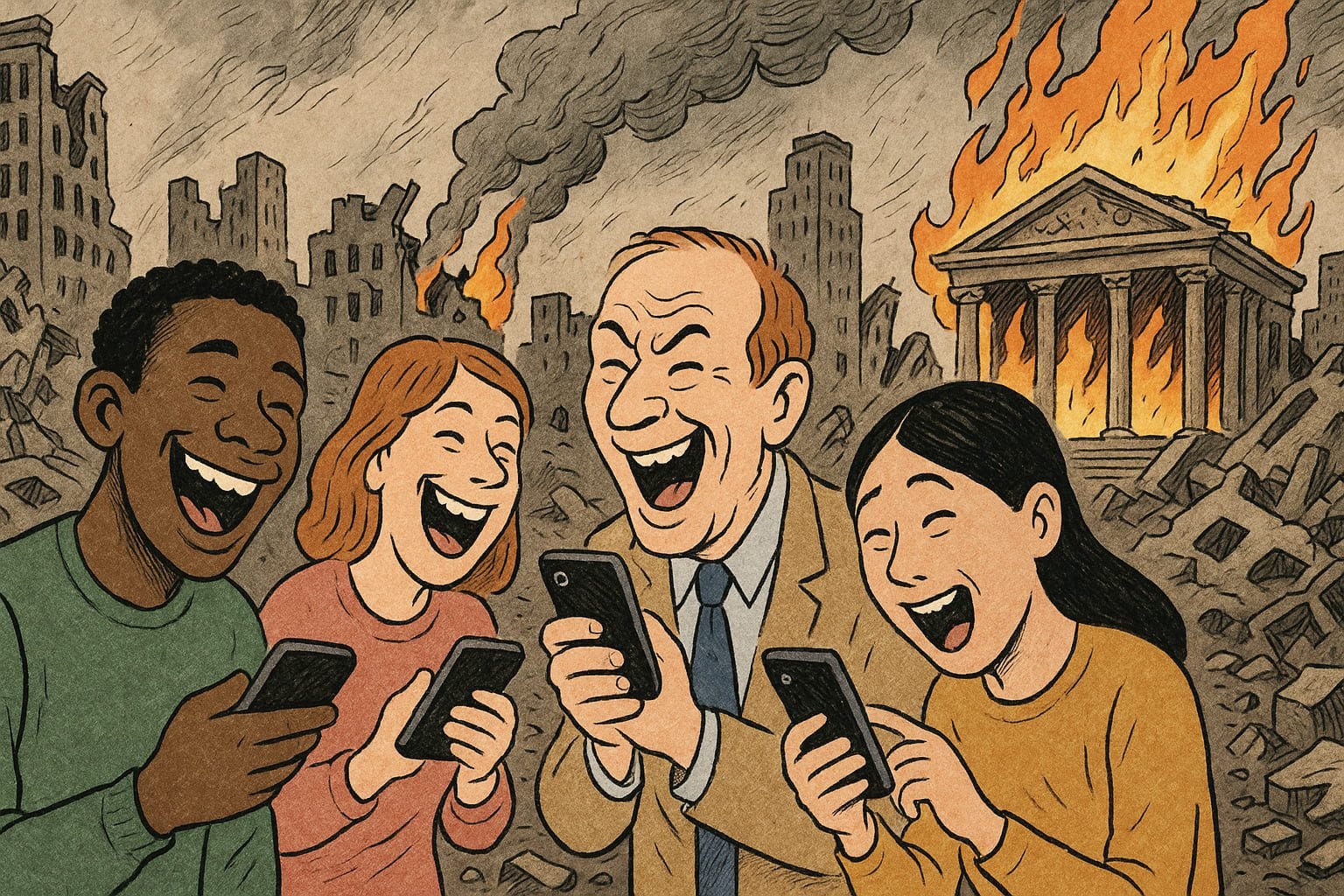
Neon lights flicker across a deserted supermarket aisle. Cereal mascots grin with hollow eyes as the shelves echo with a silence that once hid busy footsteps and secret, desperate texts. Somewhere in the half-lit gloom, a teenager scrolls through her phone, thumbs darting in rhythm with a world on edge. Around her, a kingdom of memes; pixelated frogs, dancing coffins, office cats with existential crises; marches triumphantly over every headline, every heartbreak, every broken promise echoing through the night. As the world’s seams unravel, comedy blooms in the ruins, and laughter rises from rubble like a strange, sacred fire.
Not far away, a burned-out banker studies a meme about layoffs, laughter breaking the spell of dread around his morning coffee. His colleagues join in, sharing their favorite “end times” punchlines, swapping jokes faster than management can schedule another all-hands call. Even the executives, tucked away in their glass towers, can’t resist smirking at a viral stock chart meme that turns financial bloodbaths into TikTok spectacle. Irony is the new oxygen: every laugh becomes a lifeline, every share an unspoken confession of how close to the edge we really live.
A story circulates about Mia, a young nurse, who comforted patients with meme printouts during a pandemic surge. The hospital overflowed, exhaustion and loss tangled in every hallway, but patients clung to those absurd cartoons like they were IV drips for the soul. Mia never thought a SpongeBob meme would calm fear better than sedatives, but in those fragile moments, the absurd became the essential. She wondered if all medicine would one day need a side of meme therapy, just to keep hope breathing.
Meanwhile, in a dark apartment, two startup founders toast their last round of venture funding with pizza and laughter, scrolling through memes about doomed unicorns and the futility of pitch decks. “If we can’t build a unicorn,” one jokes, “at least we can ride a Shiba Inu into the sunset.” The other snaps a photo for their Slack, the caption reads: “Mood board for 2024: Survive, but make it hilarious.” It goes viral before their pizza cools.
As another news cycle crashes through, a pattern emerges: the bigger the crisis, the bolder the meme. Collapse becomes content, disaster morphs into comedy, and everyone; CEOs, cashiers, college students, presidents; grabs a seat at the world’s weirdest stand-up show. Memes don’t just distract, they transform. They turn anxiety into armor, uncertainty into punchlines, and ordinary people into philosophers with a thousand likes and one viral tweet. When collapse comes, laughter is the last rebellion that nobody can regulate.
Quick Notes
- Memes Are Survival Gear: Memes are no longer just a way to kill time; they’ve become a shield against chaos. When every headline feels like an alarm bell, humor lets people feel less alone and more in control, even if just for a second.
- Humor as Weapon and Wound: Jokes aren’t just about escape. They cut to the truth when nothing else can, helping people speak about pain, stress, or burnout without sounding like they’ve given up. A good meme is a confession disguised as comedy.
- Culture’s Currency Has Changed: In this era, attention is worth more than dollars. The right meme can flip a corporate reputation overnight or topple a political argument faster than any debate. It’s the people, not the powerful, who set the agenda one share at a time.
- Philosophy Hidden in Punchlines: Memes act as the world’s stoic philosophers. By laughing at collapse, people accept the absurdity of modern life, finding meaning where others see only noise. Irony isn’t apathy; it’s a strategy for staying sane.
- From Collapse to Connection: Every viral meme is a rope thrown across the abyss. Whether you’re a CEO or a student, the shared joke says: “You’re not alone in thinking this is all a bit much.” In the end, community outlives collapse.
Viral Armor—Why Memes Save Us When Empires Crumble
When the world starts to look like a glitchy video game, memes become more than entertainment; they turn into digital armor. On the worst days, a single meme can cut through fear with a punchline sharp enough to remind you you’re still human. “During layoffs, memes on our group chat kept us from falling apart,” says Priya Kapoor, a mid-level manager at a struggling tech company. Instead of panic, her team bonded over jokes about their uncertain fate, finding in humor the unity they lost in leadership.
This transformation isn’t accidental. Research on humor in high-stress environments, from hospital wards to disaster relief sites, shows that laughter acts like a pressure valve. Humor gives you distance from the problem, a moment to breathe before you face the next blow. A janitor at an overwhelmed hospital tells how the staff would share absurd memes about “zombie patients” at midnight. Those laughs weren’t disrespect; they were survival, a coded language for “we’re in this together.”
Pop culture has always known this. Watch an episode of “The Simpsons” during a recession or scroll through Twitter after a stock market crash, and you’ll find a flood of memes. These jokes aren’t just distractions; they’re protest songs sung in GIFs and pixels. Even ancient Roman graffiti had meme-like jokes about politicians and landlords. The technology changes, but the impulse to laugh in the face of disaster is eternal.
Modern brands have caught on. When KFC ran out of chicken, its “FCK” meme ad turned an embarrassing crisis into a PR win. Instead of hiding, the company leaned into the joke, earning respect for owning its mess. The lesson is clear: those who laugh first recover fastest, especially when everyone’s waiting for someone else to break the tension.
At its best, meme culture unites people across divides that used to seem insurmountable. Politics, age, geography, even language fade when the right joke hits the right nerve. Humor breaks the ice over a burning planet, reminding everyone that if you can still laugh, you can still fight.
Punchlines or Paranoia? The Double-Edged Sword of Digital Irony
Every meme is a double agent. What looks like simple fun is often loaded with anxiety, rage, or social critique. Jokes about “adulting” or “everything is fine” aren’t just funny; they’re ways to talk about burnout without getting fired. Sofia, an overworked publicist, found herself screenshotting sad-clown memes during another endless Zoom meeting. “It’s how we say what we’re not allowed to say,” she tells friends, sending another meme with the caption: “Monday, but with extra collapse.”
The best memes hit a nerve because they smuggle vulnerability behind a mask of sarcasm. They make it possible to share disappointment or shame in a way that feels safe. In many workplaces, talking about anxiety or exhaustion is taboo, but swapping memes about “dying inside” or “imposter syndrome” becomes a coded support group. The meme isn’t just a joke; it’s a lifeline thrown across cubicles.
Yet this edge cuts both ways. Sometimes irony becomes a wall, keeping people from ever saying what’s really wrong. The more people joke about disaster, the less it feels real, and that can numb you to problems that desperately need action. Digital culture can turn every problem into content, every crisis into a contest for the funniest take. When everything is a joke, is anything still serious?
Pop-culture icons understand the power and peril of laughter. Dave Chappelle’s comedy is filled with memes, but he often flips the punchline into something uncomfortable. “If you can laugh at your pain,” he once said, “you own it. But you also risk hiding behind it.” This paradox defines meme reign: humor is both shield and mirror, hiding the wound and exposing it.
Philosophers like Albert Camus would see meme culture as modern absurdism: a way to live honestly with chaos by turning it into a joke you can share. Whether that’s brave or reckless is still up for debate, but either way, the punchline has replaced the manifesto as our favorite way to process pain.
From LOL to ROI—How Memes Hijacked Business and Power
Businesses used to fear going viral for the wrong reasons. Now, everyone is chasing the next meme moment, hoping it will spin disaster into gold. Wendy’s Twitter account turned savage meme warfare into a brand strategy, roasting competitors and turning bored teenagers into loyal fans. Suddenly, the most powerful companies weren’t the richest; they were the funniest, the quickest, the most meme-able.
Inside agencies, whole teams now exist to spot meme trends before they peak. When a viral meme about “quiet quitting” started trending, dozens of HR teams rushed to add it to their employee engagement campaigns. Consultants coach executives on how to drop meme references into town halls to sound human. The CEO who can’t meme is like the king with no clothes, exposed and outdated.
But this new power isn’t just for brands. Activists and ordinary people have learned how to weaponize memes for real impact. The “OK Boomer” meme deflated decades of generational tension in two words, leaving politicians scrambling to catch up. Meme stock traders turned financial markets into a rollercoaster with a single Reddit thread and some dog-themed jokes. Suddenly, a punchline could wipe out millions in value or launch a revolution overnight.
Of course, with great meme power comes great meme risk. One poorly timed joke can destroy years of brand trust or get an executive “canceled” by tomorrow’s lunchtime. Pepsi’s infamous protest ad became a meme for all the wrong reasons, showing that tone-deaf attempts at humor backfire spectacularly. Reputation now depends on reading the digital room as much as reading a balance sheet.
At the top of the meme food chain, even the most serious institutions are forced to play along or risk irrelevance. The World Health Organization tweets memes about hand-washing, banks sponsor TikTok creators, and politicians campaign with viral dance trends. The new kings of culture aren’t crowned by votes; they’re chosen by retweets.
Laughing Stoics—Philosophy and Survival in Meme Times
If memes are the soundtrack to collapse, then their underlying philosophy is stoicism disguised as silliness. Every joke about “this is fine” or “it’s all burning” is a reminder to focus on what you can control and to laugh at what you can’t. Marcus Aurelius never saw a TikTok, but he would have understood why a meme can keep someone going when the world makes no sense.
In the heart of Silicon Valley, a founder named Raj built a startup around the idea of “radical transparency,” where bad news was announced through custom memes. Investors raised eyebrows, but morale soared, and employees reported less anxiety because no problem could hide behind corporate doublespeak. Humor became the company’s unofficial language for facing failure without shame.
This stoic humor is now everywhere. Hospital staff in disaster zones have been known to draw cartoons on whiteboards after long shifts, making jokes about “boss level viruses” or “respawn points.” Soldiers stuck on endless night watch pass memes to cope with boredom and fear, their laughter echoing through trenches more powerful than any pep talk.
In philosophy, the ability to joke in the face of absurdity has always been a mark of resilience. Nietzsche said that man alone suffers so deeply he had to invent laughter. Meme reign is just the latest proof that people will use any tool, even a cartoon frog, to survive. Irony and wit become weapons, not just for coping but for building a new kind of wisdom.
Even therapy has adapted. Counselors use memes as prompts to talk about real emotions, finding that laughter opens doors where logic fails. The lesson is ancient: in the darkest times, the bravest thing is to laugh; not because nothing matters, but because everything does.
Collapse, Community, and the Meme as Mirror
In a fractured world, memes do something extraordinary; they turn private pain into shared experience. When the pandemic locked down cities, people across continents sent each other memes about loneliness, hope, and sourdough bread. Grandparents and grandchildren bonded over viral videos, teachers broke the ice in Zoom classes with SpongeBob jokes, and neighbors left funny signs on doors just to remind each other they were still there.
A high school teacher named Jamal used memes as homework prompts, asking students to submit their favorite jokes about “remote learning fails.” Grades soared and so did participation. Students who never spoke in class found their voice through humor, discovering that even in isolation, laughter built bridges.
Community groups have turned meme pages into mental health check-ins. In Kenya, a group of young activists uses memes to destigmatize therapy, sharing stories about depression and recovery in meme form. Their page exploded in popularity, showing that even heavy topics become bearable when people know they’re not laughing alone.
Corporate leaders who once banned “wasting time online” now sponsor meme contests to boost morale and spark creativity. At a major consulting firm, a “best meme of the week” prize became more coveted than employee of the month. The managing partner, notorious for his stern demeanor, became an office legend for posting a meme about “spreadsheet PTSD.” Suddenly, laughter became currency.
Memes reveal the truth about collapse: every joke is a mirror, every punchline a way of saying, “This hurts, but I’m still here.” In a world obsessed with productivity and profit, the simple act of sharing a laugh is revolutionary. The meme reign shows that when everything else falls apart, what people cling to isn’t power or status; it’s each other.
Shattered Screens, Unbroken Spirits: The Haunting Echo of Meme Reign
Outside, the city lights blink and fade, as if the grid itself were laughing at humanity’s stubborn insistence on order. Inside, the glow of a phone screen lingers on the face of a lonely dreamer, the last meme of the night flickering like a lighthouse in a digital storm. A thousand miles away, a boardroom falls silent as an executive shares a joke so painfully true that the whole table dissolves into helpless laughter. The world collapses, but the punchline never does.
A janitor, an intern, and a CEO stand at the edge of tomorrow, united not by job title or bank balance, but by the jokes they remember in the dark. Each story, each meme, is a thread in the net that keeps them from falling all the way down. Even as systems break and headlines scream, the secret society of laughter endures; spreading hope, hiding heartbreak, and stitching community from the ruins.
For a moment, the collapse doesn’t feel like an ending. It feels like an invitation to keep building; joke by joke, meme by meme, memory by memory. Underneath the digital static, something wild and ancient persists: the defiant, contagious will to laugh, no matter what.
You, reading this, are proof that comedy still lives where collapse tries to reign. So ask yourself: When the world crumbles, will you mourn the ruins, or laugh loud enough to build something new?
Partnered. Provocative. Worth Your Scroll.
This is a Promoted Post by ESYRITE—yes, it’s paid, but never filtered. Our voice stays raw, real, and razor-sharp. We team up with bold ideas, game-changers, and stories that spark something real. If it’s here, it earned its place—no fluff, just impact. We don’t just promote—we provoke. Stay sharp. Dive deeper.
